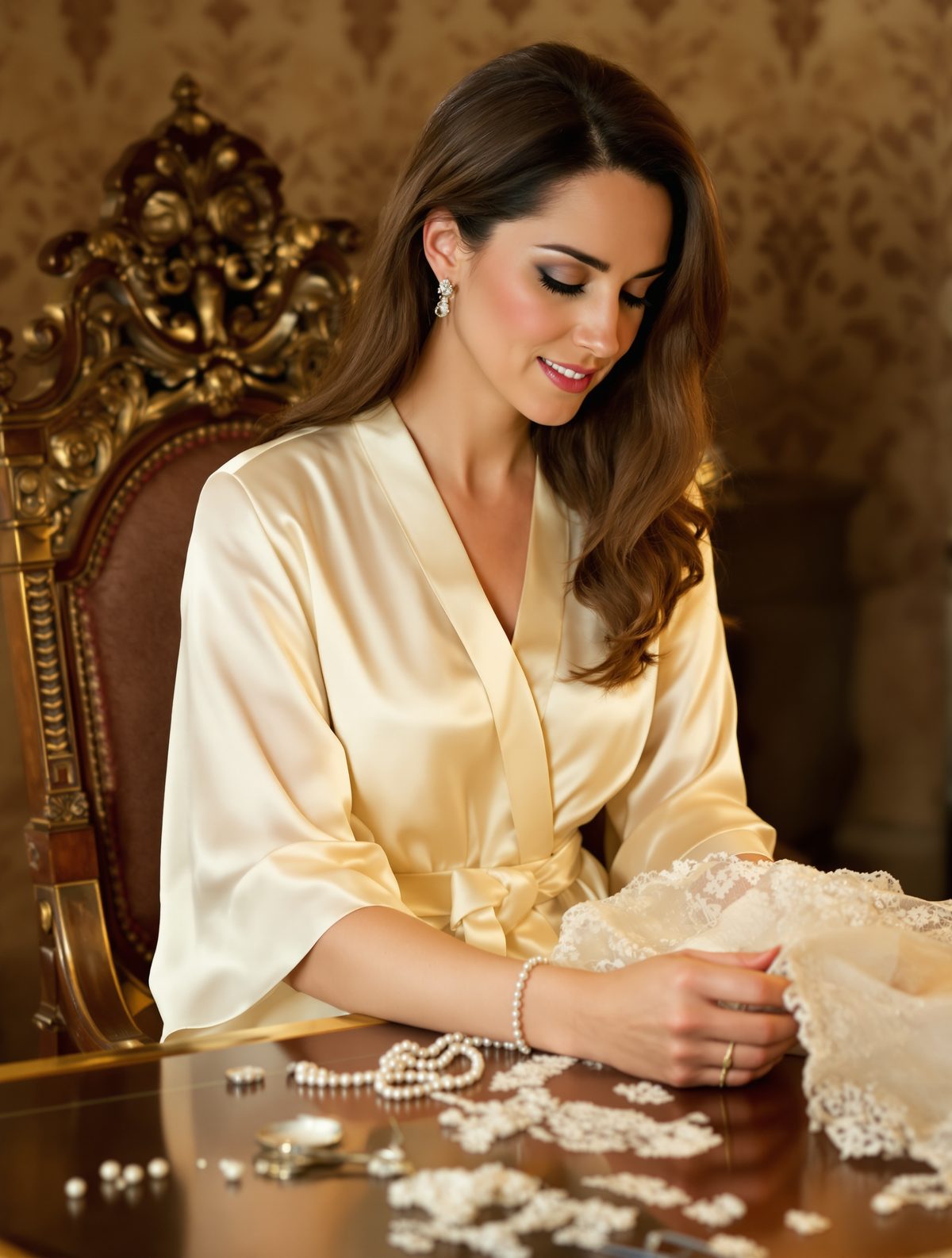
The clock at Buckingham Palace struck midnight on April 28, 2011, as Catherine Middleton sat hunched over her dressing table, squinting in the lamplight at hundreds of tiny seed pearls scattered across the mahogany surface. Her fingertips were already pricked and bleeding from the delicate needlework, but she couldn't stop—not when the entire world would be watching her walk down Westminster Abbey's aisle in less than twelve hours. The Cartier Halo Tiara, on loan from Queen Elizabeth II herself, lay waiting nearby, but it would be worthless without the ivory silk tulle veil it was meant to secure. A veil that had torn catastrophically during the final dress rehearsal just hours earlier.
What should have been Kate's last peaceful night as a commoner had transformed into a frantic race against dawn, armed with nothing but a needle, thread, and the determination that would soon make her one of the most beloved members of the Royal Family.
The Heirloom That Nearly Wasn't
The wedding veil that caused such eleventh-hour drama wasn't just any piece of fabric—it was a masterpiece of British craftsmanship that had taken the Chantilly lace-makers at Alexander McQueen months to perfect. Sarah Burton, who had taken over as Creative Director following McQueen's tragic death the previous year, had personally overseen every detail of what would become one of the most scrutinized wedding dresses in royal history.
The veil itself measured an impressive 2.7 meters long, hand-embroidered with floral motifs using the Carrickmacross lace-making technique—a method that originated in Ireland in the 1820s. But it was the delicate trim of hand-sewn seed pearls and crystals that made the piece truly extraordinary, and unfortunately, extraordinarily fragile.
According to palace insiders, the disaster struck during what was meant to be a routine final fitting at the Goring Hotel, where Kate and her family were staying. As she practiced her processional walk, the ancient wooden floorboards of her suite caught the veil's intricate beadwork. The result was devastating: dozens of precious pearls scattered across the floor like teardrops, leaving bare threads and gaps in the otherwise perfect pattern.
A Future Queen's Crisis Management
While most brides might have panicked or called in professional help, Kate Middleton's response revealed the steel beneath her famously composed exterior. Palace staff offered to contact emergency seamstresses, but Kate declined—partly due to the impossibly tight timeline, but also because of the sensitive security concerns surrounding the wedding details.
Instead, she sent her sister Pippa on a midnight mission to find matching pearls and the finest silk thread available. The future Duchess of Cambridge had learned needlework as a child, a skill that suddenly proved invaluable in the most high-pressure situation imaginable. Her mother, Carole Middleton, later revealed that Kate had always been "remarkably calm under pressure," but this was a test unlike any other.
The work was painstakingly precise. Each seed pearl had to be positioned exactly where the original had been placed, maintaining the delicate balance of the overall design. The ivory silk thread had to be virtually invisible, and every stitch needed to be secure enough to withstand the weight of the tiara, the movement of walking down the Abbey's long aisle, and the inevitable handling that would occur throughout the ceremony.
The Long Night Before History
As the hours ticked by, Kate's small hotel suite became an impromptu workshop. Palace sources suggest that she worked steadily through the night, taking only brief breaks to rest her eyes and massage her cramped fingers. The irony wasn't lost on anyone present—here was a woman about to marry into unimaginable wealth and privilege, spending her final hours as a commoner doing the kind of detailed handwork that royal ladies might once have been expected to master, but which modern royalty rarely needed to perform themselves.
The physical toll was evident by morning. Kate's fingertips were dotted with tiny puncture wounds from the needle, and her hands showed the strain of the repetitive, detailed work. Palace makeup artists later had to carefully conceal the evidence of her midnight marathon, though some observers noted that her hands appeared slightly swollen during the early morning preparations.
The psychological pressure was perhaps even more intense than the physical demands. This wasn't just any wedding dress—it was a gown that would be photographed, analyzed, and remembered for generations. Every detail would be scrutinized by fashion experts, royal watchers, and millions of viewers worldwide. The veil needed to be absolutely perfect, and Kate knew that she alone could ensure it met that standard.
Dawn, Victory, and a Royal Wedding
As the first light of April 29th crept through the hotel windows, Kate Middleton placed the final pearl in position and secured it with a barely visible knot. The veil was restored—not just repaired, but arguably improved, as her careful work had actually reinforced some of the original stitching that had begun to weaken.
The rest of the morning proceeded with the clockwork precision that royal events demand. Kate's hair was styled in her signature loose chignon, the Cartier Halo Tiara was positioned perfectly, and the restored veil flowed behind her like liquid silk. None of the estimated 2 billion viewers worldwide could have guessed the drama that had unfolded just hours before.
When Kate walked down Westminster Abbey's aisle, every step vindicated her midnight efforts. The veil moved with ethereal grace, the pearls caught the light streaming through the Gothic windows, and the overall effect was nothing short of magical. Fashion critics called it one of the most beautiful bridal looks in royal history, never knowing how close it had come to disaster.
The Making of a Modern Royal
The story of Kate's midnight sewing marathon offers a fascinating glimpse into the character of the woman who would become the Duchess of Cambridge, and eventually, Queen Consort. In an age when royalty is often criticized for being out of touch with ordinary life, here was a future queen literally getting her hands dirty—or in this case, bloodied—to solve her own problems.
This wasn't the last time Kate would demonstrate this hands-on approach to royal life. Throughout her years as a senior royal, she has consistently shown a willingness to engage directly with challenges rather than simply delegating them to staff. From her early patronages focused on children's mental health to her later environmental initiatives, Kate has maintained the same determined, personal involvement that saw her through that crucial night in 2011.
The incident also highlights the unique pressures faced by modern royals, where every public appearance is documented and analyzed in unprecedented detail. Unlike previous generations of royal brides, who might have had their weddings recorded for posterity but not broadcast live to billions, Kate faced scrutiny that was both immediate and permanent. Her response—taking personal responsibility for ensuring perfection—set the tone for her entire royal career.
Today, as the Princess of Wales, Kate's wedding veil hangs carefully preserved in the royal collection, its midnight repairs invisible to all but the most expert examination. It stands as a testament not just to British craftsmanship, but to the quiet determination of a woman who refused to let circumstances beyond her control derail one of the most important days of her life. In a world where royal stories often focus on privilege and protocol, Kate's bloody fingertips remind us that sometimes the most regal response to a crisis is simply to roll up one's sleeves and get to work.