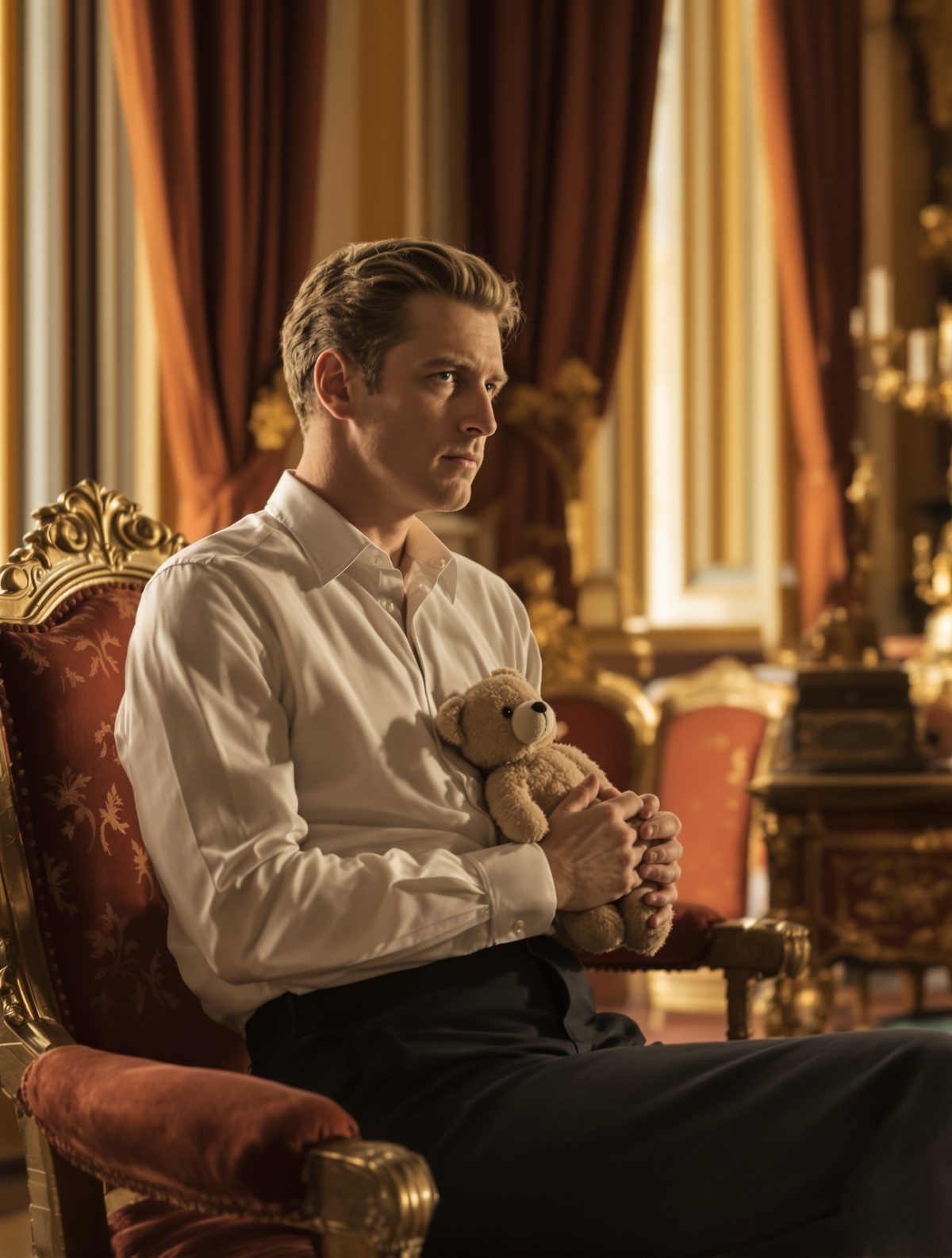
In the early hours of December 11, 1936, as dawn broke over Fort Belvedere, valet Frederick Corbitt made a discovery that would forever change how history remembers one of Britain's most controversial monarchs. Entering King Edward VIII's private study to collect the signed Instrument of Abdication, Corbitt found his master not poring over state papers or gazing contemplatively from the window, but curled in his leather armchair, fast asleep, clutching a threadbare teddy bear against his chest.
The sight was both heartbreaking and profoundly human—here was the man who had just surrendered the throne of the British Empire, reduced to seeking comfort in a childhood companion that had weathered decades of secrets, struggles, and now, the ultimate sacrifice for love.
The Bear That Witnessed a Reign's End
The teddy bear in question was no ordinary toy. According to palace records and accounts from household staff, this particular bear had been Edward's constant companion since childhood, a gift believed to have been given to him by his beloved grandmother, Queen Alexandra, when he was just four years old. Unlike the pristine toys displayed in royal nurseries for photographers, this bear showed every sign of a life well-lived and deeply loved.
Lady Diana Cooper, a close friend of the royal family, once noted in her diary how she had glimpsed the then-Prince of Wales quickly concealing something soft and brown when she entered his private quarters unexpectedly during a house party at Fort Belvedere in 1934. At the time, she had dismissed it as a cushion, but palace insiders later confirmed what many suspected—that Edward had never truly parted with his childhood comfort.
The bear had reportedly accompanied Edward through his turbulent youth, his military service during World War I (though carefully hidden from fellow officers), and his years as the glamorous Prince of Wales who charmed the world while privately struggling with the weight of his destiny. Staff at his various residences grew accustomed to finding the worn toy carefully placed among his personal effects, though none dared speak of it publicly.
A Night of Impossible Choices
The events of December 10, 1936, had unfolded with the inexorable weight of Greek tragedy. Edward had spent months wrestling with the constitutional crisis sparked by his determination to marry Wallis Simpson, the twice-divorced American socialite who had captured his heart but scandalized his government and the Church of England.
Prime Minister Stanley Baldwin had made the government's position crystal clear: Edward could be King, or he could marry Wallis, but he could not do both. The dominion governments had unanimously opposed any compromise, and the Archbishop of Canterbury had declared the marriage incompatible with Edward's role as Supreme Governor of the Church of England.
That final evening at Fort Belvedere, Edward's private residence in Windsor Great Park, the King had dismissed most of his household staff early. According to accounts from those who remained, he spent hours walking the grounds alone, occasionally returning to his study where the abdication papers waited on his desk like a death sentence.
When he finally sat down to sign the documents that would end his 325-day reign—one of the shortest in British history—witnesses reported that his hands shook slightly as he penned his name. The formal language of the Instrument of Abdication could barely contain the enormity of what was transpiring: "I, Edward the Eighth, of Great Britain, Ireland, and the British Dominions beyond the Seas, King, Emperor of India, do hereby declare My irrevocable determination to renounce the Throne for Myself and for My descendants."
The Valet's Discretion
Frederick Corbitt had served the royal household for over fifteen years and had witnessed Edward's transformation from carefree prince to burdened king to abdicated exile. His memoirs, published decades later, provide one of the most intimate accounts of those final hours of Edward's reign, though he wrote with the discretion that marked the finest royal servants.
Corbitt described finding his former master in what he diplomatically termed "a state of emotional exhaustion." The valet's training had prepared him for many scenarios, but discovering the man who had been King-Emperor just hours before seeking solace in a childhood toy tested even his legendary composure.
Rather than wake Edward immediately, Corbitt quietly collected the signed documents and placed them in the dispatch box for delivery to Buckingham Palace. He then gently covered the sleeping figure with a cashmere throw and retreated, allowing Edward a few more moments of peaceful oblivion before the harsh realities of exile would begin.
When Edward finally stirred, Corbitt later wrote, the first thing he did was carefully place the teddy bear in his travel case—ensuring it would accompany him into his new life as the Duke of Windsor. The gesture spoke volumes about a man who had given up everything he had been born to be, yet refused to abandon the simple comfort that had sustained him through a lifetime of royal duty.
The Psychology of Royal Comfort
Modern psychologists might not find Edward's attachment to his childhood bear particularly surprising. Transitional objects, as they're clinically known, often provide crucial emotional support during times of extreme stress or major life changes. For someone facing the unprecedented trauma of voluntary abdication, such comfort would be not just understandable but perhaps essential for psychological survival.
What makes Edward's story particularly poignant is the context of royal upbringing in the early 20th century. Born into an era when emotional expression was severely constrained, especially for those destined to rule, Edward had grown up in a world where showing vulnerability was considered a dangerous weakness. His father, King George V, was notorious for his stern, unforgiving approach to child-rearing, believing that royal children needed to be toughened for their future responsibilities.
That Edward managed to maintain this one connection to softness and comfort speaks to a more complex character than the playboy prince persona he cultivated in public. Beneath the glamorous exterior lay a deeply sensitive individual who understood, perhaps better than anyone, what he was sacrificing for love.
Palace historians note that Edward's attachment to his teddy bear also reflects the broader isolation of royal life. Surrounded by servants, courtiers, and politicians, but with few genuine confidants, even adult royals often struggle to find authentic emotional connections. A childhood toy, incapable of judgment or betrayal, might represent the purest form of unconditional acceptance available to someone in Edward's position.
A Legacy Beyond the Throne
The teddy bear that comforted Edward VIII through his abdication crisis reportedly remained with him for the rest of his life, traveling from his initial exile in Austria to his wedding in France and eventually to his final home in Paris. Wallis, the woman for whom he sacrificed a throne, was said to understand the bear's significance and never questioned its continued presence among her husband's possessions.
This small detail adds unexpected depth to one of the 20th century's most famous love stories. While historians continue to debate Edward's fitness for kingship and the wisdom of his choice, the image of him clutching his childhood comfort during the darkest hours of his life reveals something profound about the human cost of his decision.
In our modern age, when members of the Royal Family speak more openly about mental health and emotional wellbeing, Edward's story takes on new relevance. His teddy bear represents not weakness but wisdom—the understanding that even those born to the highest positions need something soft to hold onto when the world becomes too hard to bear. Perhaps in that moment of vulnerability, grasping his childhood companion as he faced an uncertain future, Edward VIII was never more relatable, never more human, and never more worthy of our understanding than when he was no longer King.