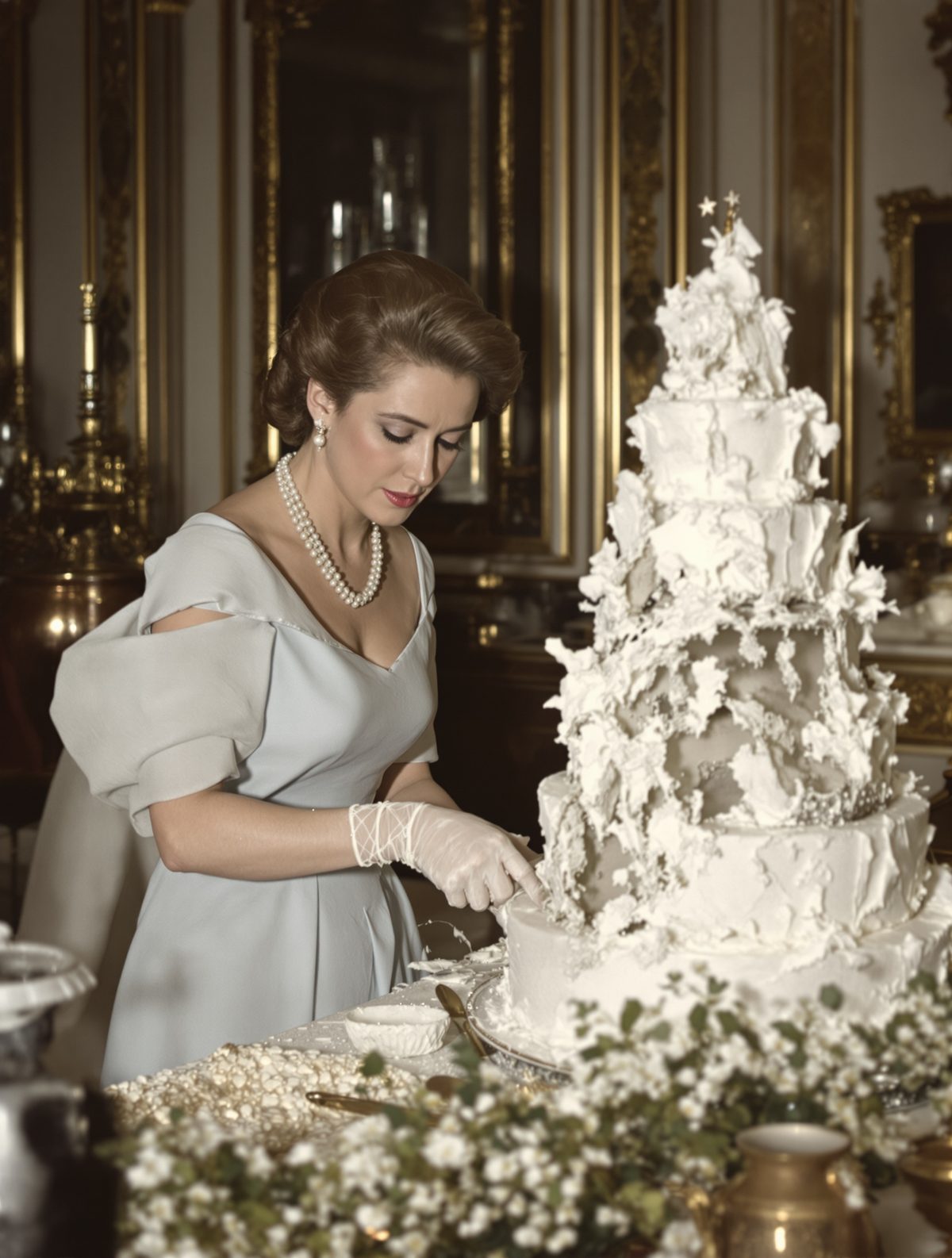
The morning of 6 May 1960 should have been perfect for Princess Margaret. After years of heartbreak, scandal, and public scrutiny following her forbidden romance with Group Captain Peter Townsend, the Queen's younger sister was finally having her fairy-tale moment. She was marrying Antony Armstrong-Jones, a talented photographer who had captured not just her portrait, but her heart. Westminster Abbey was adorned with 20,000 blooms, television cameras were positioned to broadcast the ceremony to 300 million viewers worldwide, and 2,000 distinguished guests awaited the spectacle. But behind the scenes at Buckingham Palace, a catastrophe was unfolding that threatened to turn triumph into disaster.
When Royal Perfection Crumbles
At precisely 11:30 AM, three hours before the wedding breakfast was due to begin, a sickening crash echoed through the palace kitchens. The magnificent five-tier wedding cake—a towering masterpiece of royal icing, sugar flowers, and intricate piped decorations that had taken the pastry team six days to create—lay in ruins across the marble floor.
The cake had been a work of art befitting a royal wedding. Standing nearly four feet tall, each tier was decorated with delicate sugar roses, the couple's intertwined initials, and intricate lacework piping that had taken master craftsmen hours to perfect. The top tier featured a miniature replica of Westminster Abbey, while cascading sugar flowers in shades of pink and white—Princess Margaret's favorite colors—adorned each level. The estimated cost was £500, equivalent to roughly £12,000 today.
Head pastry chef Henri Dubois, a temperamental Frenchman who had served the royal household for fifteen years, reportedly took one look at the devastation and suffered what palace staff later diplomatically described as "a complete nervous collapse." The man who had crafted confections for coronations and state banquets was found sitting on the kitchen floor, head in his hands, muttering in rapid French about his ruined reputation.
The Princess Takes Charge
What happened next became the stuff of palace legend, though it remained strictly confidential for decades. Princess Margaret, already dressed in her Norman Hartnell wedding gown but covered with kitchen aprons, made an executive decision that shocked even the most experienced royal staff. Rather than panic or delegate the crisis to others, she rolled up her sleeves—quite literally—and took command of the kitchen.
"Your Royal Highness, you simply cannot—" began the palace steward, but Margaret cut him off with a wave of her hand. The Princess, known for her strong will and occasional defiance of protocol, had no intention of letting a collapsed cake ruin her wedding day. She had waited long enough for this moment.
Margaret immediately summoned every available kitchen staff member, from the most junior scullery maid to the sous chefs. Together, they began the seemingly impossible task of rebuilding the wedding cake from scratch. Fortunately, the palace kitchens maintained emergency supplies of pre-made cake layers and royal icing—a precaution developed after previous, less dramatic baking disasters at royal events.
The Princess proved surprisingly adept at cake decoration, a skill she had quietly developed during her youth when she would escape to the kitchens for informal cooking lessons. Her steady hands and artistic eye, honed through years of painting and photography, served her well as she piped delicate borders and positioned sugar flowers with remarkable precision.
A Race Against Time
The kitchen became a scene of controlled chaos as staff worked at breakneck speed. Margaret directed the reconstruction like a general commanding troops, her wedding dress carefully protected but her tiara slightly askew from the frantic activity. The Princess's lady-in-waiting, Lady Elizabeth Cavendish, later recalled being astounded by Margaret's composure and practical leadership during what could have been a complete catastrophe.
Time was running desperately short. The wedding ceremony at Westminster Abbey was scheduled for noon, followed immediately by the reception at Buckingham Palace. Guests would expect to see the magnificent cake as the centerpiece of the wedding breakfast, and its absence would certainly be noticed—and reported—by the assembled media and dignitaries.
The team worked with military precision, each person assigned specific tasks. Some focused on stabilizing the cake's structure with hidden wooden supports, while others concentrated on the decorative elements. Margaret herself took charge of the most delicate work, recreating the sugar Westminster Abbey that would crown the top tier. Her hands, which had learned to play piano to concert standard and paint with remarkable skill, proved equally capable of the intricate work of royal cake decoration.
The Ultimate Royal Cover-Up
As church bells began ringing across London to herald the ceremony, the reconstructed cake was finally complete. It looked, according to those present, even more magnificent than the original. The crisis had brought out unexpected talents and revealed the remarkable teamwork possible when royal protocol was temporarily set aside in favor of practical necessity.
Margaret quickly changed into a fresh gown—the original having acquired telltale traces of royal icing despite the protective aprons—and her hair was hastily restyled by her personal dresser. She arrived at Westminster Abbey with just minutes to spare, looking every inch the radiant bride. Not a single guest suspected the drama that had unfolded behind palace doors.
The reconstructed cake was positioned in the State Dining Room as planned, and when the newlyweds performed the traditional cake-cutting ceremony for photographers, it held perfectly. The disaster that could have overshadowed the wedding of the decade remained a closely guarded palace secret, known only to the small group of staff who had participated in the frantic reconstruction effort.
Chef Dubois, who eventually recovered from his nervous breakdown, was quietly reassigned to less high-pressure duties within the royal household. He never spoke publicly about the incident, maintaining the discretion expected of royal staff even after his retirement.
A Legacy of Royal Resilience
This extraordinary episode reveals something profound about Princess Margaret's character that often gets lost in accounts of her later rebellious years and personal struggles. Behind the glamorous exterior and sometimes difficult public persona was a woman of remarkable practical capability and grace under pressure. Her willingness to abandon royal protocol and get her hands dirty—quite literally—to save her own wedding celebration shows a side of Margaret rarely seen by the public.
The cake disaster also highlights the immense pressure and expectations surrounding royal events. Every detail must be perfect, every moment choreographed, with no room for the kind of ordinary mishaps that might simply add character to a normal wedding. The fact that this near-catastrophe was successfully covered up demonstrates the extraordinary lengths to which the royal household will go to maintain the illusion of effortless perfection.
Today, as we watch modern royals navigate their own challenges and occasionally let us glimpse their more human moments, Princess Margaret's cake crisis seems remarkably contemporary. It reminds us that behind all the pomp and ceremony, royal families face the same unexpected challenges as anyone else—they're just usually better at hiding them. Margaret's quick thinking and hands-on approach that morning in 1960 saved not just a wedding cake, but perhaps the entire memory of what became one of the most celebrated royal weddings of the twentieth century.