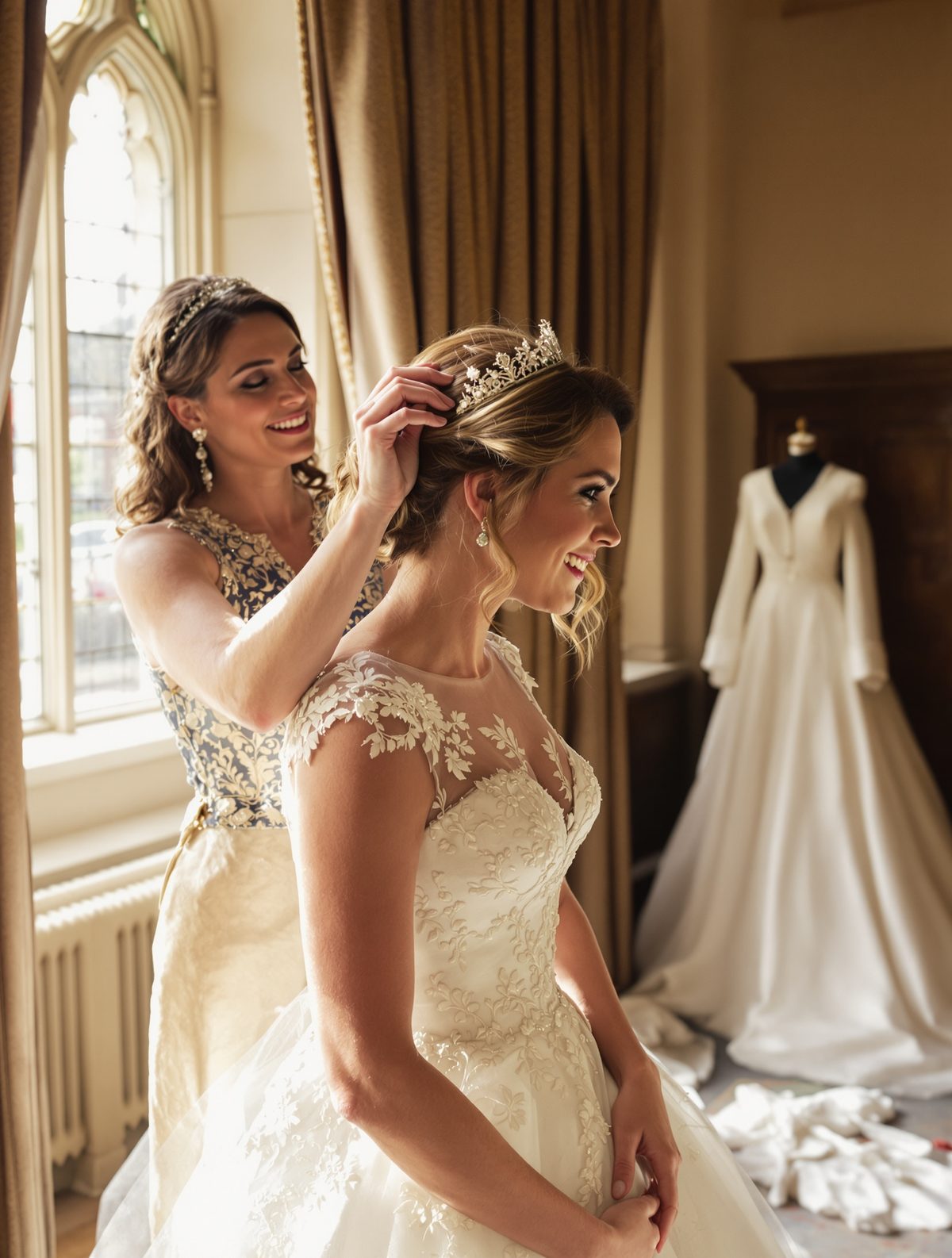
The morning of October 12, 2018, should have unfolded like clockwork at Windsor Castle. Princess Eugenie, radiant in her Peter Pilotto gown, was mere moments away from walking down the aisle of St. George's Chapel to marry Jack Brooksbank. Eight hundred distinguished guests had taken their seats, television cameras were broadcasting live to millions worldwide, and even the notoriously punctual Queen had arrived precisely on schedule. But behind the scenes, a crisis was unfolding that would test centuries of royal protocol and create one of the most unexpectedly touching moments in recent royal wedding history.
When Royal Perfection Shattered
The Greville Emerald Kokoshnik tiara, borrowed from Her Majesty's personal collection, had been the crown jewel of Eugenie's bridal ensemble. The stunning piece, created by Boucheron in 1919 for socialite Dame Margaret Greville, featured brilliant cut diamonds set in a distinctive Russian-style design that perfectly complemented the princess's elegant updo. It was a choice that spoke to both tradition and personal style—exactly what royal brides are expected to achieve.
But as Eugenie's hairdresser made final adjustments in the moments before departure, disaster struck. The historic tiara, weakened perhaps by its century of existence or the stress of its intricate construction, simply snapped in half. One can only imagine the collective intake of breath from the bridal party as priceless diamonds and emeralds scattered across the dressing room floor of the castle's private apartments.
Royal weddings operate on military precision. Every moment is choreographed, every entrance timed to the second, every camera angle calculated for maximum impact. There are no do-overs, no calling for a brief intermission while the bride sorts herself out. The Queen doesn't wait, and neither do the millions of viewers tuned in around the globe.
A Grandmother's Love in Action
What happened next would have been unthinkable under the strict protocols that governed royal ceremonies for generations. With no backup tiara—an oversight that seems impossible but speaks to the assumption that nothing could go wrong with such carefully maintained pieces—the bridal party faced an unprecedented crisis. Traditional royal protocol would have demanded finding another suitable tiara from the Queen's collection, a process that could have taken precious time and required formal permission.
Instead, in a moment that revealed the deeply personal relationships behind the pomp and ceremony, the Queen herself took charge of the situation. Moving with the decisive authority that had served her through decades of public service, she unpinned one of her own brooches and handed it to the hairdresser. It was the Queen Mother's emerald brooch, a piece with profound sentimental value that had belonged to her beloved mother.
The choice was both practical and deeply meaningful. The emerald brooch not only provided the necessary something for Eugenie's hair but also carried the weight of family history. The Queen Mother, known for her warmth and her ability to navigate crises with grace, would have undoubtedly approved of her brooch serving as an emergency rescue for her great-granddaughter's wedding day.
Breaking Protocol with Purpose
The transformation took place in what courtiers later described as "sixty seconds of controlled chaos." Royal hairdressers are trained for many scenarios, but repurposing a brooch as emergency bridal headwear isn't typically covered in their preparation. Yet somehow, the Queen Mother's emerald piece was secured into Eugenie's carefully styled hair, creating an entirely different but equally elegant look.
This moment represented something revolutionary in royal wedding history. For perhaps the first time, a major change to a bride's appearance was made not through months of careful planning and committee approval, but through quick thinking, family love, and a willingness to abandon protocol when human needs took precedence.
The Chapel Knew Nothing
As Princess Eugenie finally made her entrance into St. George's Chapel, resplendent in her gown and wearing the Queen Mother's emerald brooch nestled in her hair, the congregation had no idea they were witnessing the aftermath of a crisis. The television commentators noted the "elegant simplicity" of her hair accessory, unaware that it represented one of the most dramatic behind-the-scenes moments in royal wedding history.
The ceremony proceeded flawlessly. Eugenie's radiant smile never wavered, Jack's obvious delight in his bride was infectious, and the Queen watched from the congregation with what observers noted was particular warmth. Only the inner circle knew that they had just witnessed not only a wedding, but also a masterclass in grace under pressure.
The broken tiara was, of course, later restored by the Crown Jewellers. Such pieces are too historically significant to remain damaged, and the expertise exists within royal circles to repair even the most delicate antique jewelry. But the repaired tiara would return to the Queen's collection carrying its own new story—a reminder that even the most perfect royal occasions can require very human solutions.
A New Chapter in Royal Flexibility
The significance of Princess Eugenie's wedding morning crisis extends far beyond one broken tiara. It marked a subtle but important shift in how the modern royal family approaches the unexpected challenges that inevitably arise in public life. The Queen's immediate, practical response—cutting through protocol to solve a problem with the resources at hand—demonstrated a leadership style that prioritizes outcomes over procedures.
This wasn't the first time royal weddings had faced last-minute adjustments, but it may have been the first time such a significant change was made so quickly and with such personal involvement from the monarch herself. Previous generations of royals might have delayed the ceremony, sent for alternatives, or found some other solution that maintained the original plan. The Queen's willingness to literally give the brooch off her own dress showed a grandmother's love in action, transcending her role as sovereign.
The story also reveals the hidden vulnerabilities in even the most carefully planned royal events. These historic pieces of jewelry, despite their careful preservation, remain subject to the simple physics of age and wear. The assumption that they will perform flawlessly, like so many assumptions about royal life, can be shattered in an instant—sometimes quite literally.
Princess Eugenie's wedding day crisis and its elegant resolution remind us that behind all the ceremony and tradition, the royal family remains fundamentally human. When disaster strikes, they respond not with rigid adherence to protocol, but with the same quick thinking, family loyalty, and practical problem-solving that any loving family would employ. The Queen Mother's emerald brooch didn't just save a wedding day—it created a new family story that will likely be treasured for generations, proving that sometimes the most meaningful royal moments happen not in front of the cameras, but in those precious seconds when love and practicality triumph over protocol.