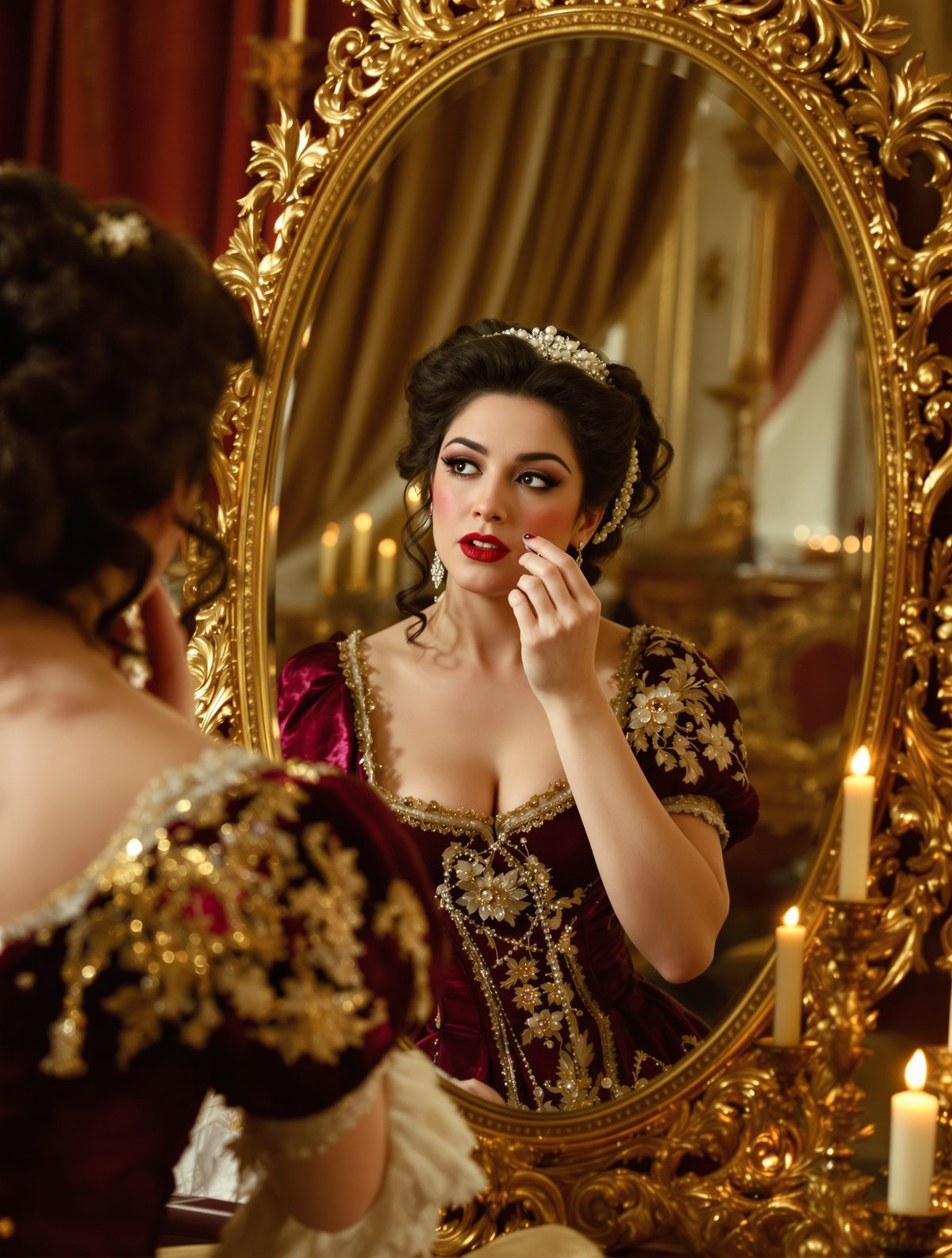
In the glittering yet suffocating world of Regency high society, where ladies were expected to appear as pale as porcelain dolls and as delicate as morning dew, Princess Caroline of Brunswick was painting her face like an actress preparing for the stage. Behind the closed doors of her apartments, away from the disapproving eyes of King George IV and his courtiers, the estranged Queen Consort was learning the forbidden art of theatrical makeup from the one person she trusted most: her devoted lady's maid.
What emerged from these clandestine beauty sessions would scandalise a court already reeling from the royal couple's very public marital breakdown, and establish Princess Caroline as one of history's most audaciously defiant royal women.
The Art of Royal Rebellion
To understand the shock that Princess Caroline's makeup caused, we must first appreciate the beauty standards of 1820s Britain. The ideal woman of the era possessed what was termed a "natural" complexion – meaning alabaster-pale skin with perhaps the faintest hint of rose in the cheeks. Any obvious use of cosmetics was considered the mark of an actress, courtesan, or worse. Respectable ladies might pinch their cheeks for colour or bite their lips for a rosy hue, but visible rouge or powder was absolutely scandalous.
Royal women, positioned at the very pinnacle of society's moral hierarchy, were expected to embody this natural ideal to perfection. They were living symbols of virtue and refinement, their appearance as carefully managed as any state ceremony. The very suggestion that a queen might artificially enhance her features was tantamount to questioning her moral character.
Princess Caroline, however, had long since abandoned any pretence of conforming to royal expectations. Her marriage to the Prince Regent (later George IV) had been a disaster from their wedding night in 1795, and by the 1820s, their relationship had devolved into open warfare. If society expected her to fade quietly into the background, she would do precisely the opposite.
The Maid Who Knew Theatre's Secrets
The woman behind Princess Caroline's transformation remains somewhat mysterious in historical records, as was common for domestic servants of the era. What we do know is that she had previously worked in London's theatrical world before entering royal service – a background that would prove invaluable to her unconventional mistress.
Theatre in the 1820s required bold, dramatic makeup that could be seen from the back rows of gaslit playhouses. Actresses used heavy white lead powder as a base, dramatic kohl around the eyes, and most shocking of all, vivid rouge applied liberally to the cheeks and lips. These techniques created faces that were striking, memorable, and utterly inappropriate for a drawing room.
The princess's maid understood both worlds – the theatrical techniques that could create drama and impact, and the social codes of the royal household that made such techniques so transgressive. In teaching her mistress these skills, she was essentially handing her a weapon of social rebellion.
The transformation process likely took place in the princess's private chambers, away from the prying eyes of other courtiers and servants. We can imagine the intimate nature of these sessions – the maid carefully explaining how to apply the white powder base, how to line the eyes for maximum effect, and most daringly, how to apply the rouge that would become Princess Caroline's signature look.
The Scandalous Rouge That Shocked a Kingdom
When Princess Caroline began appearing in public with her dramatically rouged cheeks, the reaction was immediate and explosive. Courtiers whispered behind fans, society papers dropped barely veiled hints about her "theatrical" appearance, and King George IV was reportedly apoplectic with rage.
The rouge wasn't subtle – this wasn't a gentle hint of colour that might pass for natural flush. Contemporary accounts describe her cheeks as bearing vivid patches of red that were visible from across a room. Combined with her increasingly eccentric dress sense and her refusal to adopt the demure behaviour expected of royal women, her makeup became a symbol of everything that was "wrong" with Princess Caroline.
But perhaps that was precisely the point. In an era where women, particularly royal women, had few ways to express dissent or assert their independence, Princess Caroline's rouge became her battle standard. Every public appearance with her dramatically painted face was a declaration that she would not be controlled, contained, or made to disappear quietly.
The king's horror at his wife's appearance went beyond mere aesthetic preferences. In the rigid social hierarchy of the 1820s, appearance was deeply connected to morality and social status. By adopting the makeup techniques of actresses and courtesans, Princess Caroline was, in the eyes of many, placing herself in their category – a devastating blow to royal dignity.
A Beauty Revolution Behind Palace Walls
What makes Princess Caroline's story particularly fascinating is how it reveals the hidden networks of knowledge and rebellion that existed within royal households. Her lady's maid wasn't simply following orders; she was actively participating in her mistress's defiance of social conventions. This partnership between royal and servant, crossing both class and professional boundaries, created something genuinely revolutionary.
The theatrical techniques they employed together represented a different philosophy of feminine beauty – one that was bold, artificial, and unapologetic. While society demanded that women appear naturally beautiful (while secretly working hard to achieve that "natural" look), Princess Caroline was openly celebrating the artifice of beauty. Her face became a canvas for artistic expression rather than a symbol of moral purity.
We must also consider the courage this required from both women. The maid risked her position and reputation by teaching forbidden techniques to her royal mistress. Princess Caroline risked becoming a social pariah – though given her already precarious position as the king's estranged wife, perhaps she felt she had little left to lose.
The Legacy of Royal Rebellion
Princess Caroline's theatrical makeup experiment ended with her sudden death in 1821, but her brief reign as the most scandalously painted woman in Britain left its mark on royal history. She had proven that even queens could reject the beauty standards imposed upon them, and that cosmetics could be tools of rebellion as much as enhancement.
Looking back from our modern perspective, Princess Caroline's dramatic rouge seems almost quaint – a small act of defiance in a world that offered women few other options for self-expression. Yet in its historical context, it was genuinely radical. She was asserting her right to control her own image at a time when that image belonged, legally and socially, to her husband and his court.
Today, as we watch modern royal women navigate the complex expectations of public life – from Catherine's perfectly applied makeup to Meghan's bold choices that sometimes raise eyebrows – we can see echoes of Princess Caroline's struggle. The tension between personal expression and royal duty, between conformity and authenticity, remains as relevant now as it was two centuries ago. Perhaps Princess Caroline, with her theatrical rouge and her devoted maid, was simply ahead of her time in understanding that sometimes the most powerful statement a royal woman can make is to paint her face exactly as she chooses.