Hours before millions would watch her become Queen, young Elizabeth II slipped away from Buckingham Palace in the dead of night. What happened during those dark hours in Westminster Abbey would haunt her for decades—a moment of profound vulnerability that revealed the terrifying weight of the crown she was about to inherit.
The date was 2nd June 1953, and in just a few hours, the eyes of the world would be upon the 27-year-old princess as she transformed into Queen Elizabeth II. But as London slept and the final preparations were made for the most televised event in history, Elizabeth found herself gripped by a panic so overwhelming that it would drive her from the safety of the palace into the shadowy silence of Westminster Abbey.
The Weight of an Unexpected Crown
To understand Elizabeth's midnight crisis, we must remember that she had never been meant to rule. Born as the daughter of the Duke of York—later King George VI—she had lived the first decade of her life expecting a relatively quiet royal existence. It was only her uncle Edward VIII's abdication in 1936 that thrust her father onto the throne and her into the direct line of succession.
By 1953, Elizabeth had already been Queen for sixteen months following her father's sudden death in February 1952. Yet the coronation represented something far more profound than a ceremonial formality. It was the moment when the sacred nature of her role would be sealed before God and country—a responsibility that would bind her for life.
The pressure had been mounting for weeks. Unlike today's more intimate royal ceremonies, the 1953 coronation was designed to be a spectacular display of British power and tradition. For the first time, the ceremony would be televised live, bringing an estimated 27 million viewers in the UK alone into Westminster Abbey. The young Queen knew that every gesture, every expression, every moment would be scrutinized by more people than had ever watched a single event in human history.
Palace insiders later recalled that Elizabeth had grown increasingly quiet and withdrawn in the days leading up to the coronation. The usually composed princess was observed practicing her responses obsessively, walking through the palace corridors with a sheet draped over her shoulders to simulate the heavy coronation robes she would wear.
A Desperate Flight in the Night
What exactly drove Elizabeth from her bed at Buckingham Palace that night remains a subject of speculation, but accounts from palace staff paint a picture of a young woman overwhelmed by the magnitude of what lay ahead. Sleep had eluded her entirely, and the confines of the palace—usually her sanctuary—seemed to close in around her.
According to later testimonies, Elizabeth managed to leave the palace undetected sometime after 3 AM. The streets of London were eerily quiet, with only the occasional policeman patrolling the coronation route. Security, while tight, was not the impenetrable fortress we might expect today, and a determined royal could still move with relative freedom in the pre-dawn hours.
Westminster Abbey, just over a mile from Buckingham Palace, drew her like a magnet. Perhaps it was the need to face her fears in the very place where her destiny would unfold, or maybe she sought solace in the ancient stones that had witnessed the crowning of monarchs for nearly a thousand years.
The Abbey would have been a vastly different place in those quiet hours—stripped of the grandeur that would soon fill it, with scaffolding for television cameras creating strange shadows in the moonlight filtering through the medieval windows. Here, surrounded by the tombs of her ancestors, Elizabeth confronted the reality of what it meant to be Queen.
Dawn Discovery and Silent Witness
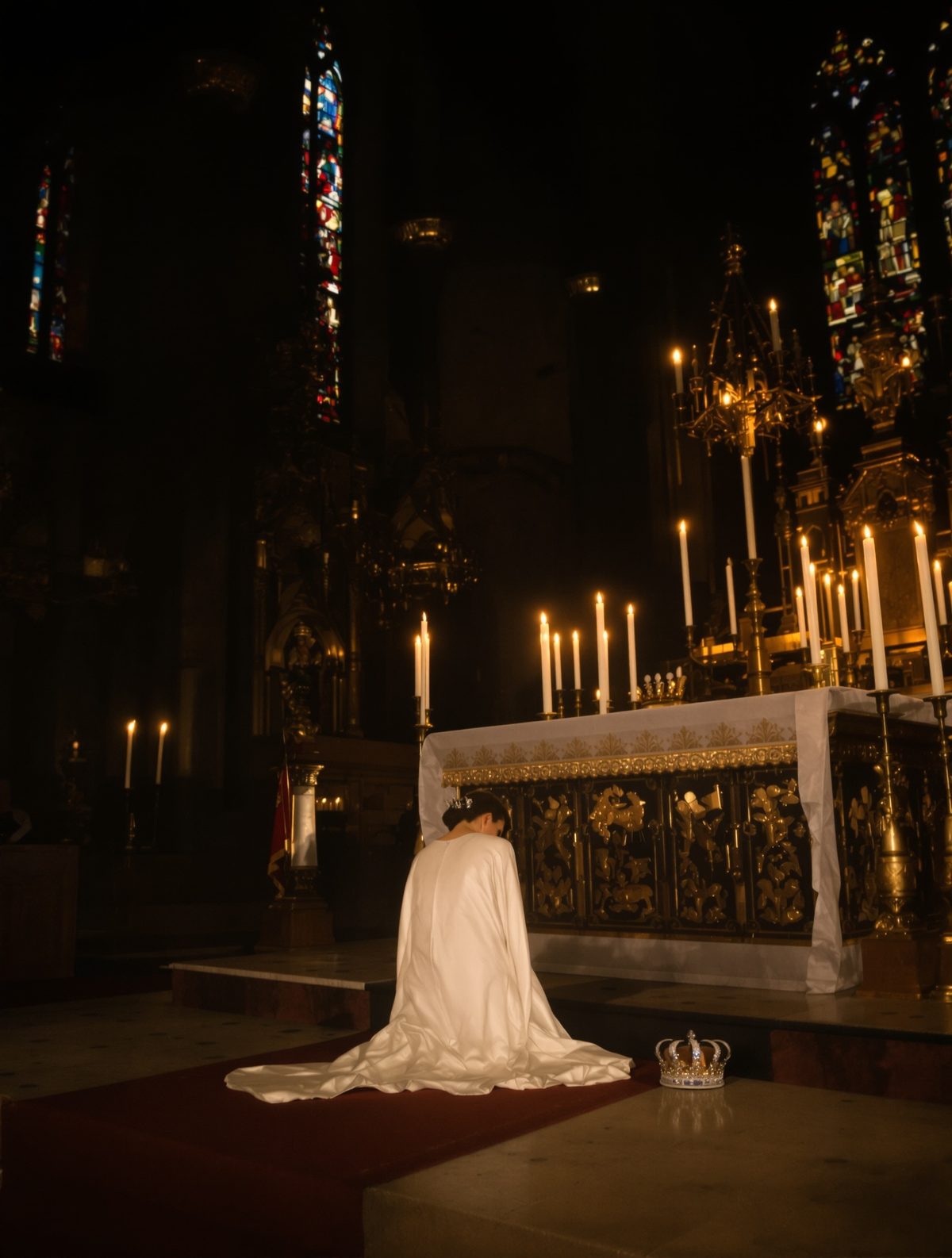
It was Harold Weatherby, a long-serving Abbey janitor, who discovered the young Queen at dawn. Arriving for his early morning duties, he was startled to find a slight figure kneeling at the altar where, in just hours, the Archbishop of Canterbury would place the crown upon her head.
Weatherby's discretion was absolute—a testament to the loyalty that the royal family inspired in their staff. He quietly withdrew, allowing Elizabeth her private moment, but not before witnessing what he later described as the most profound display of human vulnerability he had ever seen. The future Queen, he observed, was weeping—not the gentle tears of emotion, but the deep, body-shaking sobs of someone grappling with an almost unbearable burden.
What thoughts raced through Elizabeth's mind during those dark hours? The weight of her father's legacy, perhaps, and the knowledge that she would never again be simply Elizabeth Windsor. The realization that her children would grow up with a mother who belonged first to the nation, and only second to them. The understanding that every decision she made for the rest of her life would be viewed through the lens of duty and service.
Palace historians suggest that this moment marked a crucial turning point in Elizabeth's relationship with her role. The panic and tears were not signs of weakness, but rather the natural human response to comprehending the full scope of her destiny. In facing her fears alone in that sacred space, she found the strength to carry them.
The Crown's Enduring Shadow
When Elizabeth returned to Buckingham Palace as the first light of dawn broke over London, she had undergone a transformation as significant as any that would occur during the formal ceremony. Those who saw her that morning remarked on a new quality in her bearing—a gravity that seemed to age her beyond her twenty-seven years.
The coronation itself proceeded flawlessly. Television viewers around the world watched as a composed and radiant young woman took the solemn vows that would define the rest of her life. Few could have imagined the private struggle that had preceded those public moments of triumph.
In the years that followed, Elizabeth would occasionally return to Westminster Abbey for private moments of reflection, particularly during times of crisis. Courtiers noted that she seemed to find strength in the building where she had once faced her deepest fears. The Abbey became not just the site of her coronation, but a place where she could reconnect with the gravity of her calling.
This midnight crisis would indeed haunt Elizabeth throughout her reign, but perhaps not in the way one might expect. Rather than undermining her confidence, it served as a touchstone—a reminder of her own humanity in a role that often demanded superhuman composure. In later years, she would privately counsel younger members of the royal family facing their own moments of doubt, drawing on the wisdom gained during those dark hours before her coronation.
As we reflect on Queen Elizabeth II's unprecedented seventy-year reign, that night of panic and prayer takes on profound significance. It reminds us that even those born to extraordinary privilege and power must find their own way to carry the weight of destiny. In her moment of greatest vulnerability, the young Elizabeth discovered the strength that would sustain her through decades of service, transforming a frightened young woman into one of history's most enduring monarchs. The tears shed in Westminster Abbey that night were not the end of her story, but rather its true beginning.