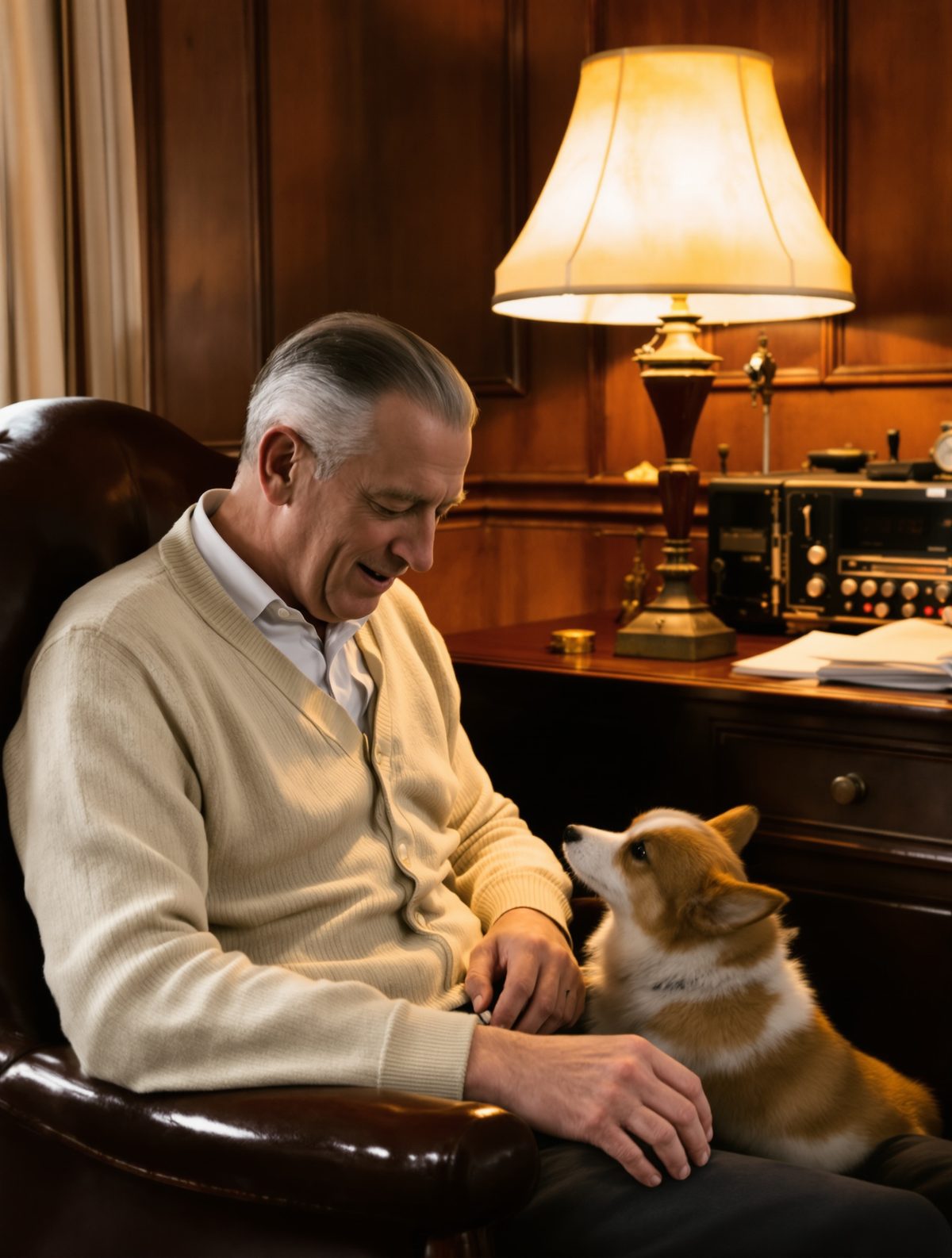
In the shadowed corridors of Buckingham Palace during the winter of 1940, a most unusual rehearsal was taking place. While London endured the Blitz and Britain stood alone against Nazi Germany, King George VI faced his own private battle—not just against a formidable enemy, but against the stammer that had plagued him since childhood. As he prepared to deliver speeches that would either inspire or deflate a nation's morale, the King found solace in an unlikely companion: his devoted corgi, who listened without judgment to every stumbled word and patient repetition.
The Weight of Words in Wartime
When George VI reluctantly ascended to the throne in 1936 following his brother's abdication, few could have predicted that this shy, stammering monarch would become the voice that steadied Britain through its finest hour. The King's speech impediment, a severe stutter that had tormented him since early childhood, made every public address an ordeal. Palace courtiers recalled how he would break into perspiration before even minor speaking engagements, his hands trembling as he gripped his prepared text.
The outbreak of war in September 1939 transformed these personal struggles into matters of national importance. Radio had become the primary means of reaching the British people, and the King's voice needed to carry across the airwaves to homes, shelters, and military posts around the globe. Each broadcast was a potential turning point in morale—his words could either bolster the nation's resolve or inadvertently reveal the depth of Britain's vulnerability.
The pressure was immense. Unlike his charismatic brother, the former Edward VIII, George VI had never been groomed for kingship. His natural diffidence, combined with his speech difficulties, meant that even reading the news headlines aloud was a challenge. Yet history demanded that he find his voice precisely when Britain needed it most.
A Four-Legged Confidant
It was during these trying preparations that the King's beloved corgi, Susan, became an integral part of the royal routine. Palace staff observed that His Majesty seemed most at ease when the little dog was present, her calm demeanor somehow transmitting itself to her anxious master. What began as coincidence soon evolved into deliberate practice—the King would rarely rehearse his speeches without Susan lying quietly at his feet.
The relationship between George VI and his corgis was already well-established before the war began. These intelligent, loyal dogs had been part of the royal household since the 1930s, and the King found their presence both comforting and grounding. Unlike human courtiers, who might unconsciously betray their nervousness about his stammer through facial expressions or fidgeting, the corgis offered pure, uncritical companionship.
Equerry Peter Townsend later noted in his memoirs how the King's entire demeanor would change when his dogs were nearby. The tension in his shoulders would ease, his breathing would become more regular, and most remarkably, his stutter would often diminish. While working with his speech therapist Lionel Logue remained crucial to his progress, these informal sessions with Susan provided a different kind of therapy—one based on unconditional acceptance rather than clinical technique.
Behind Palace Doors: The Rehearsal Ritual
The King's private study became the unlikely theater for these wartime rehearsals. Palace records and staff recollections paint a picture of meticulous preparation, with speeches typed in special large fonts and marked with breathing cues developed by Logue. But it was the presence of Susan, curled quietly on her favorite cushion, that seemed to provide the missing element the King needed.
These weren't casual run-throughs. George VI was known to practice each broadcast dozens of times, working through every challenging consonant and potential stumbling block. The Queen Mother later revealed that she would sometimes hear him rehearsing late into the evening, his voice gradually growing stronger and more confident as the hours passed. Susan, ever patient, would remain in the room throughout these marathon sessions, occasionally lifting her head when a particularly difficult passage required multiple attempts.
The transformation was remarkable. Servants noted that by the time the King was ready for his official recording sessions at the BBC, he carried himself differently. The man who entered Broadcasting House was still nervous—he always would be—but he possessed a quiet confidence that hadn't been there in the early months of his reign. The voice that emerged from radio sets across Britain was steady, authoritative, and profoundly reassuring.
The Power of Unconditional Support
What made Susan such an effective rehearsal partner wasn't just her calm presence, but what she represented: pure, non-judgmental support. In a world where every word the King spoke would be analyzed by politicians, press, and public alike, Susan offered a space free from criticism or expectation. She didn't wince at a mispronounced word or grow impatient with repetitions. She simply was—a constant, loving presence that allowed the King to practice being himself.
This dynamic speaks to something profound about leadership under pressure. Even monarchs, surrounded by advisors and experts, sometimes need the simple comfort of a loyal companion who asks for nothing more than their presence. Susan's role in those crucial wartime broadcasts reminds us that courage often grows from the smallest, most personal sources of strength.
The success of the King's wartime speeches is well-documented. His Christmas broadcasts became essential listening across the Commonwealth, and his addresses during particularly dark periods—such as after the fall of France or during the heaviest bombing of London—provided genuine comfort to millions. That a small corgi played a part in this remarkable transformation adds a deeply human dimension to one of the monarchy's finest hours.
Legacy of a Royal Partnership
George VI's relationship with his corgis continued throughout his reign, but Susan held a special place as his wartime companion. When she eventually passed away, the King was said to have mourned her deeply, crediting her with helping him through some of the most challenging moments of his kingship. The tradition of royal corgis, of course, continued with Queen Elizabeth II, who inherited not just her father's throne but his deep affection for these remarkable dogs.
Looking back at those wartime broadcasts today, knowing the private struggles that preceded each public triumph, we see a different kind of courage than we might have initially recognized. George VI's bravery wasn't just in facing down Hitler's Germany—it was in the quiet, daily battle against his own limitations, fought with determination, professional help, and the unwavering support of a faithful corgi who never once doubted his ability to find the words Britain needed to hear.
In our modern era of calculated public relations and media training, there's something profoundly moving about this image: a reluctant king, practicing late into the night with only his dog for company, gradually finding the voice that would help carry a nation through its darkest chapter. Sometimes the most powerful partnerships are the simplest ones, built not on grand gestures but on quiet loyalty and the comfort of knowing that someone—even a four-legged someone—believes in you completely.