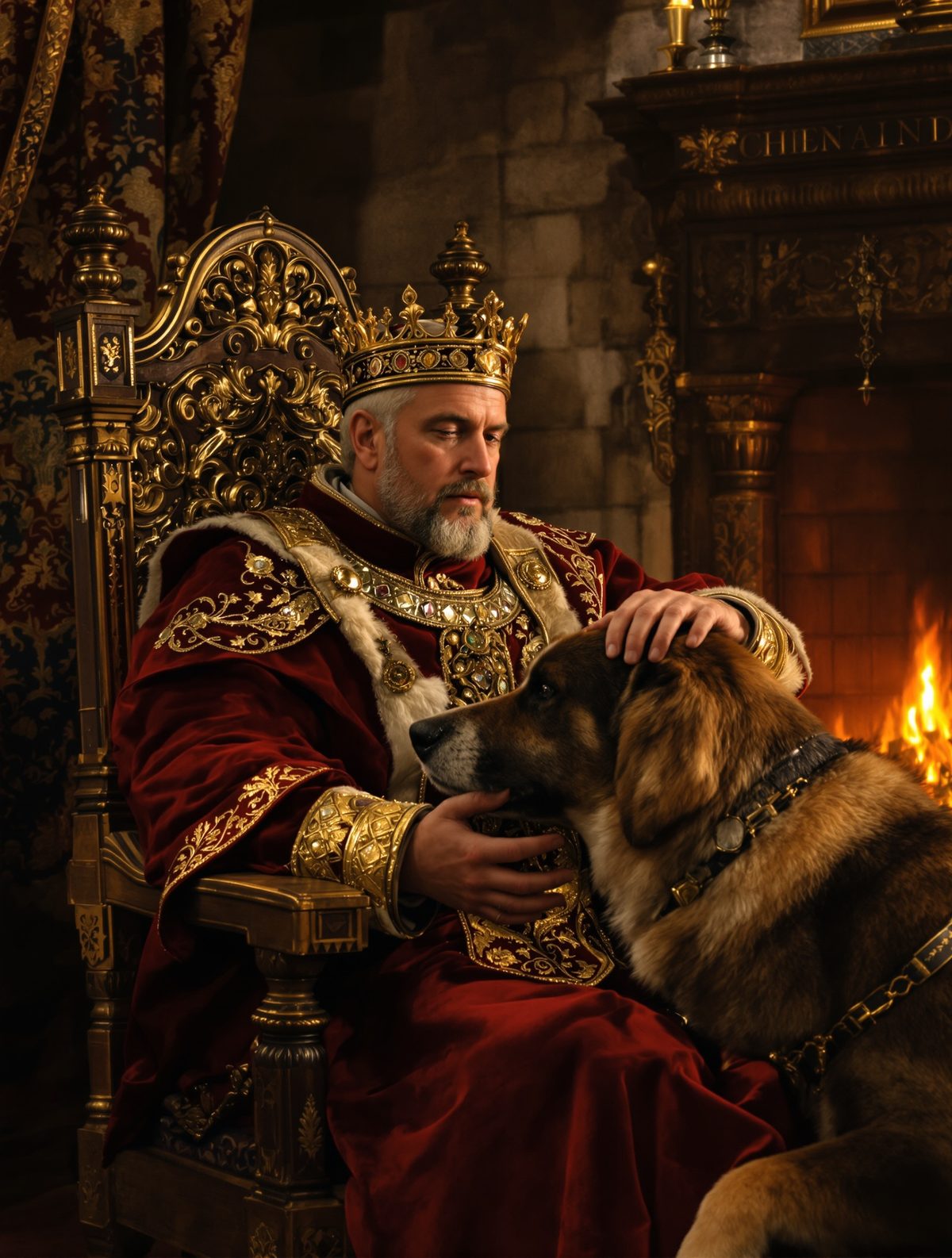
In the flickering candlelight of Newark Castle on Christmas Eve 1216, England's most reviled monarch lay dying, abandoned by nobles and despised by his subjects. Yet beside King John's bed, unwavering in devotion, sat a single companion who had never questioned his authority or plotted his downfall—his beloved hunting hound. While barons celebrated the prospect of his demise and chroniclers prepared to write his legacy in the darkest ink, this loyal creature remained, offering the kind of unconditional loyalty that had eluded John throughout his tumultuous reign.
The Loneliest Crown in Christendom
By December 1216, King John had earned the dubious distinction of being perhaps the most hated ruler in English history. The man who had lost Normandy to the French, been excommunicated by Pope Innocent III, and been forced to sign the humiliating Magna Carta just eighteen months earlier, found himself facing not just physical death but complete political isolation.
The Second Barons' War had torn England apart, with rebel nobles inviting Prince Louis of France to claim the English throne. John's own supporters had dwindled to a handful of loyal mercenaries and foreign knights. Even his own family had distanced themselves from his cause. As contemporary chronicler Matthew Paris wrote, John had become "foul as it is, fouler than itself"—a king so universally despised that his approaching death was met with barely concealed relief across his realm.
Yet in this atmosphere of complete abandonment, one relationship remained untainted by the poison of politics and ambition. John's hunting dog—whose name has been lost to history but whose loyalty became legendary—had followed the king throughout his final, desperate campaign across England. While earls and bishops fled his court, this faithful hound remained constantly at his side.
A King's Last Friend
Medieval chronicles, typically focused on battles and betrayals, rarely recorded the personal details of royal relationships with animals. However, several contemporary sources make unusual mention of John's devotion to his hunting hound during his final months. The dog had accompanied him on his disastrous march through the Wash, where much of the royal treasure was lost to the incoming tide—a disaster that many saw as divine judgment upon the king.
As John's health deteriorated—possibly from dysentery, though some suspected poison—witnesses noted that the dog refused to leave his master's chamber. The animal seemingly sensed what courtiers whispered in corridors: that England's nightmare king was approaching his end. During those long, feverish nights at Newark Castle, when John was tormented by visions of the monks he had wronged and the subjects he had oppressed, his hound provided the only comfort available.
The irony was not lost on contemporary observers. Here was a king who had inspired such hatred that his own barons had invited a foreign prince to replace him, yet he could still command the absolute devotion of this simple creature. The dog asked nothing of John—no grants of land, no titles, no political favors. It simply loved its master with the pure, uncomplicated loyalty that had proven so elusive among humans.
The Christmas Eve Vigil
As Christmas Eve 1216 descended upon Newark Castle, King John knew he was dying. The Abbot of Croxton had been summoned to hear his final confession and administer last rites. In a remarkable scene that several chroniclers recorded, even some of John's enemies who witnessed his final hours were moved to tears—not by his passing, but by the sight of his faithful hound maintaining its vigil.
The dog had positioned itself beside the royal bed and refused all attempts by servants to move it. When food was brought, the animal barely ate. When called away for exercise, it would return immediately to its post. This unwavering devotion in the face of approaching loss struck a chord even with hardened medieval warriors who had seen countless deaths on battlefields.
Medieval society understood the bonds between hunters and their hounds—these relationships were practical, built on mutual dependence during the chase. But what observers witnessed at Newark transcended mere utility. This was love in its purest form, unmarked by the calculations and betrayals that had defined John's human relationships.
According to the Barnwell Chronicle, when John briefly rallied on Christmas Eve—sitting up in bed and speaking more clearly than he had in days—his first concern was for his faithful companion. He reportedly spent precious energy ensuring the dog would be cared for after his death, asking specifically that it not be abandoned or mistreated.
A Final Farewell
King John died in the early hours of October 19, 1216 (the Christmas Eve scene appears to have been one of several rallies during his final illness). Contemporary accounts describe how his hunting dog remained beside the body long after the king had drawn his last breath. Servants eventually had to carry the animal away, as it refused to leave its master's side.
The image of this loyal creature mourning beside the corpse of England's most hated king created an indelible impression on witnesses. Here was grief in its purest form—uncomplicated by political calculation or social advantage. The dog mourned not King John the tyrant, but simply the man who had been its companion and friend.
What happened to John's faithful hound after his death remains unknown. Medieval records rarely tracked such details, focusing instead on the succession of nine-year-old Henry III and the regency that would follow. But the story of their final Christmas Eve together entered the folklore surrounding John's reign, a rare moment of genuine emotion in a life otherwise remembered for its cruelties and failures.
Legacy of Loyalty
The story of King John and his faithful hound offers a uniquely human glimpse into one of history's most vilified reigns. It reminds us that even the most flawed rulers were complex individuals capable of inspiring genuine affection—even if only from a loyal dog. In our modern age, when the British Royal Family's relationships with their beloved corgis, spaniels, and horses capture public imagination, we can trace a direct line back to this medieval Christmas Eve scene.
Perhaps most poignantly, this tale illustrates how authentic loyalty—the kind free from ulterior motive—remains as rare and precious today as it was eight centuries ago. While King John's political legacy remains deservedly dark, his final reconciliation with his most faithful friend suggests that even in history's darkest corners, love can still flicker like candlelight against the approaching darkness.