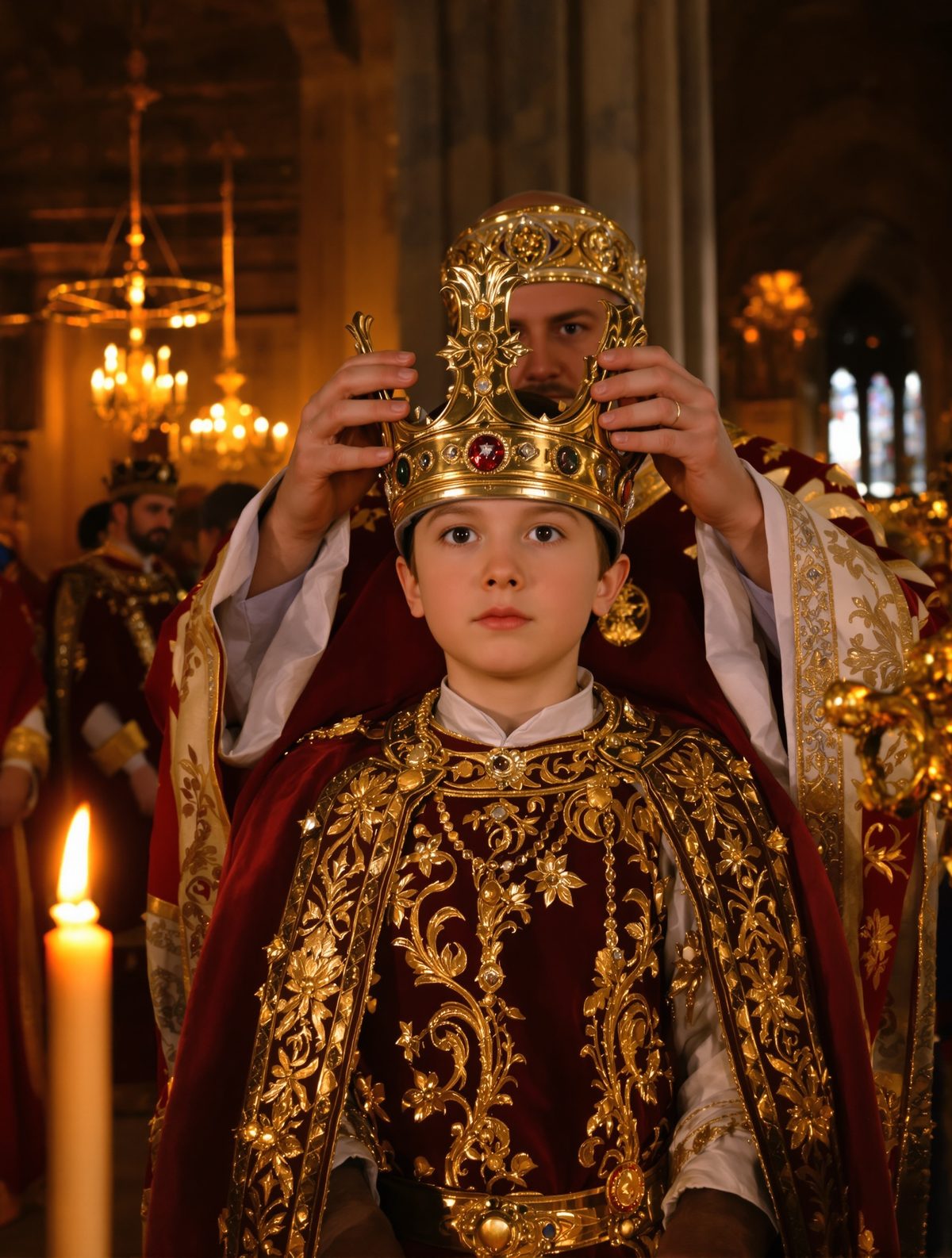
Picture the most important moment of your life, and now imagine you can't see any of it. That was the reality for nine-year-old Henry Plantagenet on 28 October 1216, as he stood in Gloucester Cathedral with England's ancient coronation crown sliding down over his frightened eyes. The boy who would become King Henry III couldn't glimpse a single face in the congregation as the Archbishop of Winchester struggled to keep the oversized symbol of royal authority from tumbling to the floor during one of the most precarious coronations in English history.
A Kingdom in Crisis
When Henry's father, King John, died suddenly at Newark Castle on 19 October 1216, England teetered on the brink of collapse. The realm was torn apart by civil war, with rebel barons having invited the French prince Louis to claim the throne. London was in enemy hands, and much of the country's nobility had turned against the Plantagenet dynasty. Into this maelstrom stepped a child barely old enough to understand the weight of kingship, let alone bear it.
The boy's supporters faced an impossible situation. Royal protocol demanded a proper coronation, yet they possessed neither the traditional regalia nor access to Westminster Abbey, the customary venue for such sacred ceremonies. Most critically, they lacked St. Edward's Crown – the ancient symbol of English kingship – which remained locked away in rebel-controlled London. The makeshift coronation would have to proceed with whatever could be hastily assembled.
Young Henry's regents, led by the formidable William Marshal – often called "the greatest knight who ever lived" – understood that legitimacy hung by the finest of threads. A botched coronation could spell doom for both the boy and the dynasty. Yet delay was equally perilous, as every passing day allowed Louis to strengthen his claim and rally more supporters to the French cause.
An Improvised Royal Ceremony
Gloucester Cathedral, while magnificent, had never witnessed a royal coronation. The hastily arranged ceremony bore little resemblance to the elaborate pageantry traditionally associated with English kingship. Instead of the usual procession through London's streets with cheering crowds, young Henry arrived at a provincial cathedral surrounded by a small band of loyal nobles, many still wearing their battle armour beneath hastily donned ceremonial robes.
The Archbishop of Canterbury, Stephen Langton, remained conspicuously absent – his loyalties uncertain in these turbulent times. Instead, Peter des Roches, Bishop of Winchester, stepped forward to perform the sacred rites. Des Roches, a battle-hardened cleric who had served as both diplomat and warrior, understood the gravity of the moment. The future of the Plantagenet line rested in his hands as much as it did in those of the trembling child before him.
The substitute crown – likely a circlet belonging to Henry's mother, Queen Isabella, or perhaps borrowed from a noble family – proved comically oversized for the nine-year-old's head. Contemporary accounts suggest that des Roches was forced to physically support the crown throughout much of the ceremony, creating the surreal image of England's newest monarch being quite literally propped up by the Church.
The Boy Behind the Crown
Henry himself cut a pitiable figure during these proceedings. Born in 1207, he had spent his short life shuttled between royal residences as his father's reign descended into chaos. The boy had witnessed the humiliation of Magna Carta, the loss of Normandy, and the gradual erosion of royal authority. Now, thrust into a role he could scarcely comprehend, he stood as the living embodiment of a dynasty fighting for survival.
Contemporary chroniclers noted the child's composure despite his obvious terror. Matthew Paris, though writing somewhat later, described how the young king maintained his dignity even as the oversized crown repeatedly slipped down over his eyes. The image of Henry peering out from beneath the golden circlet, trying to follow the ancient Latin words of the coronation oath, captures both the pathos and the determination that would characterise his long reign.
The ceremony's most poignant moment came when Henry was required to take the coronation oath. His young voice, barely audible above the cathedral's echoing spaces, promised to uphold the laws and customs of England – including, remarkably, the provisions of Magna Carta that his father had so bitterly opposed. In that moment, the boy king committed himself to a very different style of monarchy than John had practised.
Sacred Kingship in Makeshift Circumstances
Despite its improvised nature, Henry's coronation retained the essential elements that made English kingship sacred rather than merely political. The anointing with holy oil – probably the most spiritually significant moment of any coronation – proceeded as it had for centuries. Des Roches carefully applied the chrism to Henry's hands, breast, and head, transforming a frightened child into God's anointed representative on earth.
The symbolism was not lost on those present. Even with a substitute crown and a provincial setting, the ancient ritual retained its power to legitimise royal authority. The nobles who knelt before their boy king understood that they were witnessing not just a political necessity, but a sacred transformation. Henry might have looked more like a child playing dress-up than a monarch, but the ceremony itself carried the weight of centuries.
The regalia used that day – whatever its origins – became invested with royal significance through its use. This reflected a crucial principle of English kingship: the crown makes the king as much as the king makes the crown. Henry's oversized circlet, held steady by episcopal hands, carried the same authority as St. Edward's Crown gathering dust in London's Treasury.
Legacy of an Unconventional Beginning
Henry III would go on to rule for fifty-six years, making him one of England's longest-reigning monarchs. His reign, marked by artistic patronage, architectural achievement, and gradual political reform, bore little resemblance to the chaos surrounding his coronation. Yet that makeshift ceremony in Gloucester Cathedral established patterns that would define his entire kingship.
The young king who couldn't see past his crown would grow into a monarch obsessed with royal dignity and ceremonial splendour. Henry's later coronations – for he was crowned again at Westminster Abbey in 1220 with proper regalia – displayed a magnificence that perhaps compensated for the humble circumstances of his first anointing. His rebuilding of Westminster Abbey created the spectacular Gothic setting where English monarchs are still crowned today.
Most significantly, Henry's acceptance of Magna Carta during his coronation oath established constitutional monarchy as an English tradition rather than an aberration. The boy who trembled beneath an oversized crown would spend his reign learning to balance royal prerogative with baronial rights – a lesson that began in those frightening moments at Gloucester.
As we watch modern royal ceremonies unfold with flawless precision and centuries-old regalia, it's worth remembering that English kingship has always been as much about adaptability as tradition. A nine-year-old boy, a substitute crown, and a provincial cathedral once saved a dynasty and shaped a nation. Sometimes the most profound moments in royal history happen not in Westminster's grandeur, but in the improvised ceremonies that reveal monarchy's true essence: the sacred bond between ruler and realm that transcends any crown, however perfectly it might fit.