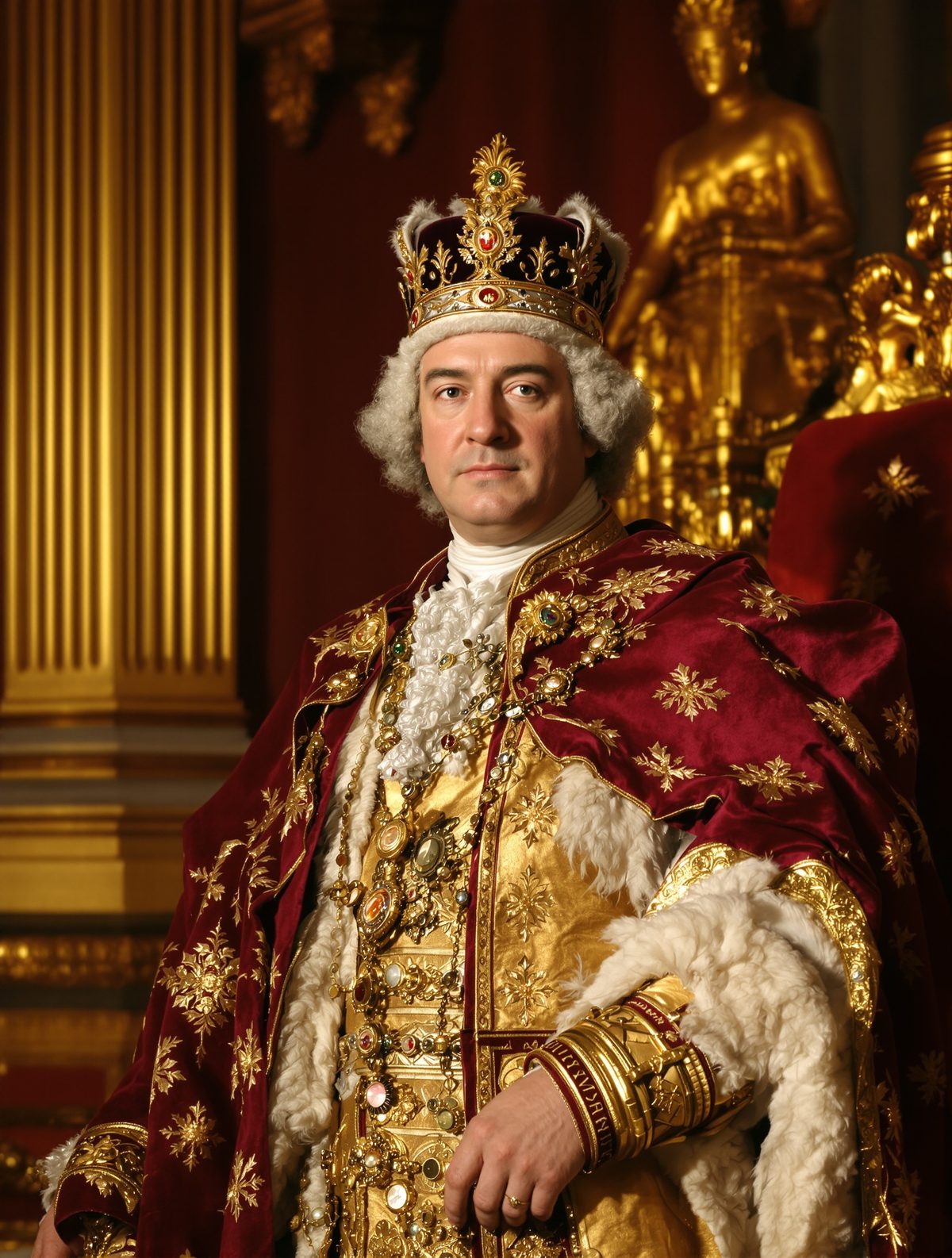
Picture this: you're a distinguished minister in early Georgian Britain, summoned to discuss matters of state with your new sovereign. You bow respectfully, await his royal pronouncement, and then... struggle to decipher what sounds like a tourist asking for directions to Westminster Abbey. Welcome to the wonderfully awkward world of King George I, whose thick German accent turned royal audiences into exercises in diplomatic confusion and polite nodding.
When the Elector of Hanover sailed across the North Sea in 1714 to claim his unexpected inheritance as King of Great Britain, he brought with him a treasure trove of German customs, Lutheran sensibilities, and a command of English so limited that courtiers began brushing up on their French and German with unprecedented urgency. The language barrier between monarch and ministers created some of the most charmingly chaotic moments in British royal history.
A Most Unlikely King
George Ludwig of Brunswick-Lüneburg had never imagined he would one day rule Britain. As a relatively minor German prince, his world revolved around the elegant court of Hanover, where conversations flowed in melodious German and sophisticated French. English was simply unnecessary—until the Act of Settlement of 1701 and a series of unfortunate deaths among the Stuart heirs suddenly made this Kurfürst the Protestant heir to the British throne.
At fifty-four, George found himself thrust into an entirely foreign world. The man who had spent decades managing the intricate politics of the Holy Roman Empire now had to navigate the equally complex but utterly alien landscape of British parliamentary democracy. The language barrier was just the beginning of his challenges, but it certainly made for memorable first impressions.
Contemporary accounts describe George's early attempts at English as valiant but mystifying. His heavy German accent, combined with unfamiliar grammatical structures, created a unique royal dialect that required considerable patience from his listeners. Imagine the scene: the King attempting to discuss taxation policy while his pronunciation turned "parliament" into something resembling "barliament" and "treasury" into an unrecognizable Germanic construction.
Court Chaos and Creative Communication
The royal court quickly adapted to their linguistically challenged sovereign with the sort of creative problem-solving that has long characterized British ingenuity. Privy Council meetings became elaborate performances of international diplomacy, with ministers switching between languages mid-sentence and the King responding in whichever tongue seemed most appropriate for the moment.
French became the court's unofficial language of serious business. George was fluent in the diplomatic tongue of European courts, and many of his ministers possessed at least functional French from their gentleman's education. Important state papers were often translated, and crucial conversations conducted in the language of Versailles rather than the language of Shakespeare.
The King's German entourage, who had followed him from Hanover, served as unofficial interpreters during particularly crucial moments. These trusted advisors found themselves wielding unusual influence simply by virtue of their multilingual abilities. The Duchess of Kendal and other German courtiers became essential bridges between the Hanoverian king and his British subjects.
What makes this linguistic confusion particularly endearing is how everyone involved seemed determined to make it work. There's something quintessentially British about the polite pretense that everything was proceeding normally while the King of England communicated in a delightful mixture of broken English, fluent French, and the occasional frustrated German exclamation.
The Royal Learning Curve
To his credit, George I did make genuine efforts to master his new kingdom's language. Palace records suggest he employed English tutors and gradually improved his comprehension, if not his pronunciation. His accent remained memorably thick throughout his thirteen-year reign, but his vocabulary expanded considerably from those early days when he reportedly knew little more than basic pleasantries.
The King's language struggles created unexpected moments of humanity in what was otherwise a rather formal court. Stories survive of George asking courtiers to repeat themselves, of diplomatic visitors adjusting their own speech to accommodate their host's linguistic limitations, and of the general atmosphere of patient mutual incomprehension that somehow never quite erupted into genuine diplomatic incident.
His ministers, meanwhile, became remarkably skilled at interpreting royal intentions through context, gesture, and the occasional triumphant moment when the King's meaning broke through clearly. Lord Townshend and Robert Walpole both developed reputations for their ability to communicate effectively with their German sovereign, a skill that undoubtedly contributed to their political success during this period.
A Kingdom United Despite the Language Barrier
Perhaps most remarkably, George I's linguistic limitations never seriously impeded his governance of Britain. The early Georgian court developed a remarkably efficient system of multilingual administration that kept the kingdom running smoothly despite the communication challenges at its very heart. Ministers learned to present complex issues in simplified terms, while the King relied heavily on written summaries and trusted interpreters for nuanced policy discussions.
The language barrier may have actually contributed to the development of Britain's constitutional monarchy. George's inability to engage in the sort of subtle political maneuvering that required perfect command of English meant he necessarily delegated more authority to his ministers. This practical necessity helped establish precedents for ministerial responsibility that would influence British governance for centuries to come.
Foreign diplomats found the linguistic diversity of George's court oddly reassuring. Here was a monarch who understood that effective governance sometimes required creative communication, that dignity didn't depend entirely on eloquence, and that goodwill could bridge even significant language gaps.
Legacy of a Linguistically Challenged King
George I's thick German accent and creative approach to English became part of his enduring charm rather than a source of lasting embarrassment. His reign proved that successful monarchy depended more on character, judgment, and the ability to work effectively with skilled ministers than on rhetorical brilliance or perfect elocution.
The early Georgian compromise—French for diplomacy, German for intimate conversation, and gradually improving English for public appearances—created a uniquely cosmopolitan court that reflected Britain's growing international connections. George's linguistic struggles humanized the monarchy in unexpected ways, showing that even kings could be charmingly fallible.
Looking back from our modern perspective, when the Royal Family effortlessly switches between languages during international visits and the current monarch speaks fluent French, it's delightful to remember that royal multilingualism once involved such endearing confusion. George I's thick German accent and tourist-like English remind us that the British monarchy has always been beautifully, imperfectly human—and that sometimes the most memorable rulers are those who triumph not despite their limitations, but because they faced them with such determined good humor.