In the gilded corridors of Kensington Palace during the 1830s, a remarkable battle of wits was unfolding between a determined young princess and the adults who sought to control every aspect of her life. Princess Victoria, barely eleven years old and still years away from ascending to the throne, had devised the perfect weapon against constant surveillance: her very own secret alphabet that would keep her most private thoughts safely hidden from her overbearing mother and ever-watchful governess.
The Kensington System: A Gilded Cage
To understand why young Victoria felt compelled to create such an elaborate system of secrecy, we must first glimpse into the suffocating world of the Kensington System that governed her every waking moment. Devised by her mother, the Duchess of Kent, and her ambitious comptroller Sir John Conroy, this rigid protocol was designed to isolate Victoria from outside influences and maintain absolute control over the future queen.
Under this system, Victoria was never left alone. She couldn't walk downstairs without holding someone's hand, she slept in her mother's bedroom, and every conversation was monitored. Her education, her friendships, even her leisure reading—all were carefully curated and supervised. The Duchess of Kent, herself feeling vulnerable as a foreign-born widow in the British court, believed that maintaining such tight control would protect both her daughter's reputation and her own position as the power behind the future throne.
For a spirited and intelligent child like Victoria, these restrictions felt increasingly oppressive. Her governess, Baroness Lehzen, though genuinely fond of her charge, was still an adult authority figure who reported on Victoria's progress and behaviour. Even Victoria's beloved diary entries—which would later become a lifelong habit spanning over sixty years of her reign—were subject to inspection and scrutiny.
A Princess's Ingenious Rebellion
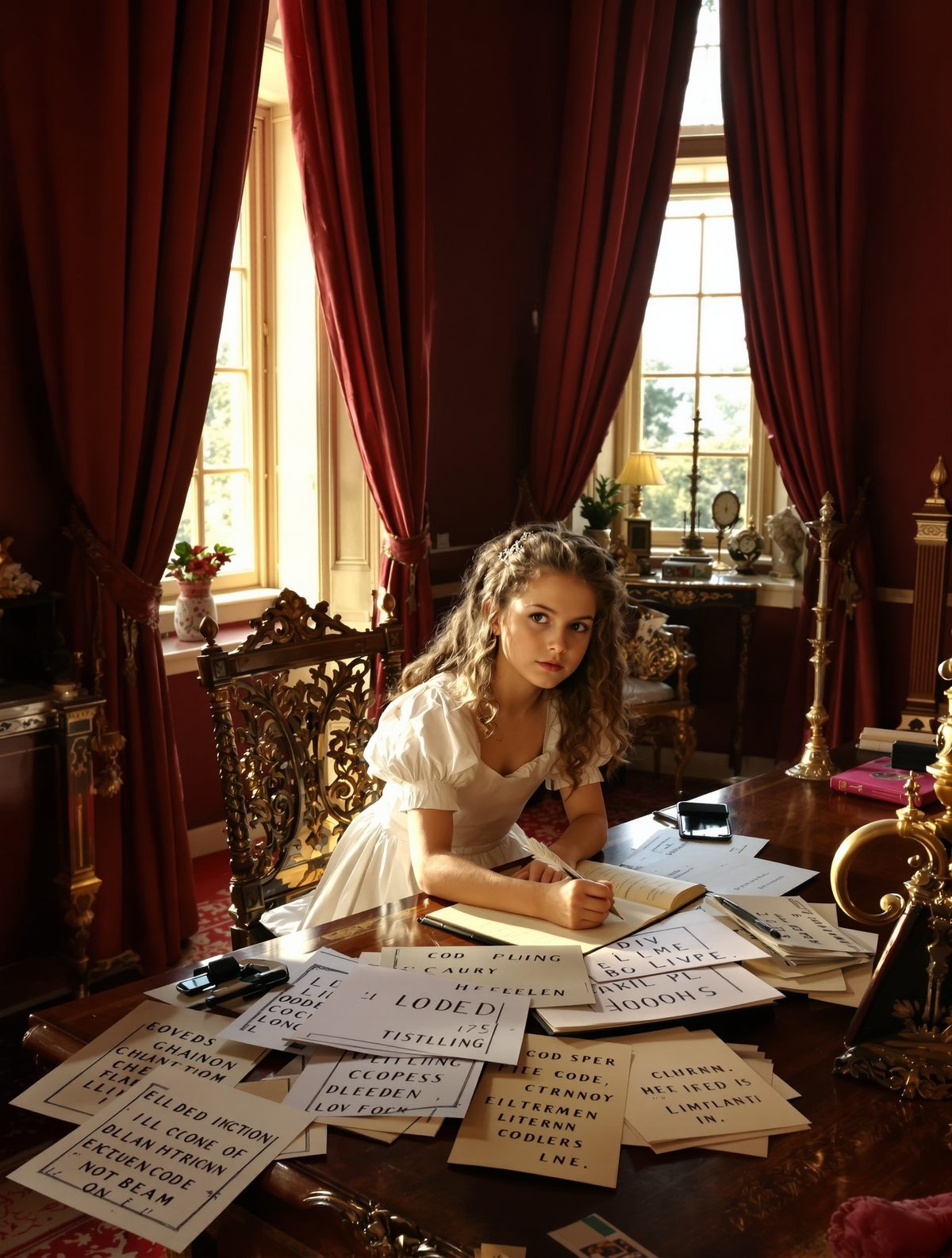
It was within this atmosphere of constant supervision that Victoria's creative mind conceived of a brilliant solution. Rather than rebel openly—which would have been futile and likely resulted in even tighter restrictions—she chose a path of intellectual subterfuge. The young princess began developing her own coded alphabet, a cipher that would allow her to record her genuine thoughts and feelings without fear of discovery.
The secret alphabet was remarkably sophisticated for a child's invention. Victoria assigned different symbols to represent letters of the English alphabet, creating what was essentially a substitution cipher. What made her system particularly clever was its apparent randomness—the symbols bore no obvious relationship to the letters they represented, making it nearly impossible for casual observers to detect patterns or crack the code through simple observation.
Victoria employed this secret writing system primarily in her diary, interspersing coded passages within her regular entries. To any adult who might glance at the pages, these sections would appear as mere doodles or decorative flourishes—perhaps the idle scribblings of a young girl amusing herself. In reality, they contained her most honest assessments of the people around her, her frustrations with the restrictions placed upon her, and her dreams for a different kind of future.
The Power of Hidden Thoughts
What makes Victoria's secret alphabet so fascinating isn't just the ingenuity of its creation, but what it reveals about the future queen's character and the psychological pressures she faced as a child. The very act of developing this code demonstrates remarkable intellectual resilience and an early understanding of the power of private thought in maintaining personal autonomy.
Through her coded writings, Victoria could express doubts about her mother's advisers, critique the endless lessons and restrictions that filled her days, and explore her own identity separate from the role being prepared for her. She could be critical, frustrated, hopeful, or simply silly—all emotions that were difficult to express freely under the watchful eyes of the Kensington System.
The psychological relief this secret writing must have provided cannot be overstated. For a child growing up under such intense scrutiny, having even a small space that remained entirely her own would have been precious beyond measure. Her coded diary entries became a form of mental sanctuary, a place where the future queen could simply be Victoria—a bright, curious, occasionally rebellious young girl trying to make sense of her extraordinary circumstances.
Remarkably, despite the best efforts of her handlers to monitor every aspect of her life, Victoria's secret alphabet remained undetected. Neither the formidable Duchess of Kent nor the observant Baroness Lehzen ever suspected that those innocent-looking symbols contained such revealing insights into Victoria's inner world.
A Queen's Foundation in Independence
The success of Victoria's secret alphabet had implications that extended far beyond childhood mischief. This early exercise in intellectual independence helped forge the strong-willed character that would later define her sixty-three-year reign. The same determination and cleverness that enabled an eleven-year-old to outwit her guardians would later help her navigate the complex political challenges of ruling an empire.
When Victoria finally ascended to the throne at eighteen, one of her first acts was to assert her independence from the Kensington System that had dominated her childhood. She moved her mother out of her private quarters, dismissed Sir John Conroy, and began making her own decisions about court protocol and daily life. The confidence to take such decisive action surely had its roots in those early years when she learned that she could maintain her own thoughts and plans, even when surrounded by those who sought to control her.
Her secret alphabet also foreshadowed Victoria's lifelong commitment to private writing. Throughout her reign, she maintained extensive journals and correspondence, often writing with remarkable candour about her experiences, relationships, and the burdens of monarchy. While she eventually abandoned the coded symbols of her youth, she never lost her understanding of writing as a means of processing complex emotions and maintaining personal authenticity amidst public duties.
Legacy of a Royal Code-Breaker
Looking back across nearly two centuries, Princess Victoria's secret alphabet offers us a uniquely intimate glimpse into the making of one of Britain's greatest monarchs. It reminds us that even those born to extraordinary circumstances face very human challenges—the need for privacy, the desire for self-expression, and the universal childhood struggle to carve out personal space within adult-imposed boundaries.
The story also speaks to the remarkable adaptability and intelligence that would characterize Victoria throughout her life. Faced with a problem that seemed insurmountable—constant surveillance by well-meaning but restrictive adults—she didn't despair or simply accept her circumstances. Instead, she innovated, creating an elegant solution that served her needs while avoiding direct confrontation.
Today's royals, growing up in an age of social media and unprecedented public scrutiny, might well appreciate their ancestor's ingenious approach to maintaining privacy. While modern princes and princesses face different challenges than those of the 1830s, the fundamental human need for personal space and authentic self-expression remains unchanged. Victoria's secret alphabet stands as a testament to the power of quiet determination and creative thinking—qualities that would serve her well as she transformed from a restricted young princess into the confident monarch who would give her name to an entire era.