While London slept during the darkest days of World War I, one royal princess was breaking every rule of palace protocol. Night after night, Princess Patricia of Connaught disappeared from her quarters, armed with nothing but fabric scraps and fierce determination. As the city lay shrouded in blackout curtains and the distant rumble of war echoed across the Channel, this remarkable young woman was quietly orchestrating her own secret mission of mercy—one that would save countless lives on the battlefields of France.
A Princess Unlike Any Other
Princess Patricia of Connaught was never destined to be a conventional royal. Born in 1886 as the youngest daughter of Prince Arthur, Duke of Connaught—Queen Victoria's third son—she possessed an independent spirit that would define her entire life. Unlike her cousins who lived in gilded cages of endless ceremony, Patricia had spent much of her childhood following her father to his military postings across the Empire, from India to Canada.
This unconventional upbringing shaped Patricia into something rare in the royal family: a princess who understood hardship firsthand. She had witnessed poverty in the slums of Dublin and seen the harsh realities of military life in remote outposts. When war erupted in 1914, while other royals organized charity galas and posed for patriotic photographs, Patricia knew she had to do something more tangible—something real.
The princess had already made headlines by doing the unthinkable: she had renounced her royal title and allowance to marry a commoner, Commander Alexander Ramsay, in 1919. But even before this dramatic gesture, she was quietly revolutionizing what it meant to serve as a member of the royal family.
The Secret Mission Begins
In the autumn of 1915, as casualty reports from the Western Front grew increasingly grim, Patricia began her clandestine operation. The Princess Patricia's Canadian Light Infantry—a regiment that bore her name and for which she had personally designed the regimental badge—was suffering devastating losses in the trenches. Reports filtering back to London spoke of severe shortages: not enough bandages, insufficient medical supplies, and soldiers making do with torn shirts and dirty rags to tend their wounds.
The official channels were overwhelmed. The War Office, despite its best efforts, couldn't keep pace with the voracious demand for medical supplies. Patricia watched in frustration as bureaucracy delayed shipments while men bled to death in muddy trenches an ocean away. That's when she decided to take matters into her own hands.
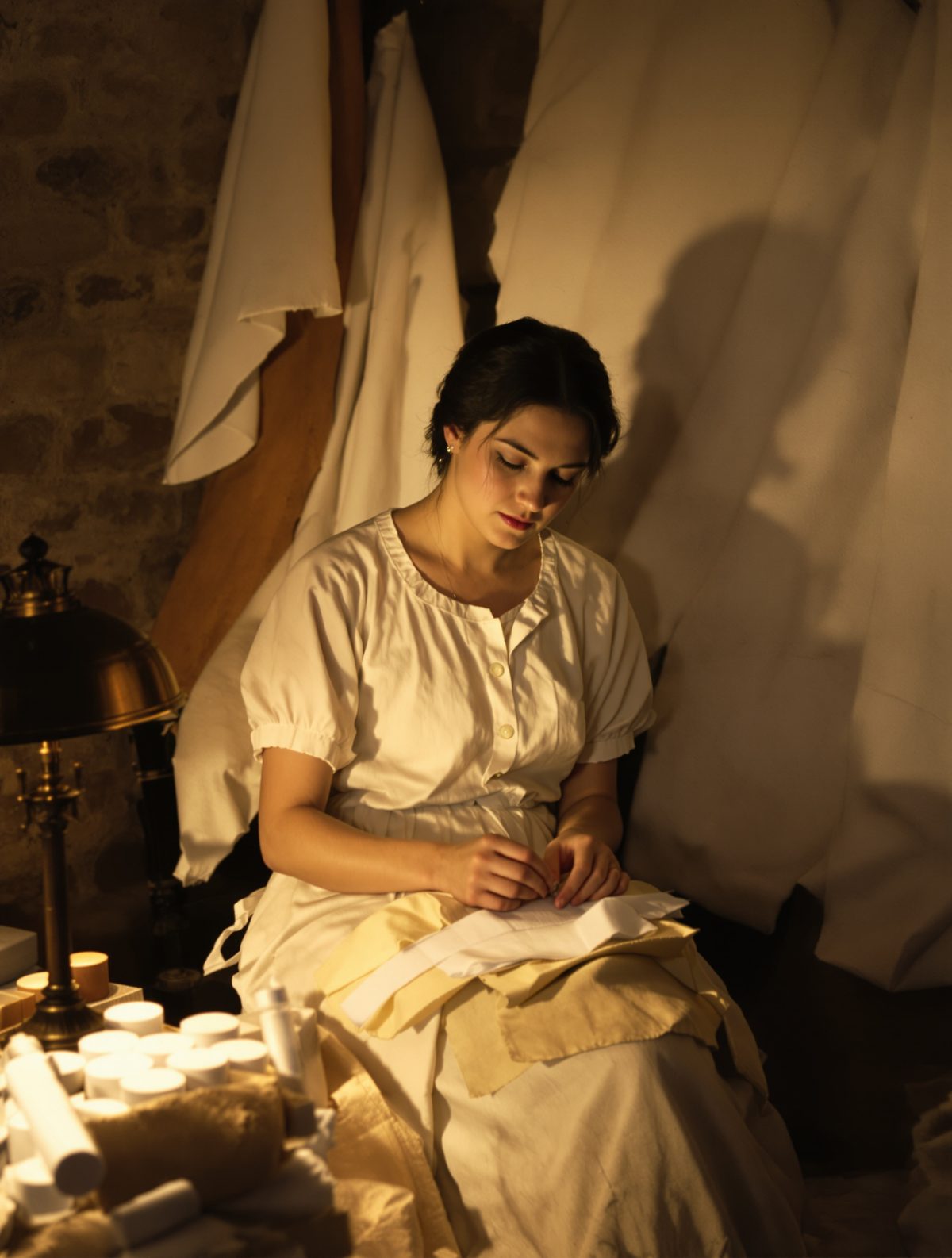
Every evening after formal dinners and royal obligations concluded, Patricia would slip away from her official duties. She had identified a forgotten storage room in the palace basement—a dusty, dimly lit space that had once housed Victorian-era linens. Here, surrounded by the musty scent of old fabric and the distant creaking of the ancient building above, she set up her secret workshop.
The princess had "requisitioned" supplies with the skill of a master strategist. Unused bedsheets disappeared from palace linen closets. Fabric scraps from dressmakers were mysteriously diverted. Even her own personal clothing became casualties in her private war effort. Patricia had learned to sew as a child—a skill considered appropriate for young ladies—but now she deployed those delicate fingers with military precision, cutting and stitching with the urgency of a field surgeon.
Midnight Manufacturing
Working by the light of oil lamps to avoid detection, Patricia transformed luxury palace linens into life-saving medical supplies. She carefully cut fine Irish linen into precise bandage strips, her royal training in needlework proving invaluable as she created neat, sterile packages. Palace tablecloths became surgical dressings. Silk undergarments were repurposed into delicate gauze for treating facial wounds.
The princess didn't work alone in her midnight mission. She had quietly recruited a small network of palace staff—a lady's maid here, a loyal footman there—who understood the gravity of her work and the need for absolute secrecy. These unlikely conspirators helped Patricia smuggle materials and provided cover when her nocturnal activities might have been discovered.
The physical toll was enormous. Patricia's hands, once soft and pampered, became rough and stained from hours of cutting and sewing. She developed a permanent stoop from hunching over her work in the poorly lit basement. Dark circles appeared under her eyes as she sacrificed sleep night after night, sometimes working until dawn before slipping back to her chambers just as the palace stirred to life.
But perhaps most remarkably, Patricia had solved the logistics challenge of getting her supplies to the front lines. She had established a covert pipeline through military contacts and Canadian officials who, while they might have suspected the unusual source of these perfectly crafted medical supplies, asked no questions. Packages marked only with "From a friend" began appearing regularly at field hospitals treating Canadian forces.
The Human Cost of War
What drove this extraordinary royal to such lengths? Letters and diary entries from the period reveal a princess tormented by the disconnect between her privileged life and the suffering of "her" soldiers. Patricia had taken her role as patron of the Canadian Light Infantry seriously—more seriously, perhaps, than anyone had expected. She corresponded regularly with officers, memorized the names of fallen soldiers, and genuinely grieved each loss as if they were family.
The princess understood something that escaped many of her contemporaries: true service wasn't about appearing at charity events or lending one's name to fundraising campaigns. It was about personal sacrifice, about giving something of yourself when others needed it most. While London society ladies organized knitting circles to produce socks for soldiers, Patricia was single-handedly operating what amounted to a secret medical supply factory.
Medical officers at the front began to notice the appearance of unusually high-quality bandages and dressings. The craftsmanship was exceptional—far superior to standard military-issue supplies. The materials were luxurious, the construction meticulous. Some suspected wealthy benefactors were contributing fine materials, but none guessed that these life-saving supplies were being produced in a palace basement by a princess working in secret.
A Legacy Beyond Protocol
Patricia's midnight sewing circle continued throughout 1915 and well into 1916, until her activities were eventually discovered by palace officials. Rather than face scandal, the story was quietly covered up, and Patricia was redirected toward more "appropriate" forms of war service. The official records remain frustratingly sparse—a testament to how effectively the palace machinery could protect royal reputations when necessary.
Yet the impact of her work lived on in ways she never knew. Decades later, veterans of the Princess Patricia's Canadian Light Infantry would speak of mysteriously excellent medical supplies that seemed to appear just when they were most desperately needed. They never learned that their survival was owed, in part, to a rebellious princess who valued their lives more than royal protocol.
Princess Patricia's story challenges our assumptions about royal duty and service. In an age when the monarchy faces constant questions about relevance and purpose, her midnight vigil in that palace basement offers a powerful reminder of what authentic service looks like. It's not about public appearances or ceremonial duties—it's about the willingness to sacrifice comfort, protocol, and even reputation for the sake of others.
Today, as we witness modern royals breaking traditional molds and seeking more meaningful ways to serve, Princess Patricia's legacy feels remarkably contemporary. Her secret sewing saved lives, but perhaps more importantly, it saved the honor of the crown itself—proving that true nobility lies not in titles or ceremony, but in the courage to do what's right, even when no one is watching.