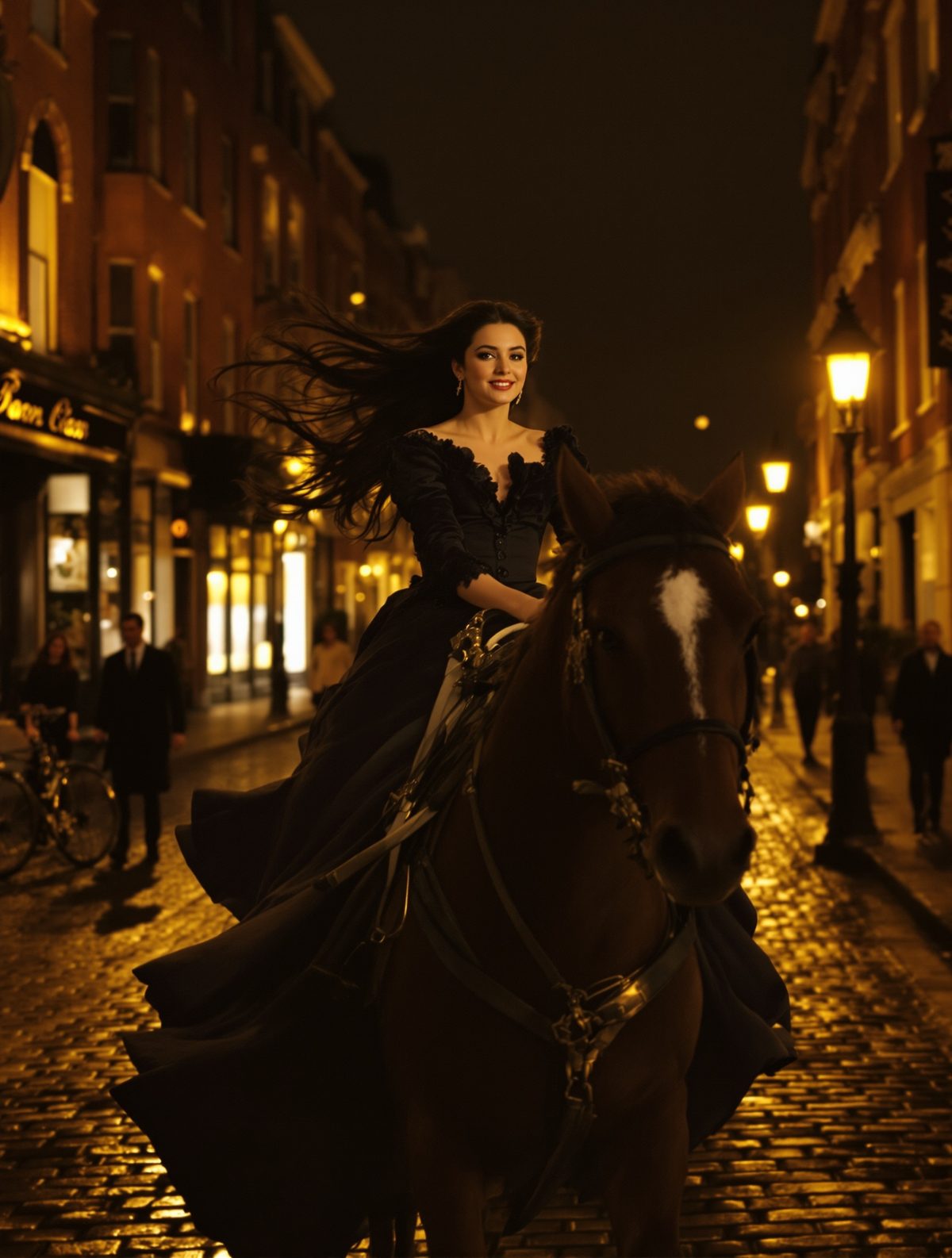
The gaslight flickered against the cobblestones as a lone figure emerged from the shadows of Kensington Palace. It was three o'clock in the morning, and while Queen Victoria lay sleeping in her chambers, her fourth daughter was about to embark on one of the most dangerous and exhilarating adventures of her privileged life. Princess Louise Caroline Alberta, born in 1848, would mount her horse bareback and disappear into the labyrinthine streets of London, leaving behind the suffocating protocols of royal life for a few precious hours of absolute freedom.
A Princess Unlike Any Other
Princess Louise was never destined to be a conventional royal daughter. From childhood, she displayed an independent spirit that both delighted and exasperated Queen Victoria. While her sisters dutifully followed the rigid expectations of Victorian royal womanhood, Louise carved her own path with remarkable determination. She was the first daughter of a British sovereign to attend art school, the first to marry outside European royalty, and certainly the first to risk life and limb galloping through London's empty streets in the dead of night.
The 1880s found Louise at the height of her rebellious phase. Married to the Marquess of Lorne in 1871, she had already established herself as an accomplished sculptor and painter—pursuits that required her to move in artistic circles far removed from the stuffy drawing rooms of the aristocracy. Her marriage, while politically advantageous, was reportedly loveless, and Louise found herself increasingly restless within the confines of her prescribed role.
The palace staff at Kensington had grown accustomed to the Princess's unconventional ways, but even they were astonished when she began her nocturnal escapades. Louise's midnight rides represented more than mere rebellion—they were a desperate grasp for the authentic experience that her royal birth had denied her.
The Secret Conspiracy of Silence
What made Louise's adventures possible was an extraordinary conspiracy of loyalty among the palace guards and stable hands. These men, bound by centuries of royal service tradition, found themselves in the unprecedented position of enabling a princess's dangerous midnight adventures while maintaining absolute secrecy from the Queen herself.
The guards who witnessed Louise's departures understood that discovery would mean not only their dismissal but likely the end of the Princess's cherished freedom. They had observed her transformation from a restless, sometimes melancholy figure during the day to a woman alive with purpose as she prepared for her rides. The stable hands, equally complicit, ensured her horse was ready and remained silent about the unusual wear patterns that might have betrayed the nocturnal expeditions.
This web of secrecy extended beyond mere service loyalty. Many of the palace staff had grown genuinely fond of Louise, recognizing in her a kindred spirit trapped by circumstances of birth. Her treatment of servants was notably egalitarian for the era, and she showed genuine interest in their lives and families—a rarity among the royals of the time.
The risks were extraordinary, not just for Louise but for everyone involved. Victorian London after midnight was no place for a solitary woman, even one capable of handling a horse with Louise's skill. The streets teemed with dangers that ranged from common criminals to the desperately poor, and the Princess's recognition could have led to kidnapping, assault, or worse.
Through the Gaslit Streets of Victorian London
Louise's chosen route took her through a London that few of her contemporaries—and certainly no other royals—ever experienced. The empty streets revealed the capital in its most honest state: the elegant facades of Mayfair giving way to the cramped quarters of working-class neighborhoods, the grand thoroughfares intersecting with narrow alleys where poverty and desperation lurked in every shadow.
Riding bareback required exceptional skill and demonstrated Louise's genuine horsemanship—this was no genteel canter through Hyde Park but serious riding that demanded complete unity between horse and rider. The absence of a saddle eliminated the security that even experienced riders relied upon, making every gallop a test of balance, strength, and nerve.
The Princess likely chose her timing carefully. Three o'clock represented the deepest part of the London night, when even the most dedicated revelers had returned home and the early morning workers had yet to begin their day. The gas lamps created pools of yellow light connected by stretches of genuine darkness, providing both illumination and concealment as Louise navigated the maze of Victorian streets.
These rides offered Louise something no amount of royal privilege could provide: genuine solitude and the intoxicating sensation of anonymity. In those midnight hours, she was not Princess Louise, Queen Victoria's daughter, but simply a skilled rider moving through the sleeping city with only her horse for company.
The Psychology of Royal Rebellion
Louise's midnight adventures reveal the profound psychological toll of royal life in the Victorian era. Born into unimaginable privilege, she was simultaneously constrained by expectations that would have crushed a less determined spirit. Every public appearance was choreographed, every social interaction governed by protocol, and every personal choice subject to royal approval.
Her artistic pursuits provided some outlet for creative expression, but even these were circumscribed by what was considered appropriate for a royal princess. The midnight rides represented pure rebellion—dangerous, solitary, and utterly beyond the control of the palace machinery that governed every other aspect of her existence.
The choice to ride bareback adds another layer of significance to these escapades. In an era when women's bodies were heavily regulated by corsets, layers of clothing, and social expectations about physical capability, Louise's bareback riding represented a radical assertion of bodily autonomy. She was demonstrating not just her riding skill but her rejection of the physical constraints that defined Victorian womanhood.
Queen Victoria, had she discovered these expeditions, would indeed have been horrified—not just by the physical danger but by what the rides represented. Louise was claiming ownership of her own experience in a way that fundamentally challenged the entire structure of royal feminine duty.
A Legacy of Independent Spirit
Princess Louise's secret rides through London's midnight streets ultimately ended, as all such adventures must, but their impact on her character and her approach to royal duty lasted throughout her long life. She lived until 1939, becoming one of the most accomplished artists ever produced by the British royal family and maintaining her reputation for independence and unconventional thinking well into her eighties.
The guards and stable hands who enabled her adventures kept their word—the full extent of Louise's midnight rides only became known through private correspondence and memoirs published decades later. Their loyalty created a space for royal authenticity that was vanishingly rare in the Victorian era.
Today, as we watch modern royals navigate the tension between public duty and personal fulfillment, Princess Louise's midnight gallops through London feel remarkably contemporary. Her solution was more dramatic and certainly more dangerous than anything attempted by today's royals, but the underlying desire remains unchanged: the need to find genuine human experience within the artificial constraints of royal life. In those dark London streets, with only gaslight and determination to guide her, Louise found something that no amount of royal privilege could provide—the simple, irreplaceable freedom of being utterly, completely herself.