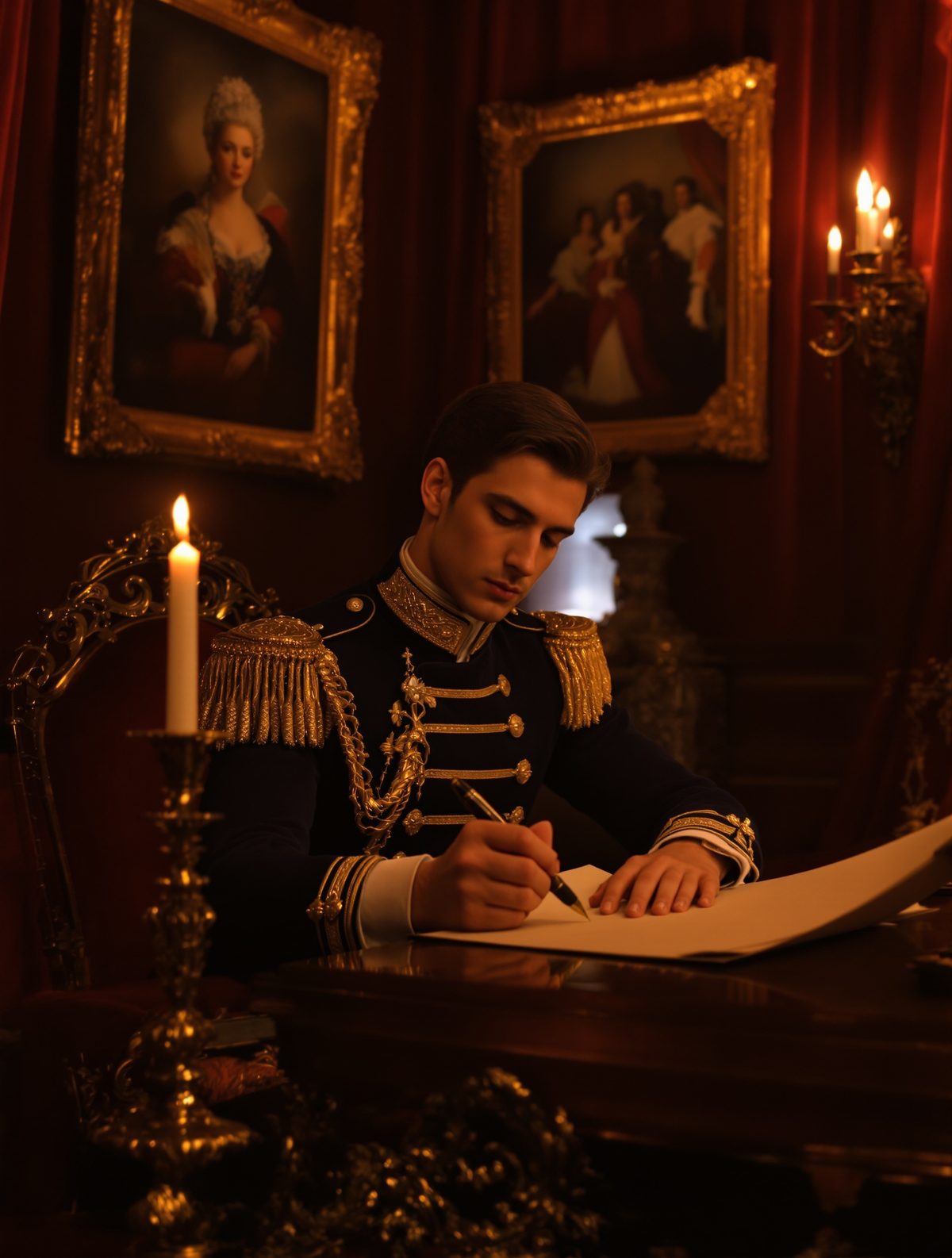
The gaslight flickered across the ornate writing desk as Prince Albert Victor, Duke of Clarence and Avondale, dipped his pen in ink once more. Night after night, the heir presumptive to the British throne would retreat to his private chambers and pour his heart onto paper. The royal household assumed these were merely the scholarly pursuits of a future king—perhaps diplomatic correspondence or philosophical musings. They had no idea that the Prince was penning passionate declarations of love that would have sent shockwaves through the monarchy and changed the course of British history forever.
What makes this story even more extraordinary is the recipient of these ardent letters: Thomas, a humble stable hand who worked in the royal mews. In an age when such relationships could result in imprisonment or worse, the Prince was risking everything for love that dared not speak its name.
A Prince Caught Between Duty and Desire
Prince Albert Victor, known as "Eddy" to his family, was born into one of the most scrutinized positions in the world. As the eldest son of the future King Edward VII, he carried the weight of royal expectations from birth. The 1880s were a time of rigid social conventions, particularly within the rarefied atmosphere of the royal court, where every action was monitored and every association carefully vetted.
Yet behind the formal portraits and ceremonial duties, Albert Victor was a young man grappling with feelings that placed him at odds with everything his position represented. The Prince's biographers have long noted his apparent reluctance to pursue the eligible princesses paraded before him by Queen Victoria and his parents. What they didn't know was that his heart lay elsewhere entirely.
The royal stables were a world away from the gilded drawing rooms of the palace, yet they provided Albert Victor with something the formal court could never offer: authenticity. Among the horses and hay, away from the constant observation of courtiers and ladies-in-waiting, the Prince found solace and, eventually, love.
Thomas: The Stable Hand Who Captured a Prince's Heart
Thomas was everything Albert Victor was not—working-class, unencumbered by protocol, and free to live without the suffocating weight of royal duty. Historical records tell us little about Thomas himself, which is hardly surprising given his humble station and the dangerous nature of his relationship with the Prince. What we do know comes primarily from the letters themselves and the discrete observations of a few palace staff members who later spoke about the Prince's frequent visits to the stables.
The relationship appears to have begun innocently enough. Albert Victor had always been fond of horses, and his regular visits to check on his mounts provided the perfect cover for spending time with Thomas. Palace staff noted that the Prince would often linger far longer than necessary, engaging in animated conversations with the stable hands about the care and training of his horses.
It was during these visits that Albert Victor and Thomas developed a connection that transcended the vast social gulf between them. The Prince found in Thomas someone who saw him not as a future king, but simply as a man. For Thomas, the relationship offered a glimpse into a world he could never have imagined, but also the constant fear of discovery and its potentially devastating consequences.
Hidden Messages in the Hay
The ingenious method by which the lovers communicated speaks to both the intensity of their feelings and the very real danger they faced. Each evening, after completing his royal duties, Albert Victor would retire to his chambers and write letters that revealed his true self—passionate, vulnerable, and desperately in love. These weren't the measured, formal communications expected of royalty, but raw expressions of emotion that laid bare the Prince's soul.
The letters were then concealed within hay bales in the royal stables, a hiding place so humble and mundane that no courtier would think to look there. For months, this elaborate system allowed the lovers to maintain their connection while keeping their secret safe from the prying eyes of the court.
The content of these letters, while necessarily kept from public view, reportedly revealed a side of the Prince that contradicted everything the public thought they knew about him. Far from the dutiful, somewhat distant royal figure, the letters showed a man capable of deep emotion and willing to risk everything for love. The very act of writing them was an act of rebellion against the constraints of his position and the expectations of Victorian society.
The Monarchy's Narrow Escape
The discovery of such a relationship would have been nothing short of catastrophic for the British monarchy in the 1880s. Victorian England was a society where appearances mattered above all else, particularly for the royal family, who were expected to embody moral rectitude and traditional values. The revelation that the heir to the throne was involved in what society deemed an "unnatural" relationship would have shaken the very foundations of the monarchy.
Queen Victoria, already protective of the royal family's reputation following various scandals involving her children, would have been horrified. The political ramifications would have been equally severe, potentially providing ammunition for republican movements and undermining the monarchy's moral authority at a crucial time in British history.
The secret remained hidden, protected by the loyalty of those few who suspected the truth and the lovers' own careful precautions. Albert Victor's untimely death from pneumonia in 1892 at the age of 28 ensured that the secret died with him, though rumors and speculation about his private life would persist for decades to come.
Love Letters That Changed Nothing—And Everything
The fate of the letters themselves remains a mystery. They may have been destroyed by Thomas after the Prince's death, or perhaps they were discovered and quietly disposed of by palace officials keen to protect the monarchy's reputation. What matters is not their physical survival, but what they represented: a young man's desperate attempt to live authentically in a world that demanded conformity above all else.
Albert Victor's story reminds us that behind the pomp and ceremony of royal life, there have always been real people struggling with the same desires, fears, and longings that affect us all. His secret letters to Thomas represent one of history's great "what ifs"—a love story that could have changed the course of British history had it ever come to light.
In our modern era, when members of the royal family enjoy far greater freedom to marry for love and live more openly, it's worth remembering those who came before and were forced to hide their true selves. Prince Albert Victor's midnight letters, hidden in humble hay bales, stand as a poignant reminder of love's power to transcend social boundaries—and the tragic cost of a world that demanded its concealment.