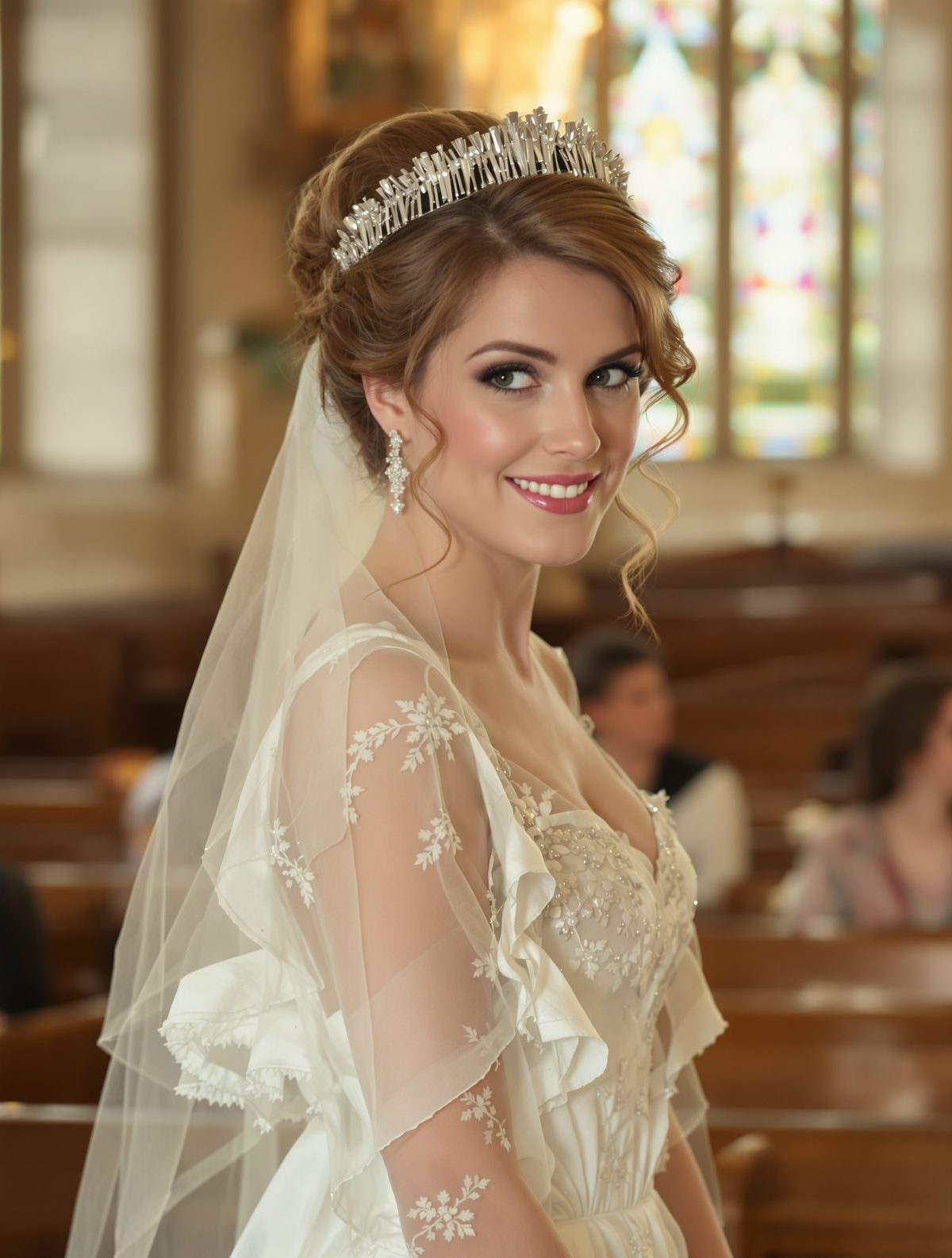
Picture this: you're walking down the aisle at your dream wedding, the Queen's own diamond tiara glittering on your head, when suddenly you feel it beginning to slide forward. Every step threatens to send the priceless heirloom tumbling to the floor in front of your guests. This nail-biting scenario wasn't from a romantic comedy—it was Princess Beatrice's very real wedding day drama in July 2020, when Her Majesty's stunning Queen Mary Diamond Fringe Tiara proved to be a perfect fit for everything except, well, actually fitting.
A Wedding Born from Chaos
Princess Beatrice's path to the altar was anything but conventional. Originally planned as a grand celebration at the Chapel Royal in St James's Palace for May 2020, her wedding to property developer Edoardo Mapelli Mozzi fell victim to the global pandemic that brought even royal celebrations to a standstill. Like countless brides around the world, Beatrice watched her carefully laid plans crumble as lockdown restrictions made her dream wedding impossible.
But love, as they say, finds a way. In a move that surprised even seasoned royal watchers, the couple decided to forge ahead with an intimate ceremony on July 17, 2020, at the Royal Chapel of All Saints in Windsor Great Park. With just 20 guests—a far cry from the 150 originally invited—the wedding became one of the most low-key royal celebrations in recent memory. The guest list included the Queen and Prince Philip, Prince Andrew, Sarah Ferguson, and Princess Eugenie, creating an atmosphere more akin to a family gathering than a state occasion.
The hastily rearranged ceremony meant that many traditional wedding elements had to be improvised at the last minute, from the scaled-back guest list to the borrowed wedding dress. Little did anyone know that the tiara would present the biggest challenge of all.
The Crown Jewel Conundrum
The Queen Mary Diamond Fringe Tiara carries extraordinary significance in royal history. Originally a wedding gift to Queen Mary in 1893, this dazzling piece features 47 diamond bars in a distinctive fringe design. But its most famous moment came in 1947, when it adorned the head of then-Princess Elizabeth on her wedding day to Prince Philip. In a dramatic twist worthy of a royal soap opera, that very tiara had snapped on the morning of the future Queen's wedding, sending palace staff into a panic as they rushed to repair it.
For Princess Beatrice, borrowing this particular tiara represented both honor and pressure. The Queen's decision to lend her granddaughter the same tiara she had worn on her own wedding day was a deeply personal gesture, especially given the intimate nature of the COVID-restricted ceremony. It seemed like the perfect touch of royal tradition for a wedding that had been stripped of so many conventional elements.
However, royal protocol regarding tiara fittings typically involves multiple appointments and careful adjustments—luxuries that simply weren't available given the rushed nature of the rearranged wedding. The tiara that had fit the Queen perfectly in 1947 was proving to be a somewhat more generous fit for her granddaughter some 73 years later.
A Sister's Secret Signals
As Princess Beatrice made her way down the aisle in the borrowed Norman Hartnell dress that had also belonged to the Queen, those closest to her began to notice the precarious situation developing atop her head. The magnificent tiara, while absolutely stunning, was slowly but surely working its way forward with each step she took.
Princess Eugenie, ever the devoted sister and the only other person present who truly understood the complexities of wearing a royal tiara, found herself in an impossible position. From her seat among the limited congregation, she could see the disaster unfolding in slow motion. The tiara's forward slide threatened to not only ruin her sister's special moment but potentially damage one of the most historically significant pieces in the royal collection.
In a moment that showcased both royal discretion and sisterly devotion, Eugenie began discreetly signaling to the royal hairdresser, who had strategically positioned themselves behind a pillar in the ancient chapel. These silent communications became a crucial lifeline, with Eugenie serving as the eyes and ears for the styling team who needed to monitor the situation without drawing attention to the unfolding drama.
The hairdresser, likely one of the trusted professionals who regularly work with the royal family, faced the challenge of their career: how to manage a tiara crisis during a live ceremony without disrupting the sacred moment or drawing unwanted attention to the mechanical difficulties.
Royal Resourcefulness Under Pressure
What happened next demonstrated the kind of quick thinking and professional grace that makes the royal household function seamlessly, even in crisis moments. The styling team, guided by Princess Eugenie's subtle communications, managed to devise a solution that kept the tiara secure throughout the ceremony without anyone outside the immediate family being aware of the near-catastrophe.
The incident highlights an often-overlooked aspect of royal life: the army of dedicated professionals who work behind the scenes to ensure that every public moment appears effortless. From dressmakers to hairdressers, from security personnel to protocol experts, royal events rely on the expertise and quick thinking of dozens of individuals who rarely receive public recognition for their crucial contributions.
For Princess Beatrice, the tiara troubles became just one more element in a wedding day that was defined by adaptation and improvisation. Rather than the carefully choreographed royal spectacle originally planned, her actual wedding day required constant flexibility and creative problem-solving—skills that proved invaluable when ancient jewelry refused to cooperate with modern heads.
The fact that the ceremony proceeded without any visible disruption speaks to both the professionalism of the royal staff and the composure of the bride herself, who managed to exchange vows and celebrate her marriage while literally keeping her crown from falling off her head.
A Modern Royal Love Story
Despite the behind-the-scenes drama, Princess Beatrice's wedding ultimately became a perfect reflection of royal life in the 21st century: a blend of ancient tradition and contemporary adaptability. The Queen Mary Diamond Fringe Tiara, despite its sizing issues, connected the bride to generations of royal women who had worn the crown jewels before her. The intimate setting and reduced guest list, while born of necessity, created a genuinely personal celebration that many couples might actually prefer to a grand state occasion.
The tiara incident also reveals something wonderfully human about royal life. Behind all the protocol and grandeur, royal weddings face the same kinds of last-minute challenges that plague ceremonies everywhere—they just happen to involve priceless historical artifacts and require discretion on a rather different scale.
Princess Beatrice's willingness to adapt her wedding plans during the pandemic, combined with her grace under pressure when faced with uncooperative headwear, demonstrated a resilience that resonates far beyond palace walls. In an era when flexibility and resourcefulness have become essential life skills, her wedding day troubles—and triumphs—feel remarkably relatable, tiara notwithstanding.
Today, as royal watchers look back on Princess Beatrice's unconventional wedding day, the tiara troubles have become part of the story's charm rather than its weakness. Sometimes the most memorable royal moments are the ones where humanity peeks through the pageantry, reminding us that even princesses occasionally struggle with their accessories—they just happen to be worth several million pounds and come with centuries of history attached.