Picture this: the grandest palace in Tudor England lies shrouded in darkness, its countless chambers filled with sleeping courtiers, servants, and guards. The only sounds are the gentle crackle of dying embers in massive fireplaces and the soft footfalls of night watchmen making their rounds. Then, from the royal apartments, a shadow emerges—not an assassin or intruder, but the King of England himself, creeping barefoot through corridors like a schoolboy sneaking sweets.
In the 1520s, during the height of his power and before his marital troubles consumed him, Henry VIII developed what can only be described as the most peculiar of royal habits. While Hampton Court Palace—his magnificent riverside retreat—slumbered peacefully, the monarch would embark on clandestine culinary adventures that left his kitchen staff utterly flummoxed and his carefully maintained royal dignity in tatters.
The Royal Night Owl's Secret Hunger
Henry VIII was never a man known for restraint. Standing over six feet tall with an athletic build (at least in his younger years), the king possessed appetites that matched his larger-than-life personality. But while his lavish daytime feasts were legendary affairs featuring dozens of courses and hundreds of guests, his nocturnal foraging told a different story entirely.
Court records and servant testimonies from the period paint an extraordinary picture of a monarch who simply couldn't resist the allure of Hampton Court's renowned kitchens after dark. The palace's culinary department was a marvel of Tudor engineering—a complex of rooms featuring massive bread ovens, roasting spits that could accommodate entire deer, and most tempting of all, the pastry kitchens where master bakers crafted elaborate confections for the royal table.
It was these pastry stores that proved to be Henry's downfall. Night after night, servants would arrive at dawn to find clear evidence of royal intrusion: flour scattered across stone floors, crumb trails leading from storage areas to doorways, and—most telling of all—sticky fingerprints at suspiciously regal height on cabinet doors and sugar containers.
Midnight Encounters in the Kitchen Corridors
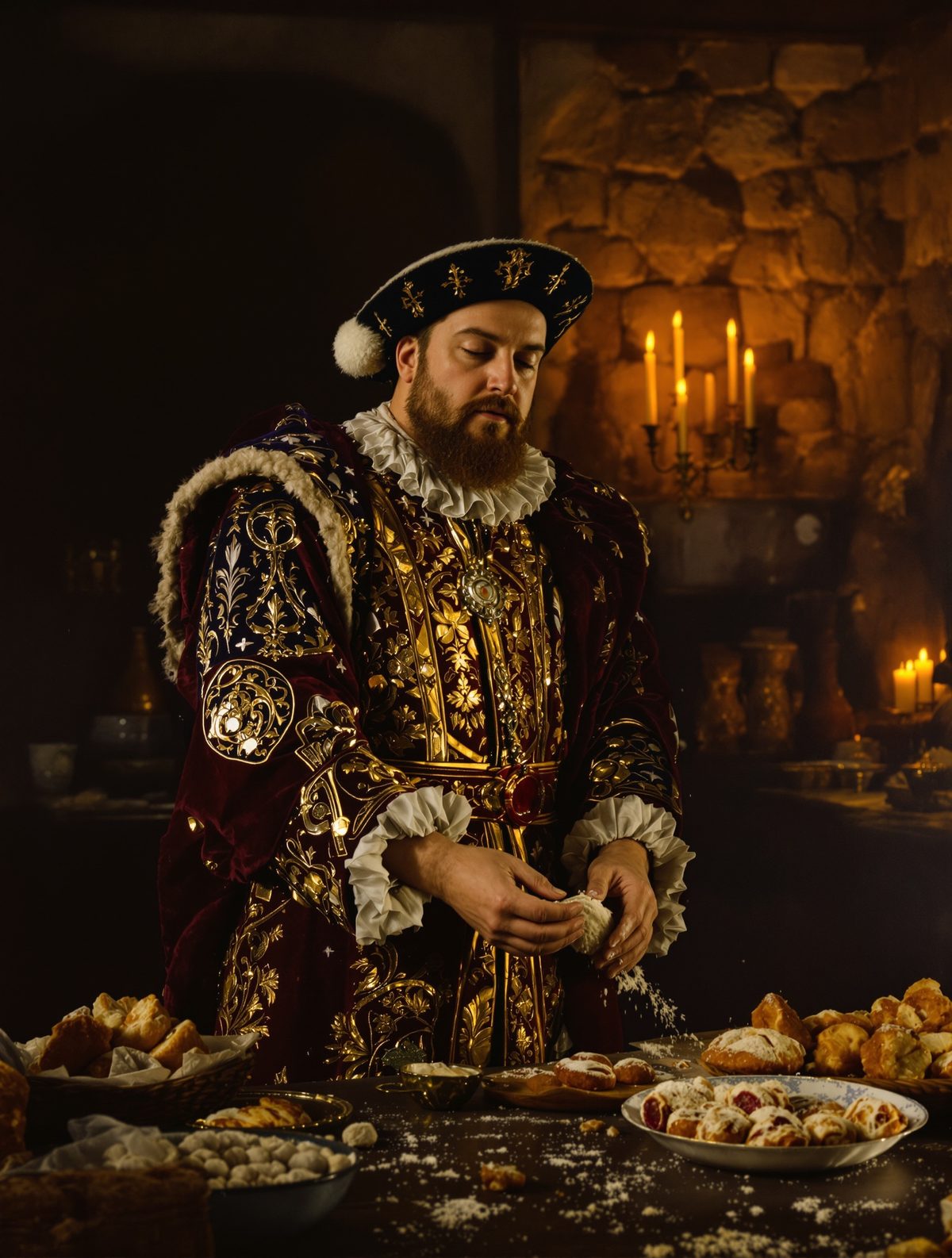
The first documented encounter between Henry and his bewildered kitchen staff occurred on a particularly cold February night in 1523. Master Baker Thomas Cordwainer, returning to retrieve a forgotten recipe scroll, stumbled upon a scene that would have been comical if it weren't so shocking: the King of England, still wearing his nightgown beneath a hastily donned robe, standing elbow-deep in a barrel of marchpane (marzipan) mixture.
According to surviving accounts, Henry was so startled by the intrusion that he attempted to hide behind a hanging side of beef—an endeavor that proved spectacularly unsuccessful given his imposing stature. Flour coated his famous red-gold beard, and sweet almond paste clung to his fingers like paste. The king's attempt at regal composure while covered in baking ingredients must have been a sight to behold.
But this wasn't an isolated incident. Over the following months, similar encounters became almost routine. Kitchen maids would discover the king sampling fresh bread straight from the cooling racks, his royal fingers leaving telltale impressions in loaves destined for the next day's breakfast service. Scullery boys reported finding His Majesty crouched behind the great hearth, gnawing on leftover roasted fowl bones like a medieval version of a refrigerator raider.
The Servants' Dilemma
For Hampton Court's domestic staff, Henry's nocturnal adventures presented an unprecedented crisis of protocol. How does one address a flour-dusted monarch caught red-handed in the act of pastry theft? Court etiquette had no provisions for such scenarios, leaving servants to navigate these encounters with a mixture of terror, bewilderment, and suppressed amusement.
The palace's Clerk of the Kitchen reportedly held emergency meetings with senior household staff to discuss the "nocturnal situation." Some suggested posting guards to prevent the king's access, but this idea was quickly dismissed—who exactly would dare to bar Henry VIII from any part of his own palace? Others proposed leaving out special treats for the king's midnight visits, but this approach risked encouraging behavior that was already causing considerable disruption to kitchen operations.
"The servants were caught between their duty to maintain order in the kitchens and their absolute inability to discipline their sovereign," explains Dr. Margaret Ashworth, a Tudor historian specializing in court life. "They found themselves in the unique position of trying to manage a king who was behaving rather like an overgrown child."
The situation became even more complicated when Henry began recruiting unlikely accomplices for his culinary capers. Court records suggest that on several occasions, he convinced young pages to join his midnight expeditions, turning the kitchen raids into impromptu royal adventures that left multiple participants covered in flour and sugar.
The Psychology Behind the Pastries
What drove one of history's most powerful monarchs to such peculiar nocturnal behavior? Modern historians suggest that Henry's kitchen raids revealed fascinating insights into the psychological pressures of Tudor kingship. The 1520s were a period of intense diplomatic activity for Henry—he was juggling complex relationships with European powers, managing the early stages of his religious reforms, and dealing with the mounting pressure to secure his dynasty's future.
In the context of a life lived entirely in public, where every meal, every conversation, and every gesture carried political significance, perhaps the dark kitchens of Hampton Court offered something precious: a space where Henry could simply be human. Away from the watchful eyes of ambassadors, courtiers, and political rivals, the king could indulge not just his physical appetite but his desire for spontaneity and genuine pleasure.
The childlike quality of these midnight adventures—the sneaking, the mess-making, the getting caught—suggests a man temporarily freed from the enormous burden of royal responsibility. In those flour-dusted moments, Henry VIII wasn't the Defender of the Faith or the head of state; he was simply a man who wanted cake and was willing to raid his own kitchens to get it.
Legacy of the Royal Raider
Historical records suggest that Henry's midnight kitchen adventures gradually diminished as the decade progressed and his attention turned to more pressing matters—namely, his pursuit of Anne Boleyn and the dramatic break with Rome that would follow. The king's expanding waistline may also have made his covert operations more challenging as the years went on.
But for those who witnessed them, these nocturnal escapades became treasured memories that humanized one of England's most formidable monarchs. Generations of Hampton Court kitchen staff would pass down stories of the night they found their king looking sheepish and flour-covered, caught in the act of satisfying his sweet tooth with all the stealth of a medieval cookie monster.
Today, as we tour the restored kitchens of Hampton Court Palace, it's impossible not to imagine Henry's ghostly figure tiptoeing through these same corridors, drawn by the irresistible lure of fresh pastries and the rare opportunity to be wonderfully, messily human. In our age of carefully managed royal images and public relations, there's something refreshingly authentic about a king who couldn't resist a midnight snack—even if it meant horrifying his servants and abandoning all pretense of royal dignity in pursuit of the perfect bite of marchpane. Perhaps the most revealing moments of any life, royal or otherwise, happen not in the grand ceremonies but in the quiet, unguarded hours when we think no one is watching.