On July 19, 1821, Westminster Hall witnessed one of the most spectacular—and nearly catastrophic—royal banquets in British history. King George IV, already notorious for his legendary appetite and love of excess, had commissioned a coronation feast so elaborate that it would make even today's celebrity chefs weep with envy. What began as the crowning glory of the most expensive coronation ceremony ever held nearly ended with the newly crowned monarch requiring emergency medical attention, his own gluttony threatening to overshadow the grandest celebration of his reign.
The scene was set for magnificence, but nobody quite anticipated that the King's famous lack of self-control would turn his moment of triumph into a medical emergency that had palace doctors fearing for his life.
A Feast Fit for a King Who Knew No Limits
George IV had waited decades to claim his throne, serving as Prince Regent during his father's illness, and he was determined that his coronation would eclipse every royal celebration that came before it. The banquet he commissioned was nothing short of extraordinary—a culinary symphony featuring 160 individual dishes that represented the pinnacle of Regency gastronomy.
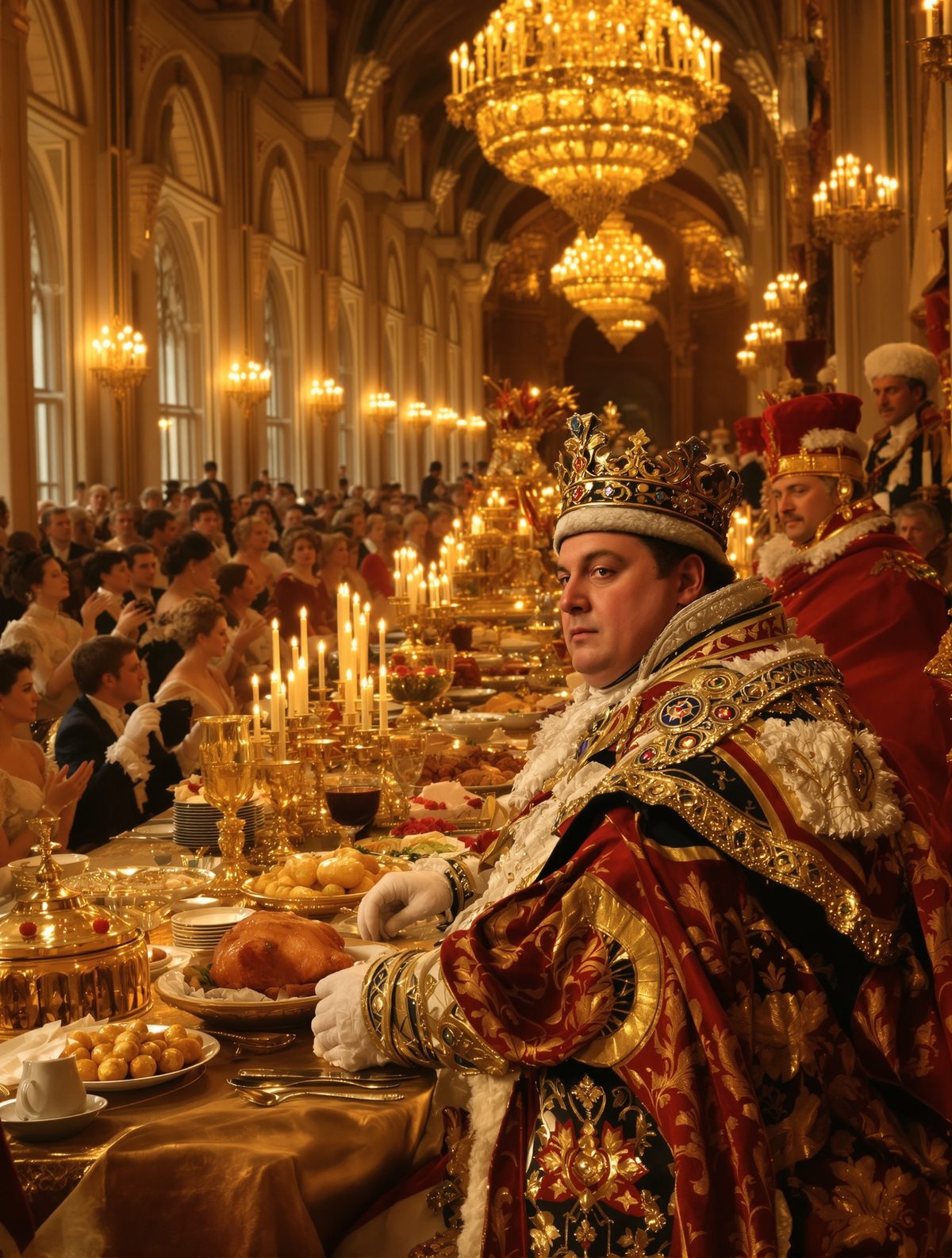
The menu read like a fantasy of imperial abundance. Tables groaned under the weight of whole roasted peacocks, their feathers restored in brilliant display, platters of venison from royal parks, towers of exotic fruits imported from across the British Empire, and delicate French pastries that required teams of confectioners working around the clock. There were soups, fish courses, game birds, beef, lamb, elaborate jellies molded into architectural marvels, and enough wine and champagne to float a small naval vessel.
Westminster Hall had been transformed into a glittering dining room worthy of an emperor. Hundreds of guests in their finest court dress awaited the royal pleasure, while the King himself, resplendent in his coronation robes and wearing a corset that struggled to contain his considerable girth, surveyed the magnificent spread before him with undisguised delight.
The Royal Appetite Unleashed
What happened next would become the stuff of court legend. Rather than sampling dishes with the restraint expected of a monarch presiding over a formal state occasion, George IV approached the banquet as a personal challenge. Contemporary accounts describe him methodically working his way through course after course, his enthusiasm undimmed by the mounting concern of his attendants.
The King's legendary appetite was already well-known throughout London society. Stories circulated of breakfast tables laden with multiple meat courses, of dinners that lasted until dawn, and of a monarch who viewed each meal as an opportunity for indulgence. But even by his own excessive standards, the coronation banquet represented a new peak of gustatory ambition.
Six Hours of Royal Gluttony
As the banquet progressed, what should have been a dignified celebration gradually transformed into something approaching a spectacle of endurance. The King continued eating with unwavering determination, moving from savory to sweet and back again, sampling wines from across Europe, and showing no signs of the restraint that etiquette demanded.
Hour after hour passed, and still George IV continued his assault on the magnificent spread before him. Courtiers began exchanging worried glances as they watched their sovereign, his face growing increasingly flushed, his breathing becoming labored, yet his appetite remaining apparently insatiable.
The tight-fitting corset that had been laced to present the King in the most flattering possible light for his coronation began to protest under the mounting pressure. Palace sources later reported that the garment was straining ominously, its stays threatening to give way entirely under the dual pressure of the King's expanding waistline and his absolute refusal to stop eating.
Medical Emergency at the Royal Table
By the fourth hour of continuous dining, the situation had become genuinely alarming. The royal physicians, who were always present at major state occasions, began to fear that their sovereign might actually collapse at his own coronation banquet. The combination of rich foods, flowing wine, physical restriction from his corset, and the sheer exhaustion of six hours of non-stop consumption was taking a visible toll.
Reports from the evening suggest that the King's breathing became increasingly labored, and his complexion took on a distinctly unhealthy hue. Yet even as concerned murmurs rippled through Westminster Hall, George IV showed no inclination to moderate his consumption. If anything, the approach of potential disaster seemed only to spur him to greater efforts.
The tension in the hall was palpable. Here was the newly crowned King of the United Kingdom, the head of a global empire, potentially eating himself into a medical crisis in front of the assembled nobility of the realm. It was a scenario that no court protocol had ever anticipated, and one that left everyone present uncertain about how—or whether—to intervene.
The Aftermath of Royal Excess
When the banquet finally concluded after six grueling hours, the King was reportedly in such a state that his physicians immediately whisked him away for emergency attention. The corset that had been threatening to burst throughout the evening was carefully removed, allowing the monarch to breathe freely for the first time in hours. Medical attention focused on ensuring that the massive quantities of rich food and wine didn't prove fatal to a man whose health was already compromised by years of similar indulgences.
The coronation banquet became an instant sensation in London society, with accounts of the King's extraordinary performance spreading throughout the capital and beyond. While some viewed it as yet another example of George IV's legendary excess, others marveled at what they saw as an almost superhuman demonstration of royal appetite.
The financial cost of the entire coronation—including the infamous banquet—was staggering even by royal standards. Parliament had approved what they thought was an extravagant budget, only to discover that the King's vision of regal magnificence far exceeded even their generous estimates. The coronation banquet alone cost more than many noble families spent in an entire year.
A King Defined by Appetite
This extraordinary evening perfectly encapsulated the character of George IV, a monarch who approached life with the same unlimited enthusiasm he brought to the dining table. Throughout his reign, he was a king who refused to accept limitations, whether in fashion, architecture, entertaining, or personal pleasure. His transformation of royal residences like the Brighton Pavilion and Buckingham Palace reflected the same appetite for magnificence that nearly proved his undoing at Westminster Hall.
The coronation banquet scandal, as it came to be known in certain circles, also highlighted the unique pressures facing a monarch who had waited so long for his moment of glory. Having spent years as Prince Regent, managing the kingdom while maintaining the fiction of his father's continuing reign, George IV was determined that his official coronation would be an event worthy of his patience and ambition.
Legacy of a Legendary Evening
The story of George IV's coronation banquet continues to fascinate royal historians and enthusiasts more than two centuries later, serving as a perfect illustration of the character and contradictions of the Regency era. It was an age that celebrated excess alongside elegance, where the highest refinement existed side by side with the most basic human appetites.
Today's royal banquets, with their carefully planned menus and diplomatically appropriate portions, seem almost modest by comparison. The current royal family's approach to state dining emphasizes grace, conversation, and international diplomacy rather than the raw display of consumption that characterized George IV's era. Yet there's something undeniably compelling about a monarch who approached even the most formal occasions with such unrestrained enthusiasm.
The tale of the six-hour coronation feast reminds us that behind the ceremony and protocol, the British monarchy has always been shaped by distinctly human personalities, complete with their own appetites, ambitions, and occasional lapses in judgment. In George IV, the nation found a king whose zest for life—however excessive—reflected the confident, expansive spirit of an era when Britain was reshaping the world stage. His coronation banquet may have nearly killed him, but it also created one of the most memorable moments in the long, colorful history of the British crown.