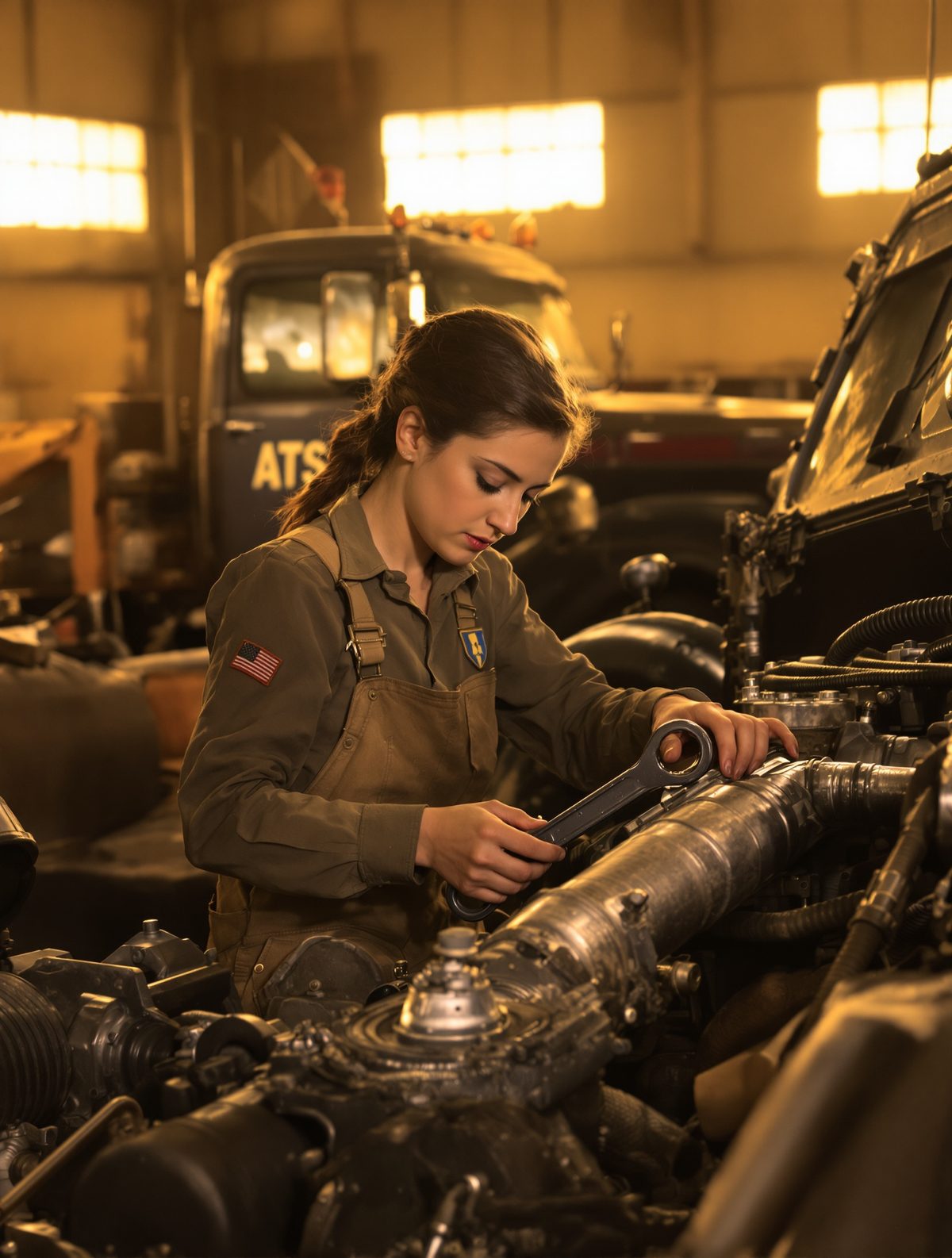
The young woman in military fatigues knelt beside the Bedford truck, her hands black with engine grease, blonde hair tucked beneath a regulation cap. To her fellow mechanics at No. 1 Mechanical Transport Training Centre in Camberley, she was simply Elizabeth Windsor—a polite, hardworking teenager eager to do her bit for the war effort. What they didn't know was that they were teaching the future Queen of England how to change spark plugs, strip down engines, and navigate military vehicles through muddy obstacle courses.
A Princess Joins the Ranks
In February 1945, as Allied forces pressed toward victory in Europe, nineteen-year-old Princess Elizabeth made history by becoming the first female member of the royal family to serve full-time in the armed forces. Her enlistment in the Auxiliary Territorial Service (ATS) wasn't merely ceremonial—this was real military training, complete with early morning reveille, shared dormitories, and the same rigorous mechanical instruction given to every other recruit.
The decision to allow the heir presumptive to serve had been years in the making. Elizabeth had watched her contemporaries join the war effort while she remained safely within palace walls, and her frustration grew palpable. Reports suggest she had been pressing her father, King George VI, to allow her meaningful participation in the war effort since she turned eighteen. The King, initially hesitant about exposing his daughter to military life, eventually relented—though not without considerable security precautions.
When Elizabeth arrived at the Camberley training centre, she carried the service number 230873 and a determination to prove herself as more than just a royal figurehead. Her commanding officers had been briefed about their special recruit, but the rank-and-file mechanics working alongside her remained blissfully unaware of her true identity.
Getting Her Hands Dirty
The training was no gentle introduction to military life. Elizabeth learned to drive and maintain heavy military vehicles, from ambulances to lorries. Her days began before dawn and were filled with intensive mechanical instruction that left her uniforms permanently stained with oil and her hands calloused from working with tools and engines.
Contemporary accounts describe a young woman who threw herself wholeheartedly into the work. She mastered the art of changing massive truck tires—no small feat given the weight and size of military vehicle wheels. More impressively, she learned to completely disassemble and rebuild vehicle engines, understanding every component from carburettors to timing chains.
The intensity of the training cannot be overstated—these weren't gentle lessons in automotive basics. Military mechanics needed to perform emergency repairs under pressure, often in challenging conditions. Elizabeth learned to work in mud, rain, and poor lighting, skills that would prove essential for keeping military convoys moving in the field.
Her fellow trainees later recalled a quiet, focused young woman who never complained about the demanding work or sought special treatment. She queued for meals like everyone else, cleaned her own kit, and approached each mechanical challenge with methodical determination. To them, she was simply another recruit doing her duty.
The Secret Revealed
The carefully maintained anonymity couldn't last forever. According to military records, Elizabeth's true identity was discovered by one of her commanding officers in the most mundane way possible—while reading his morning newspaper. A photograph accompanying a news story about the Princess's military service showed their diligent young mechanic in uniform, and the officer reportedly did a double-take that became the talk of the officers' mess.
The revelation sent ripples through the training centre. Suddenly, the mechanics who had been working alongside the future Queen realised they had been teaching royalty how to gap spark plugs and adjust carburettors. Some admitted to feeling mortified about their casual treatment of their royal colleague, though Elizabeth herself seemed determined to continue as before.
Despite her identity becoming known, Elizabeth completed her full course of training. She qualified as a fully competent military mechanic and driver, earning her credentials through the same examinations and practical tests required of every ATS member. The certificates she received were not honorary—they represented genuine mechanical expertise that she had earned through weeks of intensive study and hands-on work.
Beyond the Garage: A Future Queen Learns Leadership
Elizabeth's time in the ATS provided more than mechanical skills—it offered invaluable lessons in leadership and service that would shape her approach to monarchy. Working alongside people from all walks of life, she gained firsthand experience of the dedication and sacrifice that ordinary Britons were making for their country.
The Princess also learned the importance of competence over ceremony. In the garage, what mattered wasn't royal protocol but whether you could diagnose why an engine wouldn't start or properly torque wheel bolts. This emphasis on practical capability over ceremonial role would later influence her approach to royal duties, where she consistently demonstrated thorough preparation and genuine engagement with the technical aspects of the institutions and industries she visited.
Her commanding officers noted her natural aptitude for responsibility and her ability to remain calm under pressure—qualities that served her well whether troubleshooting a mechanical problem or, decades later, navigating constitutional crises as Queen. The military structure also reinforced lessons in duty and service that had been instilled since childhood, but now in a practical, hands-on context.
A Legacy Written in Engine Oil
When Elizabeth completed her ATS training in April 1945, just weeks before VE Day, she had achieved something unprecedented in royal history. She possessed genuine professional qualifications and practical skills that had nothing to do with her royal birth and everything to do with her personal dedication and effort.
Photographs from her training show a confident young woman in oil-stained coveralls, holding tools with the assurance of someone who knows how to use them. These images became iconic representations of royal service—not the ceremonial kind performed in ballgowns and tiaras, but the practical, hands-on contribution that demonstrated the monarchy's connection to the wartime experiences of ordinary families.
The mechanical expertise Elizabeth gained would prove surprisingly useful throughout her reign. She maintained a lifelong interest in engineering and technology, often impressing industrialists and engineers with her technical knowledge during royal visits. Her understanding of how things actually work—gained from stripping down truck engines in a Camberley garage—informed her approach to understanding the practical challenges facing British industry and innovation.
Today, as we reflect on Queen Elizabeth II's remarkable seven-decade reign, it's worth remembering that it began not with a crown or ceremony, but with a toolkit and a determination to serve. The young Princess who learned to rebuild engines in 1945 carried those lessons of practical service, quiet competence, and genuine engagement through nearly eight decades of royal duty. In an age where authenticity is highly valued, her willingness to literally get her hands dirty in service of her country established a template for meaningful royal engagement that continues to resonate with new generations who admire substance over style.