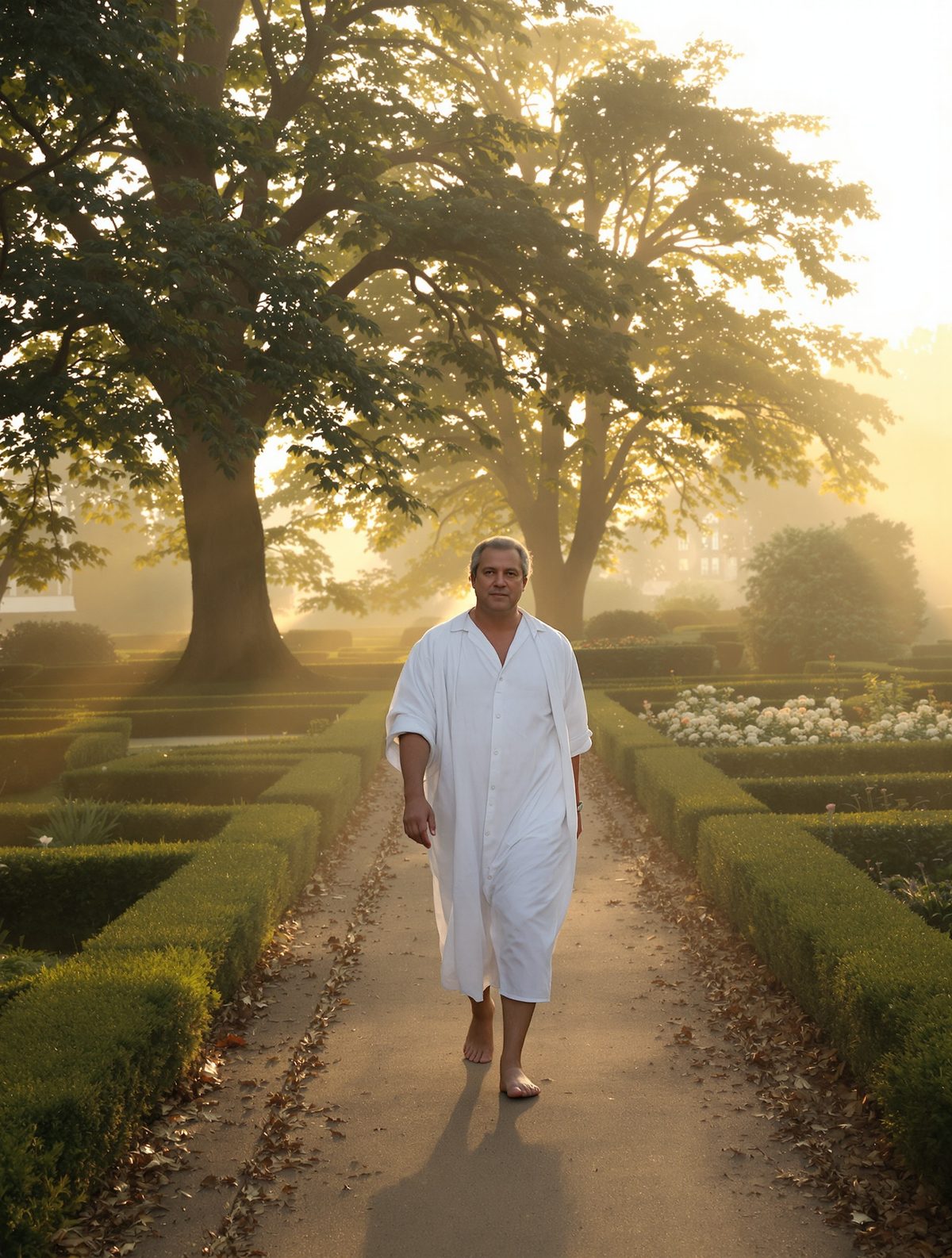
While his court physicians prepared their daily arsenal of purges, bleedings, and restraints, King George III had discovered something far more powerful than any medicine in their black bags. Each morning, as the first pale light crept across the gardens of Windsor Castle, the troubled monarch would perform a ritual so simple—and so shocking to Georgian sensibilities—that it sent his doctors into fits of despair. The King of Great Britain and Ireland walked barefoot through his own gardens, feeling the dew-soaked grass beneath his feet and breathing the crisp morning air into his lungs.
This wasn't mere eccentricity. For George III, these dawn escapes became a lifeline during some of the darkest periods of his reign, particularly during the 1780s when his mysterious illness first began to manifest in ways that terrified both his family and his government.
The King's Great Escape
Picture, if you will, the scene at Windsor Castle as the 1780s dawned. The King's household operated with the precision of a military campaign—every moment scheduled, every movement monitored, every meal carefully prepared according to royal protocol. George III's daily routine was as rigid as the court ceremonies he presided over, from his morning audiences to his evening prayers.
Yet somehow, this most dutiful of monarchs managed to slip away from his attendants with remarkable regularity. Court records and contemporary accounts suggest that George III had developed an almost supernatural ability to evade his minders in those precious moments before the castle fully stirred to life. How he managed this feat remains something of a mystery—the King was hardly a small man, standing over six feet tall, and Windsor Castle was never truly empty of servants and guards.
What we do know is that His Majesty had discovered the therapeutic power of direct contact with nature. While his contemporaries believed that morning air was dangerous to health—particularly for someone of delicate constitution—George III intuited what modern medicine now confirms: that natural light, fresh air, and the grounding sensation of earth beneath one's feet can have profound effects on mental wellbeing.
Medical Horror and Royal Rebellion
The King's physicians were, quite simply, appalled. In an era when medical wisdom dictated that patients—especially royal ones—should be kept warm, dry, and preferably indoors, George III's barefoot wanderings represented everything they had been trained to prevent. Dr. Francis Willis, who would later become one of the King's primary physicians during his illness, and his colleagues viewed these morning excursions as nothing short of dangerous rebellion against proper medical care.
Georgian medicine operated on principles that seem almost medieval to our modern understanding. Physicians believed in the critical importance of maintaining proper "humours" within the body, and exposure to morning dampness was thought to upset this delicate balance. The idea of the King of England padding about barefoot like a common peasant was not merely unseemly—it was, in their professional opinion, courting disaster.
The royal doctors prescribed increasingly elaborate countermeasures. They insisted on additional layers of clothing, heated rooms, and carefully regulated indoor air. They argued, pleaded, and eventually demanded that His Majesty abandon this "dangerous habit." Contemporary medical journals of the period reveal the genuine concern among court physicians that the King's morning walks were exacerbating whatever mysterious condition had begun to affect his behavior and judgment.
But George III, despite his reputation for dutiful compliance with royal protocol, proved remarkably stubborn on this particular point. The man who submitted to painful medical treatments and endured the constraints of kingship with stoic acceptance would not be moved from his morning ritual.
A King's Sanctuary in Nature
What drew George III so powerfully to these solitary dawn walks? Contemporary accounts from courtiers and family members provide tantalizing glimpses into the King's state of mind during these precious stolen moments. Lady Charlotte Finch, governess to the royal children, noted in her private correspondence that His Majesty seemed "remarkably composed and clear-minded" following his morning excursions, in stark contrast to his often agitated state during formal court proceedings.
The gardens of Windsor provided the King with something increasingly rare in his constrained royal existence: genuine solitude. Here, among the carefully manicured lawns and ancient trees, George III could simply be a man rather than a monarch. No petitioners awaited his attention, no ministers demanded decisions, no protocol dictated his every gesture. The simple act of feeling grass beneath his feet connected him to something fundamental and healing.
These weren't mere strolls, either. Accounts suggest that the King walked with purpose and intensity, sometimes covering considerable distances within the castle grounds before his absence was discovered. He seemed particularly drawn to areas where the formal gardens gave way to more natural landscapes—spots where he could experience something approaching wilderness within his gilded confines.
The timing of these walks—always at dawn—suggests that George III understood instinctively what modern chronobiology has since proven: that early morning natural light helps regulate circadian rhythms and can have profound effects on mood and mental clarity. In an age of candlelight and closed windows, the King had discovered light therapy three centuries before it had a name.
The Wisdom of a Troubled King
As George III's mysterious illness—now believed by many historians and medical experts to have been porphyria or a related metabolic disorder—progressed through the 1780s and beyond, his morning walks took on even greater significance. During periods when his behavior became erratic and his judgment questioned, these moments of natural communion may have provided crucial anchoring points for his sanity.
The irony was not lost on more observant members of the court. While physicians applied increasingly harsh treatments—cold baths, restraining chairs, and powerful purgatives—the King's own instincts led him toward something genuinely therapeutic. Modern understanding of mental health emphasizes exactly the elements that George III sought in his dawn walks: natural light, physical movement, connection with nature, and temporary escape from stressful environments.
Even more remarkably, the King maintained this practice despite enormous pressure to abandon it. Royal physicians, court officials, and concerned family members all united in their opposition to these "dangerous" morning excursions. Yet George III, a man who rarely defied the expectations placed upon him, held firm to this one small rebellion.
The sight of their sovereign, the man appointed by divine right to rule over a vast empire, padding barefoot through the morning grass like a country parson, may have scandalized the medical establishment. But it also revealed something profound about George III's character: beneath the heavy robes of state lived a human being wise enough to recognize what his spirit needed to survive the impossible burdens of his position.
Today, as our understanding of mental health continues to evolve, George III's morning ritual appears less like dangerous eccentricity and more like remarkable intuitive wisdom. In seeking healing through direct contact with the natural world, this most traditional of monarchs was, in his quiet way, remarkably ahead of his time. His barefoot walks remind us that sometimes the most profound medical breakthroughs come not from learned physicians but from the simple courage to trust our own deepest instincts about what makes us whole.