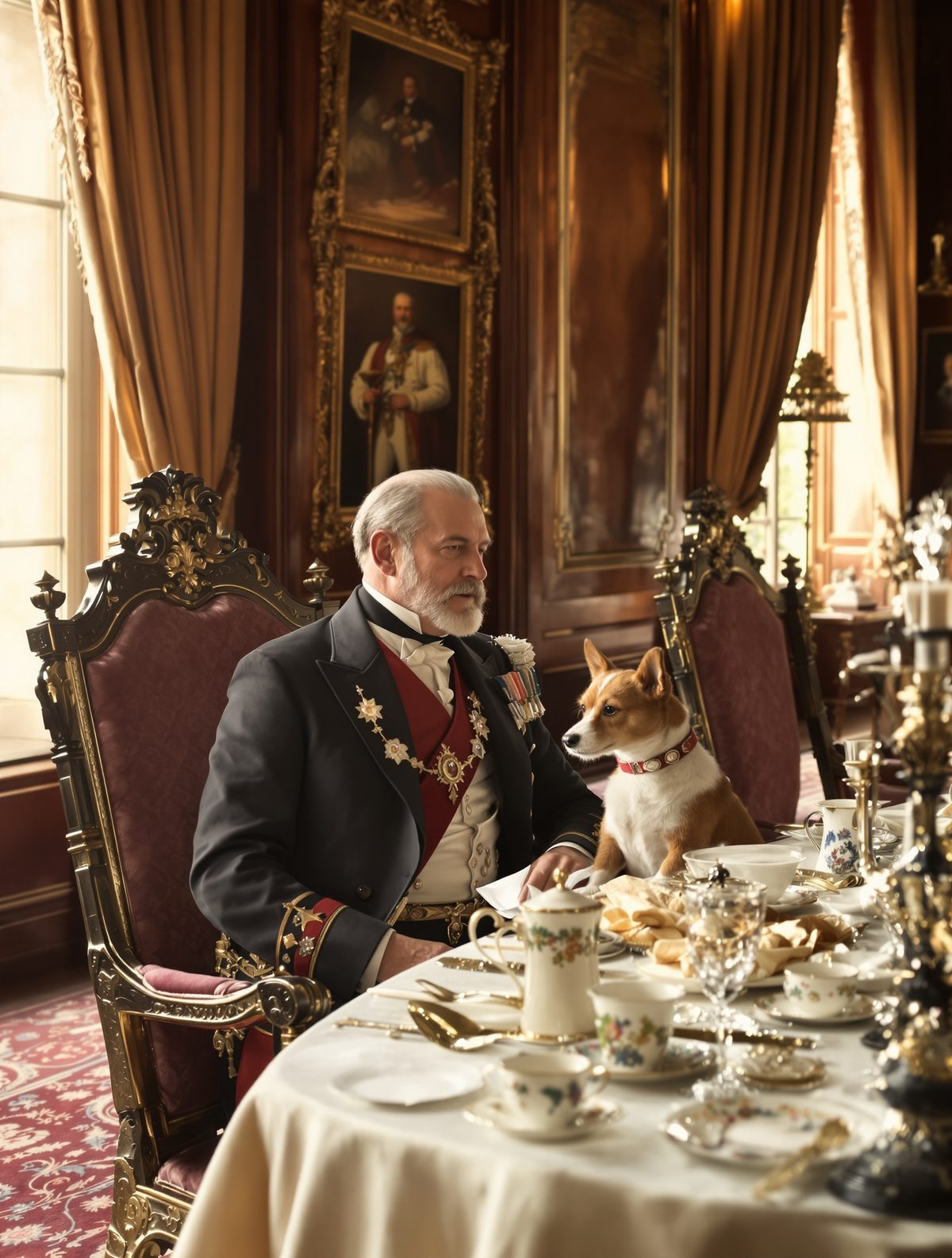
While the British Empire watched King Edward VII maintain the strictest royal protocol in public, behind palace doors he was breaking every rule of etiquette for the love of a spirited fox terrier named Caesar. Each morning at precisely seven o'clock, the King of the British Empire would engage in a secret ritual that would have left Victorian society utterly aghast: sharing his royal breakfast with his four-legged companion, who dined from his own velvet chair at the sovereign's table.
A King's Unconventional Morning Routine
The Edwardian court was renowned for its elaborate protocols and rigid hierarchy, where every gesture carried meaning and proper etiquette governed every aspect of royal life. Yet in the private dining rooms of Buckingham Palace and Sandringham House, King Edward VII threw convention to the wind each morning in favour of an endearing routine that revealed the tender heart beneath his regal exterior.
Caesar, a wire-haired fox terrier with an independent spirit that perfectly matched his royal master's, had earned a position of unprecedented privilege within the royal household. While courtiers and ministers waited for audiences, this small dog enjoyed immediate and unrestricted access to the King. The morning feeding ritual became so established that palace staff learned to set two places for breakfast: one befitting a monarch, and another—complete with velvet cushioned chair—for his devoted canine companion.
The King's insistence that Caesar dine properly seated rather than begging at his feet demonstrated Edward's belief that his beloved pet deserved the same courtesy extended to any honoured guest. This wasn't merely about feeding a dog; it was about acknowledging a genuine friendship that transcended the usual boundaries between sovereign and subject—even a four-legged one.
Palace Staff in Quiet Desperation
For the meticulously trained palace servants, Caesar's elevated status presented daily challenges to their understanding of proper royal protocol. Generations of royal attendants had been schooled in the precise hierarchy of service, where every person knew their exact place in the complex machinery of court life. The sight of a terrier occupying a chair at the King's breakfast table—and being served choice morsels from the sovereign's own plate—represented a complete upheaval of everything they considered proper.
Yet the staff's horror was tempered by genuine affection for both the King and his extraordinary pet. Edward VII was known for his warmth toward those who served him, and his obvious devotion to Caesar revealed a side of the monarch that endeared him to many within the household. The servants learned to navigate this new reality with characteristic British adaptability, ensuring Caesar's velvet chair was properly positioned each morning and that the finest china was available for the King's unconventional breakfast companion.
The ritual required careful coordination behind the scenes. Kitchen staff had to prepare portions suitable for both royal and canine palates, while footmen learned the delicate art of serving a fox terrier with the same dignity they would afford any distinguished guest. These devoted servants, bound by loyalty and discretion, ensured that the King's morning routine remained a closely guarded secret from the outside world.
Caesar: The Most Privileged Dog in the Empire
Caesar's influence extended far beyond the breakfast table, as he became perhaps the most travelled and photographed dog in royal history. The terrier accompanied King Edward VII on official visits, stayed in the finest hotels across Europe, and developed his own reputation among foreign dignitaries who quickly learned that winning Caesar's approval was often the surest path to the King's favour.
The bond between Edward and Caesar reflected the King's lifelong love of animals, particularly dogs, which he considered essential companions rather than mere pets. This relationship offered the monarch genuine companionship free from the political calculations and formal constraints that governed most of his daily interactions. In Caesar's company, the King could simply be himself—a man who happened to wear a crown rather than a remote figurehead bound by endless ceremony.
Palace photographs from the period often capture Caesar positioned prominently beside the King, wearing his distinctive collar inscribed with the words "I am Caesar. I belong to the King." This wasn't merely identification; it was a declaration of the special relationship that existed between them. The terrier's confident bearing in these formal portraits suggests a dog completely at ease with his extraordinary circumstances.
A Reflection of Edward's Character
The morning breakfast ritual with Caesar illuminated aspects of King Edward VII's personality that formal state occasions could never reveal. Here was a monarch willing to prioritise genuine affection over rigid protocol, demonstrating the same warmth and humanity that made him such an effective diplomat on the international stage. His willingness to share his most private moments with Caesar spoke to a generosity of spirit that extended throughout his reign.
Edward's devotion to his pet also reflected the changing attitudes toward animal companionship that characterised the Edwardian era. While previous generations might have viewed such attachment to a dog as undignified for a sovereign, Edward VII's public affection for Caesar helped normalise the idea that pets could be genuine family members deserving of love and respect.
The King's morning routine with Caesar became a source of genuine joy in a life otherwise dominated by duty and ceremony. This daily ritual provided a anchor of normalcy and personal happiness that sustained Edward through the considerable pressures of ruling the British Empire during a period of rapid social and political change.
Legacy of an Extraordinary Friendship
When King Edward VII died in 1910, Caesar's grief became part of the historical record, as the devoted terrier was observed by courtiers searching the palace corridors for his beloved master. The dog's prominent position in the King's funeral procession—walking directly behind the gun carriage—provided a public acknowledgment of the extraordinary bond they had shared.
The story of Caesar and the morning breakfast ritual has become one of the most beloved anecdotes of Edward VII's reign, revealing a monarch who understood that true kingship meant remaining fundamentally human despite the weight of crown and empire. In an age when royal protocol seemed designed to create distance between sovereign and subject, Edward's willingness to share his breakfast table with a faithful terrier demonstrated that genuine relationships could transcend even the most established conventions.
Today's royal family continues this tradition of close bonds with beloved pets, from Queen Elizabeth II's famous corgis to the current generation's love of family dogs. The morning ritual between Edward VII and Caesar established a precedent showing that royal dignity need not require emotional distance, and that some of life's greatest pleasures come from the simple act of sharing breakfast with those we love most—regardless of whether they walk on two legs or four.