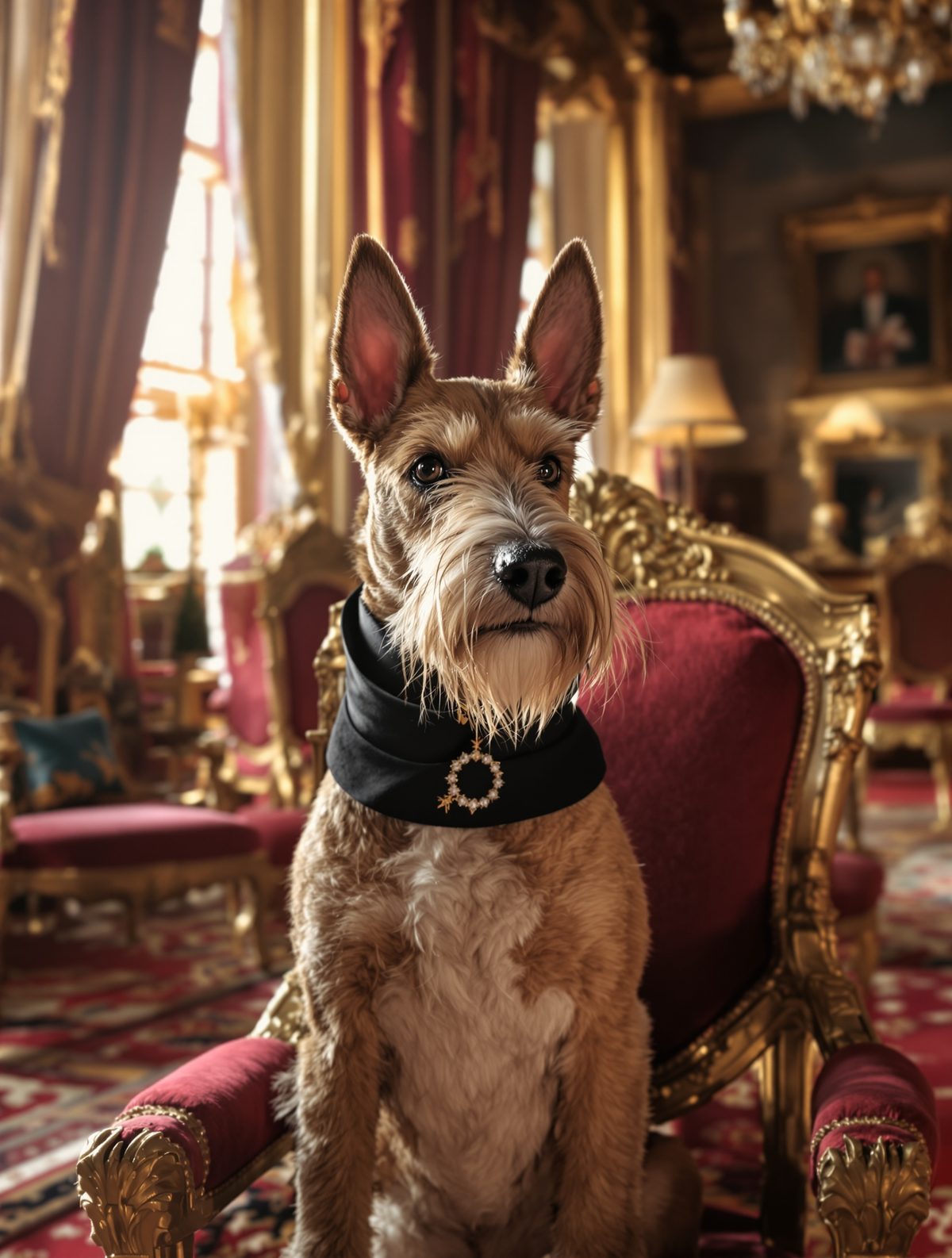
In 1910, nine kings and five queens gathered for the grandest royal funeral in history. But walking directly behind King Edward VII's coffin, ahead of European emperors and world leaders, was a small fox terrier named Caesar wearing a mourning collar. This touching scene would become one of the most memorable images of royal devotion ever captured, as a faithful companion claimed his rightful place in the procession that marked the end of an era.
The sight of Caesar padding solemnly through the streets of London, his collar draped in black crepe, spoke volumes about the character of the king he served. Here was a monarch who, despite all the pomp and protocol of Edwardian court life, never forgot the simple joy of unconditional canine companionship.
A King's Best Friend
Caesar's relationship with King Edward VII began in the early years of the 20th century, when the wire-haired fox terrier arrived at the royal palaces as a young dog. Unlike the formal hunting hounds and sporting dogs traditionally favoured by royalty, Caesar was chosen purely as a companion—a reflection of Edward VII's more relaxed approach to kingship compared to his mother, Queen Victoria.
The little terrier quickly became the king's constant shadow, following him through the corridors of Buckingham Palace, Windsor Castle, and Sandringham House. Courtiers grew accustomed to seeing Caesar trotting alongside His Majesty during informal moments, whether Edward was reviewing correspondence in his private study or taking his daily constitutional through the palace gardens.
What made Caesar special wasn't just his devotion to the king, but the way Edward VII treated him as a cherished family member rather than merely a pet. The dog wore a collar inscribed with the proud declaration: "I am Caesar. I belong to the King." This simple statement would take on profound significance in the days following Edward's unexpected death in May 1910.
Caesar's presence in the royal household represented something uniquely modern about Edward VII's reign. While maintaining all the dignity and ceremony expected of a monarch, the king understood the value of simple pleasures and genuine affection. In an age of rigid protocol, Caesar moved freely through spaces that were forbidden to all but the highest-ranking officials.
The Death of a King
When King Edward VII died on 6 May 1910, after a brief illness, Caesar was reportedly inconsolable. The dog had been by his master's side during the king's final days, and palace staff observed the terrier's obvious distress at the sudden absence of his beloved companion. In the immediate aftermath of the king's death, as the great machinery of state funeral preparations began to turn, someone had to make a decision about what to do with the grieving dog.
The arrangements for Edward VII's funeral were staggering in their complexity. As the first British monarch to die in the 20th century, and given his extensive personal relationships with European royalty, the guest list read like a who's who of world leadership. Kaiser Wilhelm II of Germany, despite growing political tensions, would attend to honour his uncle. The King of Spain, the King of Portugal, the King of Bulgaria, and numerous other crowned heads were making their way to London.
Yet amidst all this grand planning, Queen Alexandra—Edward's beloved wife—made a touching decision. Caesar would have his place in the funeral procession, walking directly behind the gun carriage bearing the king's coffin. This wasn't merely sentiment; it was a recognition of the genuine bond that had existed between the king and his faithful companion.
The decision spoke to the personal character of both Edward VII and Queen Alexandra. Even in the midst of profound grief and overwhelming state obligations, the human—and canine—elements of loss were not forgotten. Caesar's inclusion in the funeral procession elevated him above protocol and rank, placing him where his devotion, rather than his pedigree, dictated he should be.
A Funeral Procession for the Ages
On 20 May 1910, the funeral procession of King Edward VII began its solemn journey from Westminster Hall to Paddington Station, where the king's body would travel by royal train to Windsor for burial. The sight that greeted the millions of mourners lining the streets of London was unprecedented in its grandeur and poignancy.
Following the gun carriage came Caesar, held on a lead by a Highland servant, his coat brushed to perfection and his special mourning collar clearly visible against his white and tan fur. The little dog maintained perfect composure throughout the long procession, as if understanding the solemnity of the occasion. Behind Caesar walked King George V, the new monarch, followed by Kaiser Wilhelm II and an extraordinary assembly of European royalty.
The symbolism was impossible to miss: in the hierarchy of mourning, Caesar's position reflected not worldly power or political alliance, but pure, uncomplicated love. While emperors and kings walked in order of diplomatic precedence, the fox terrier walked in order of the heart. Contemporary newspapers noted the touching sight of the small dog maintaining his dignified pace throughout the lengthy procession, never wavering or seeking attention, simply fulfilling his final duty to his master.
Spectators along the route were particularly moved by Caesar's presence. In an age when class distinctions were rigidly maintained, there was something profoundly democratic about the sight of this humble terrier accorded such honour. The dog represented the possibility that loyalty and love could transcend social boundaries—a message that resonated powerfully with the crowds who had gathered to bid farewell to their king.
Legacy of Devotion
After the funeral, Caesar lived out his remaining years in the care of Queen Alexandra at Marlborough House. The dowager queen, who understood better than anyone the depth of her late husband's affection for the little terrier, ensured that Caesar continued to receive the attention and care he had known during the king's lifetime. The dog lived until 1914, when he was buried at Marlborough House with a headstone commemorating his faithful service.
Caesar's story became part of the enduring mythology surrounding King Edward VII's reign, representing the more human and accessible side of monarchy that the king had embodied. Unlike the distant majesty of Queen Victoria's later years, Edward VII's relationship with Caesar demonstrated a monarch who found joy in simple companionship and wasn't afraid to show genuine affection.
The image of Caesar in the funeral procession has been reproduced countless times in histories of the Edwardian era, serving as a powerful reminder that even in the most formal circumstances, authentic emotion finds a way to express itself. The dog's presence at the funeral wasn't merely a charming footnote to history; it was a statement about the values and character of the king he served.
In our modern era, when the Royal Family's relationships with their beloved corgis, spaniels, and other four-legged companions regularly capture public attention, Caesar's story resonates more strongly than ever. The tradition of royal devotion to their pets continues unbroken, from Queen Elizabeth II's famous corgis to the current generation's love for their canine companions. Caesar wasn't just King Edward VII's dog; he was a pioneer in the long tradition of royal pets who become cherished members of the family, worthy of the same love and respect accorded to any other family member. His dignified walk behind his master's coffin remains one of the most touching demonstrations of loyalty—both human and canine—in royal history.