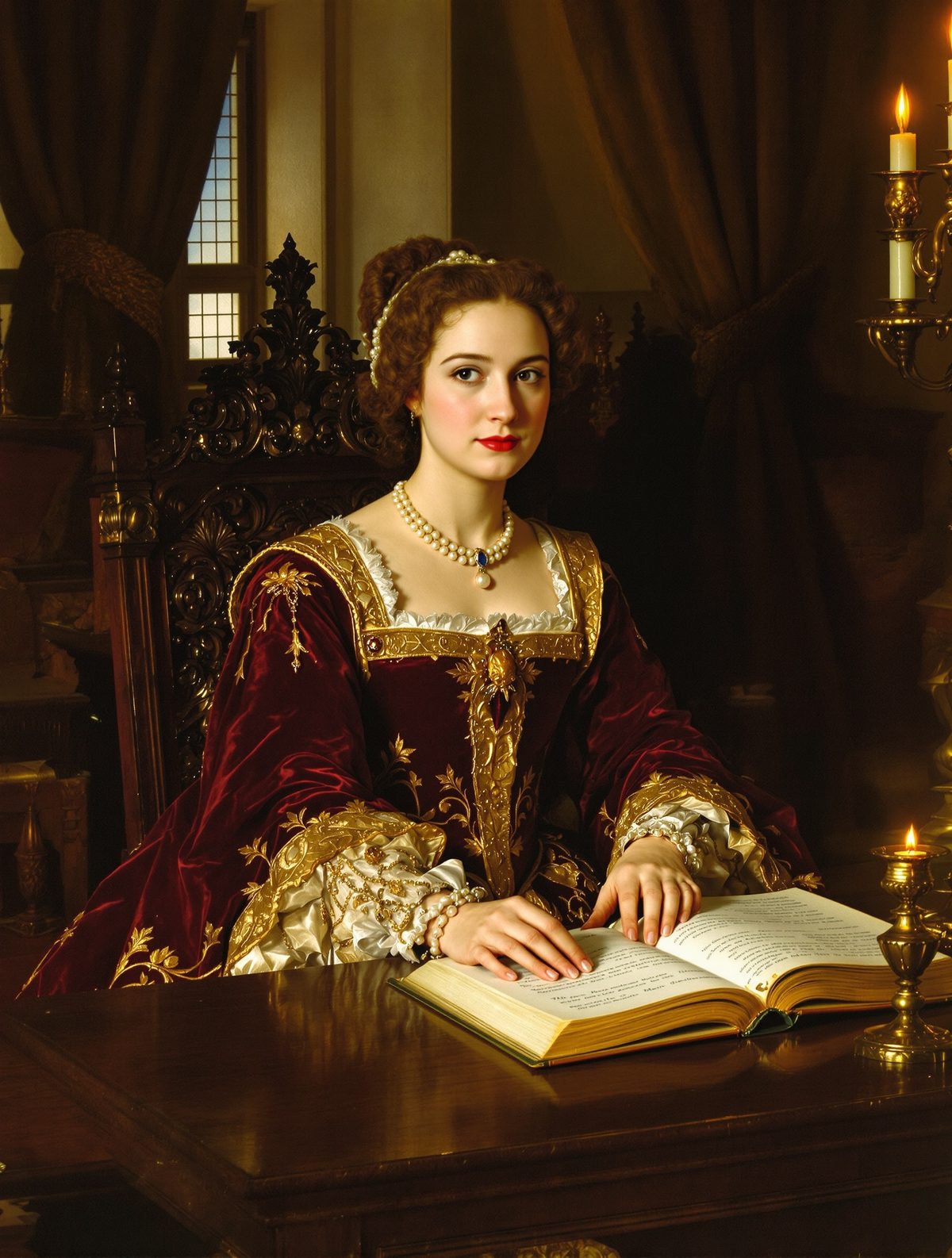
Princess Mary was exiled to Holland after her controversial marriage, dismissed by English courtiers as a lonely royal pining for home. But behind closed doors, the future queen was quietly mastering a secret skill that would change everything. While her husband William of Orange conducted affairs of state and her attendants whispered about her melancholy, Mary was teaching herself Dutch—word by painstaking word, transforming herself from a homesick exile into a woman who could understand every conversation, every letter, and every political machination happening around her.
A Princess in Political Exile
The year 1677 marked a dramatic turning point for fifteen-year-old Princess Mary. Her marriage to her Dutch cousin, William III of Orange, was nothing short of a political masterstroke orchestrated by her uncle, King Charles II, but it came at an enormous personal cost. Torn from the familiar comforts of English court life, Mary found herself transplanted to the Netherlands—a country that might as well have been on another continent for all its differences from her homeland.
The Dutch Republic of the 1680s was a fascinating contradiction: a small nation that had become a global powerhouse through trade and naval supremacy, yet one locked in perpetual struggle against the might of Louis XIV's France. For Mary, however, these grand geopolitical realities mattered little compared to the immediate challenge of daily life in what felt like a foreign land. The language barrier was particularly isolating—Dutch seemed impenetrable to English ears, with its harsh consonants and unfamiliar rhythms.
Contemporary accounts describe Mary during her early months in Holland as withdrawn and melancholy. English visitors to the court at The Hague reported seeing the young princess looking pale and homesick, spending long hours in correspondence with friends back home. What they didn't realize was that Mary's apparent solitude was actually the beginning of an extraordinary act of self-determination.
The Secret Scholar
Behind the carefully maintained facade of the dutiful but distant wife, Mary embarked on what can only be described as a covert educational mission. Without tutors, without fanfare, and crucially, without her husband's knowledge, she began the painstaking process of learning Dutch. This wasn't merely about picking up basic conversational phrases—Mary was determined to achieve genuine fluency.
The logistics of this secret study would have been formidable. Royal households of the era operated under intense scrutiny, with every moment of a princess's day subject to observation and comment. Yet Mary managed to carve out private hours, likely during the long winter evenings when darkness fell early over the Dutch landscape. She appears to have begun with religious texts—safer material that wouldn't raise eyebrows if discovered, and content with which she was already familiar in English.
The challenge cannot be overstated. Dutch grammar, with its complex verb conjugations and sentence structures, bears little resemblance to English despite their shared Germanic roots. The pronunciation alone would have presented significant hurdles. Yet Mary persevered, driven perhaps by a combination of intellectual curiosity and the very practical need to understand the world in which she now lived.
By her own account in later letters, Mary's breakthrough moment came when she realized she could follow the gist of conversations between her Dutch attendants. This small victory spurred her to greater efforts, and she began seeking out more challenging material to test her growing comprehension.
Reading the Political Winds
Mary's linguistic triumph reached its zenith during the winter of 1684-1685, when she achieved what had seemed impossible just years earlier: she could read Dutch newspapers with genuine understanding. This accomplishment was far more significant than it might initially appear. Newspapers in the Dutch Republic were among Europe's most sophisticated, offering detailed coverage of international affairs, trade developments, and political intrigue.
For a princess whose husband was one of Protestant Europe's most important political figures, access to unfiltered Dutch perspectives on current events was invaluable. While William received briefings from his advisors and read selected reports, Mary could now absorb the full spectrum of Dutch public opinion and analysis. She understood the concerns of merchants worried about French expansion, the anxieties of Calvinist ministers about Catholic influence, and the complex web of alliances that kept the Republic secure.
The power dynamics this created were extraordinary. In an age when information was carefully controlled and filtered, especially for royal women, Mary had quietly given herself access to unmediated intelligence. She could listen to her husband's conversations with Dutch officials, understanding not just his words but their responses, their hesitations, their unguarded moments of honesty or concern.
Perhaps most remarkably, she chose to keep this knowledge secret. There's no evidence that William ever learned of his wife's linguistic achievement during these early years. This decision speaks to Mary's growing political sophistication—she understood that knowledge was most powerful when others didn't know you possessed it.
The Making of a Future Queen
Mary's clandestine education in Dutch proved to be far more than an intellectual exercise or a remedy for homesickness. It was, in many ways, her apprenticeship for queenship. The skills she developed—patience, discretion, the ability to absorb information while appearing passive—would serve her well when she and William were called to take the English throne during the Glorious Revolution of 1688.
The transformation is striking when we compare the uncertain fifteen-year-old who arrived in Holland with the confident woman who would co-rule England. Mary's secret study had taught her that power often lay in understanding rather than being understood, in listening rather than speaking. These lessons would prove invaluable during the delicate negotiations and political maneuvering required to successfully establish William and Mary's joint reign.
Her Dutch fluency also gave Mary unique insights into Protestant European politics that few English monarchs had ever possessed. She understood the concerns and perspectives of England's most important continental allies not through translation or interpretation, but directly. This knowledge informed her approach to foreign policy and religious matters throughout her reign.
Contemporary observers noted Mary's unusual confidence in dealing with Dutch diplomats and merchants once she became queen. What they attributed to her years of residence in Holland was actually the fruit of her secret intellectual labor—the deep cultural and linguistic understanding she had painstakingly acquired through her covert studies.
Mary's story reminds us that even in the most constrained circumstances, determined individuals can find ways to expand their horizons and increase their agency. Her secret Dutch lessons were more than just language learning—they were acts of quiet rebellion against the limitations placed on royal women, and stepping stones toward the confident leadership she would later display on the English throne. In our own age of constant connectivity and instant translation, there's something profoundly moving about a young woman sitting alone by candlelight, slowly deciphering foreign words and transforming herself from exile into expert, one careful sentence at a time.