In the shadowy corridors of Kensington Palace during the 1830s, a teenage princess staged the most important rebellion in British royal history. But this wasn't a dramatic confrontation or public defiance—it was conducted in absolute silence, by candlelight, in the depths of night. Princess Victoria, future Empress of the British Empire, discovered that her most powerful weapon wasn't a crown or sceptre, but a simple pen and the fierce determination to use it when no one was watching.
A Gilded Prison at Kensington
To understand Victoria's midnight rebellions, we must first step into the claustrophobic world of her childhood. Kensington Palace in the 1830s was far from the grand royal residence we know today. Young Victoria lived under what historians call the "Kensington System"—a suffocating regime of control orchestrated by her German mother, the Duchess of Kent, and her ambitious advisor Sir John Conroy.
The future Queen was never allowed to be alone. She slept in her mother's bedroom until she was eighteen. She couldn't walk down a staircase without holding someone's hand. Every letter she wrote was read before being sent, every conversation monitored, every social interaction carefully managed. The Duchess and Conroy hoped to control Victoria so completely that when she became Queen, they would be the true powers behind the throne.
But they underestimated the iron will brewing beneath Victoria's seemingly compliant exterior. The very restrictions meant to contain her actually forged the legendary strength that would define her sixty-three-year reign. And the catalyst for this transformation happened not in grand state rooms, but in the intimate darkness of her bedroom, illuminated only by smuggled candles.
The Secret Sanctuary of Words
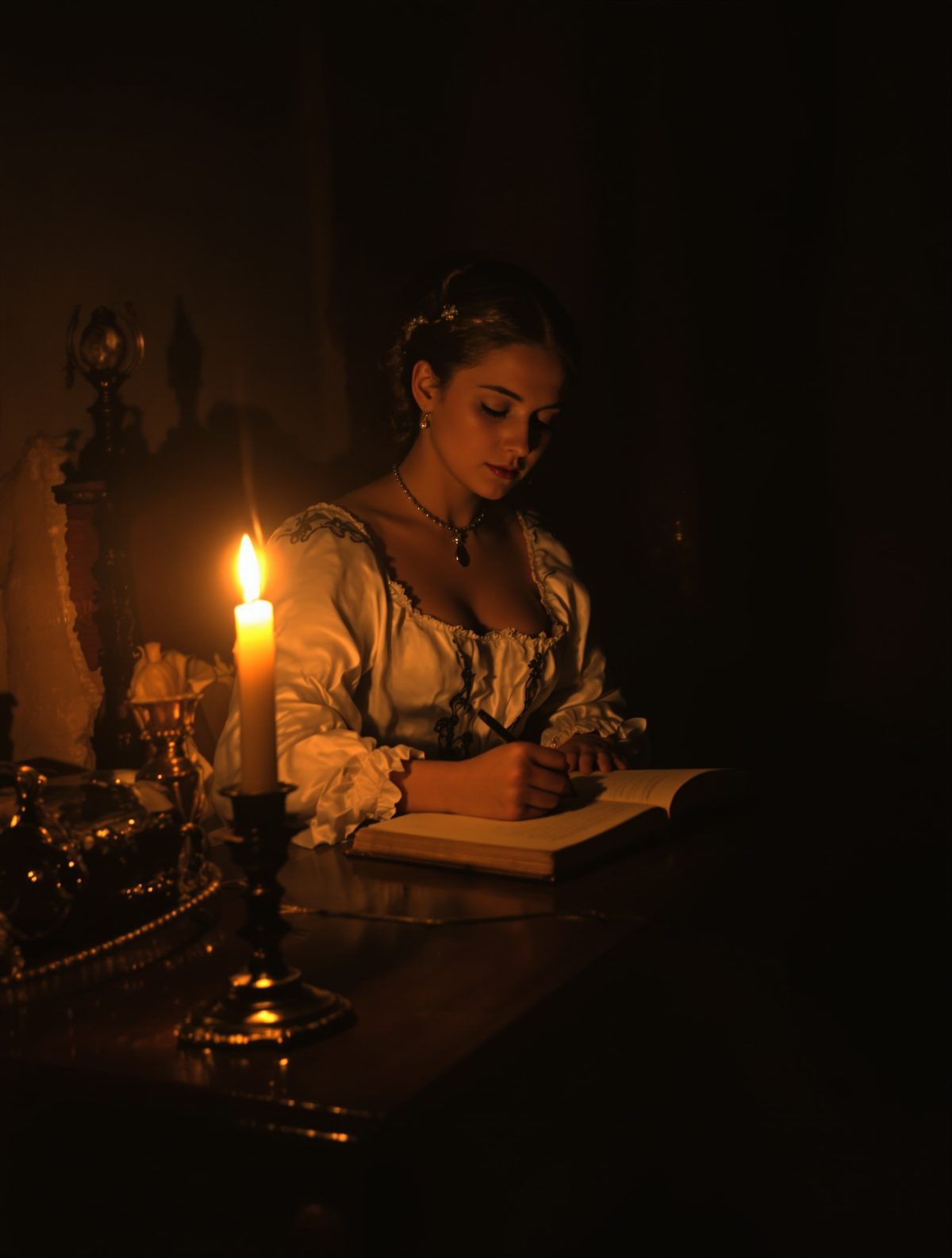
Each night, after the palace settled into silence and her mother's breathing grew deep and regular, Victoria would slip from her bed with practiced stealth. Moving like a ghost through the moonlit chambers, she would make her way to her small writing desk—a piece of furniture that would become as significant to British history as any throne.
There, by flickering candlelight, Victoria poured her true thoughts onto paper. Her diary became her confidant, her therapist, and her fortress of solitude all in one. While her days were filled with forced smiles and careful compliance, her nights belonged entirely to her authentic self. She wrote with a passion and honesty that would have horrified her handlers—recording her frustrations, her dreams, her growing awareness of her destiny, and most importantly, her fierce determination to rule on her own terms.
These weren't the sanitized, diplomatic entries we often associate with royal correspondence. Victoria wrote with raw emotion about her resentment toward Conroy, her complex feelings about her mother, and her burning desire for independence. She understood instinctively that these midnight hours were shaping not just her character, but the future of the monarchy itself.
The Making of an Iron Will
What makes Victoria's secret writing sessions so remarkable is how they forged the psychological steel that would serve her throughout her legendary reign. Night after night, as she processed her experiences and emotions through writing, she was essentially conducting an intensive course in self-knowledge and emotional resilience.
Her diary entries from this period reveal a young woman who was learning to trust her own judgment despite being constantly told she couldn't be trusted to make decisions. She was developing her own moral compass while surrounded by people trying to manipulate her direction. Most crucially, she was learning that her private thoughts and authentic self were precious commodities that she needed to protect at all costs.
The secrecy itself was transformative. Every night that Victoria successfully evaded detection, every entry she completed without discovery, was a small victory that built her confidence. She was proving to herself that she could outmaneuver those who sought to control her. These tiny rebellions were rehearsals for the much larger act of independence she would need to perform when she became Queen.
Palace servants later recalled seeing candlelight flickering under doors at odd hours, but none suspected their future monarch was conducting a revolution by quill pen. The Duchess of Kent's spies, so thorough in monitoring Victoria's daytime activities, never discovered the treasure trove of authentic thoughts hidden in plain sight.
The Night That Changed Everything
The most significant of Victoria's midnight writing sessions may have occurred in the weeks leading up to her eighteenth birthday in May 1837. Historical evidence suggests she used these precious nighttime hours to plan her strategy for independence—working out exactly how she would break free from her mother's control the moment she legally could.
When King William IV died just weeks after Victoria's eighteenth birthday, the teenage Queen was ready. Her first official acts shocked the court with their decisiveness and independence. She immediately moved her bed out of her mother's room, banned Sir John Conroy from her presence, and established herself as the sole authority in her royal household. The courtiers who had expected to manage a malleable young woman instead found themselves facing a monarch who knew exactly who she was and what she wanted.
This remarkable transformation didn't happen overnight when she received the crown—it had been carefully cultivated during those secret midnight hours when a determined teenager taught herself to rule by first learning to rule her own thoughts and emotions.
A Legacy Written in Darkness
Victoria's secret rebellion illuminates something profound about both monarchy and human nature. The greatest leaders often aren't those who never face restrictions, but those who learn to transcend them creatively. By finding a way to preserve and develop her authentic self despite overwhelming pressure to conform, Victoria developed the psychological independence that would make her one of history's most formidable monarchs.
Her midnight writing sessions remind us that sometimes the most important battles are fought not in public, but in the quiet moments when we choose who we want to become. Victoria's quill pen, wielded in candlelit secrecy, proved mightier than all the controlling schemes of ambitious courtiers. Those stolen hours of authentic self-expression shaped not just a Queen, but an entire era of British history.
Today, as we watch current royals navigate the challenges of public life while maintaining their personal identity, we can trace a direct line back to that determined teenager who refused to let others write her story. Victoria's secret midnight rebellions teach us that true strength often begins not with grand gestures, but with the quiet courage to remain true to ourselves when no one else is watching.