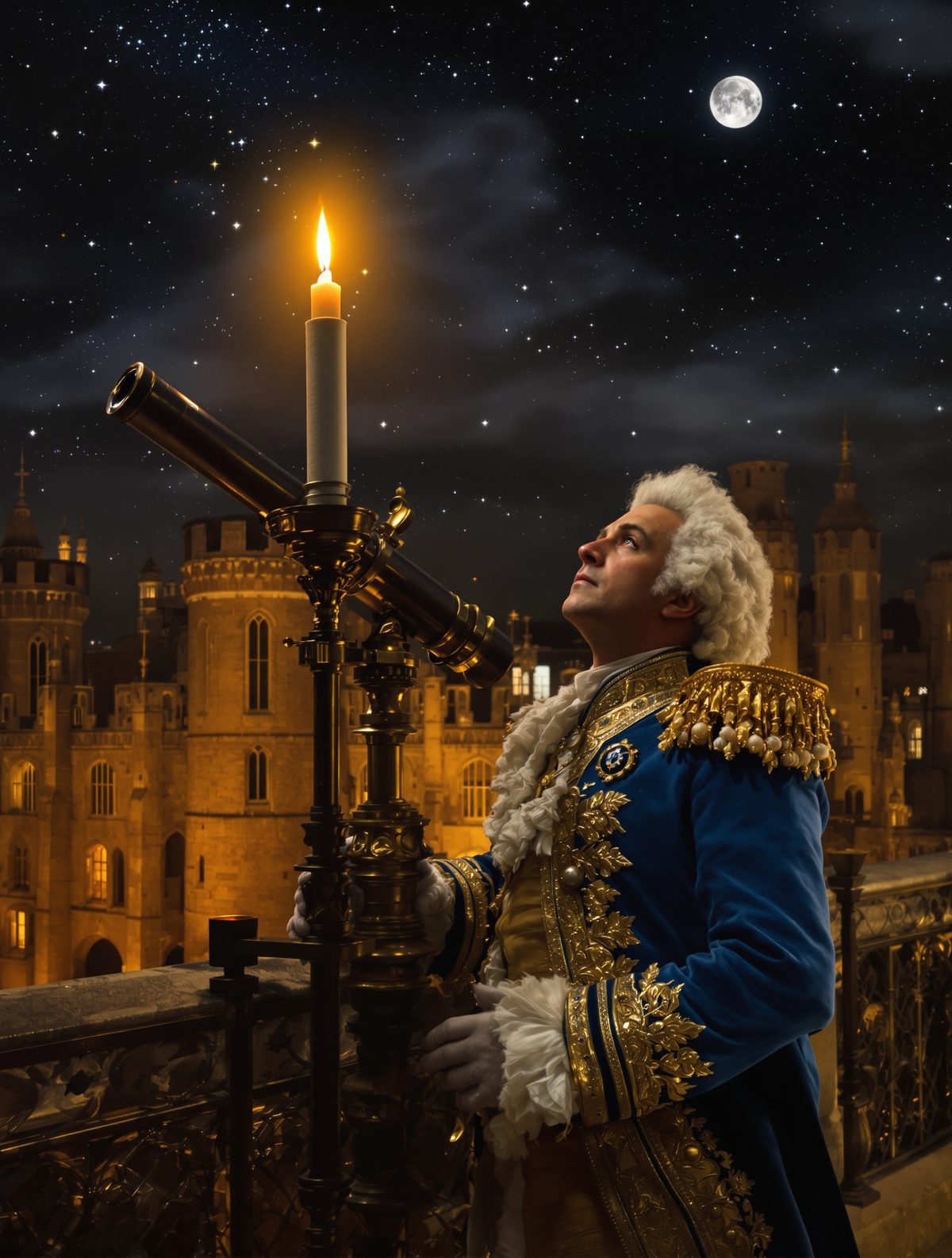
While his subjects slumbered in their beds, King George III would slip quietly from his royal chambers and ascend the winding stone steps of Windsor Castle's highest tower. There, beneath the vast canopy of stars that stretched across the English countryside, the monarch who ruled over an empire found solace in the infinite cosmos above. Armed with his treasured telescope and an insatiable curiosity about the heavens, George III transformed his sleepless nights from periods of torment into voyages of celestial discovery.
The King's Celestial Sanctuary
The 1780s marked a turbulent period in George III's reign. The loss of the American colonies weighed heavily upon his mind, and the first signs of the mysterious illness that would plague him throughout his later years were beginning to manifest. Yet amidst the political upheaval and personal struggles, the King discovered an unexpected refuge in astronomy—a passion that would become both his greatest comfort and his most closely guarded secret.
Every night at precisely two o'clock in the morning, George III would make his solitary pilgrimage to the castle's rooftop observatory. Court attendants grew accustomed to the soft footsteps echoing through the corridors at this ungodly hour, knowing their sovereign sought communion with the stars. The King's physician, Sir George Baker, noted in his private correspondence that these nocturnal astronomical sessions were often the only periods when His Majesty appeared truly at peace.
Windsor Castle's position, elevated above the Thames Valley, provided an ideal vantage point for stargazing. Away from the smoke and bustle of London, the night sky revealed its treasures with remarkable clarity. George III had commissioned the finest telescopes money could procure, including instruments crafted by the renowned William Herschel, who would later become the King's personal astronomer.
A Royal Mind Seeking Order in Chaos
The King's attraction to astronomy extended far beyond mere hobby or idle curiosity. In the precise movements of planets and the predictable patterns of constellations, George III found the order and stability that seemed increasingly elusive in his earthly realm. Each night, he would meticulously record his observations in leather-bound journals, documenting the positions of celestial bodies with the same attention to detail he applied to matters of state.
The regularity of the heavens provided a stark contrast to the unpredictability of political life. While Parliament debated and ministers schemed, the stars followed their eternal dance with mathematical precision. For a monarch grappling with the chaos of revolution abroad and political pressure at home, this celestial clockwork offered profound psychological comfort.
Court physicians of the era possessed limited understanding of mental health, but they recognized the therapeutic value of the King's astronomical pursuits. Dr. Francis Willis, who would later treat George III during his more severe episodes of illness, observed that the King's condition invariably improved following his nighttime observations. The concentration required for astronomical work, combined with the meditative quality of stargazing, seemed to quiet the troubled thoughts that plagued the royal mind.
The Secret World of Royal Science
Few members of the court were aware of the extent of George III's astronomical expertise. By day, he fulfilled his royal duties with characteristic diligence, attending councils, receiving ambassadors, and managing the affairs of his kingdom. But his true intellectual passion remained hidden in the darkness of night, known only to a trusted circle of servants and scientific advisors.
The King's astronomical journals reveal a sophisticated understanding of celestial mechanics. He tracked the orbits of newly discovered planets, recorded the appearance of comets, and even attempted to map previously uncharted star clusters. His observations were not merely recreational; they contributed valuable data to the scientific community of his time, though the King insisted on anonymity for his contributions.
George III's dedication to astronomy reflected the broader intellectual curiosity that characterized his reign. He was a patron of the sciences, founding the Royal Academy of Arts and supporting numerous scientific expeditions. However, his personal astronomical work remained intensely private, perhaps because it served such a vital role in maintaining his mental equilibrium.
The solitude of his nighttime observations was equally important. Away from the constant demands of courtiers and ministers, the King could simply be a man contemplating the universe. These precious hours of independence allowed him to escape the suffocating protocols of royal life and engage with something greater than himself.
When Science Meets Sovereignty
The King's astronomical activities occasionally intersected with his royal duties in unexpected ways. When Herschel discovered the planet Uranus in 1781, George III was among the first to observe it through his own telescope. The King's enthusiasm for this discovery led to Herschel receiving royal patronage and the position of Court Astronomer—a relationship that began with shared wonder at the night sky atop Windsor Castle.
The King's support for astronomy extended beyond personal interest to active patronage of scientific advancement, demonstrating how royal passion could drive national progress.
These midnight sessions also influenced the King's approach to governance. The patience required for astronomical observation—waiting hours for a particular celestial event or spending weeks tracking the movement of a comet—cultivated a similar patience in his political dealings. Ministers noted that the King seemed more contemplative and measured in his decisions during periods when he was actively engaged in astronomical work.
The King's scientific pursuits helped establish Britain's reputation as a center of astronomical research. His support for observatories and scientific instruments contributed to advances that would benefit navigation, timekeeping, and exploration—all crucial to Britain's growing maritime empire.
Legacy Written in Starlight
As George III's illness progressed in later years, his ability to conduct these midnight observations gradually diminished. The clear, methodical thinking required for astronomical work became increasingly difficult, and eventually, the King's nightly journeys to the castle roof ceased entirely. Yet the impact of those peaceful hours among the stars had left an indelible mark on both the monarch and the scientific community he had quietly supported.
The King's astronomical journals, preserved in the Royal Collection, stand as testament to a remarkable mind seeking truth and beauty in the cosmos. They reveal a side of George III rarely seen by his contemporaries—not the mad king of popular imagination, but a thoughtful, curious individual finding solace in scientific pursuit.
Today, as we grapple with our own forms of mental strain and seek healthy outlets for stress, George III's midnight astronomy offers a timeless lesson. In an age of constant connectivity and endless demands, perhaps we might all benefit from occasionally stepping outside, looking up at the same stars that comforted a troubled king, and remembering our place in the grand celestial order that continues its eternal dance above Windsor Castle and beyond.