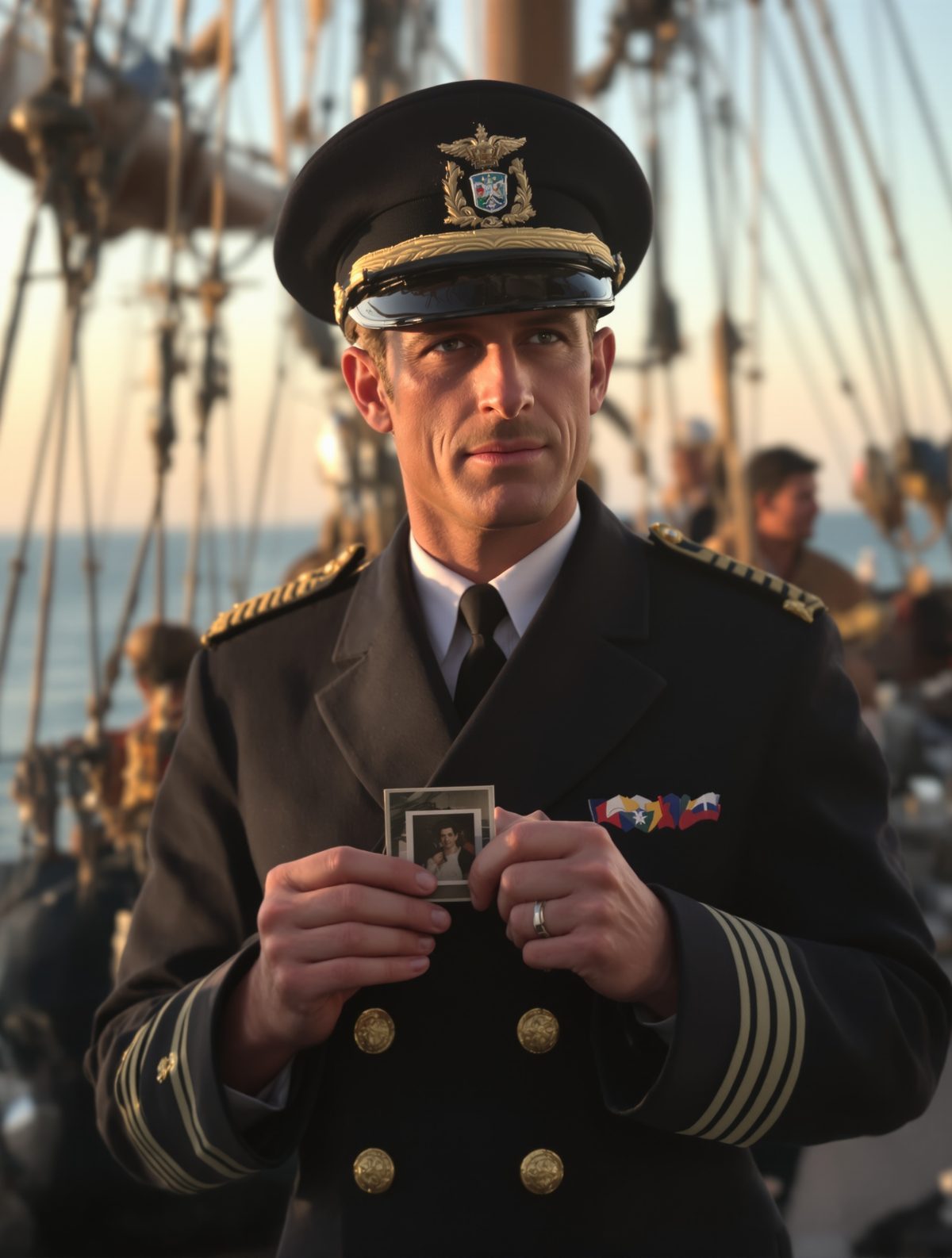
Long before Prince Philip became the steadfast consort to Queen Elizabeth II, he was a dashing young naval officer navigating treacherous Mediterranean waters—with the photograph of a beautiful Canadian woman tucked close to his heart. For two years during the height of World War II, it wasn't Princess Elizabeth's image that accompanied him through some of the war's most dangerous naval battles, but that of Osla Benning, a spirited Canadian debutante who had captured the future Duke of Edinburgh's affections in wartime London.
This remarkable chapter in royal history reveals a very human side to the man who would become Britain's longest-serving royal consort—a young prince torn between the stirrings of first love and the weight of royal expectations that would ultimately shape his destiny.
A Wartime Romance Blooms in London
When Prince Philip of Greece and Denmark arrived in London in 1939, he was a virtually penniless royal exile with little more than his Royal Naval training and his striking good looks to recommend him. It was during this uncertain period that he encountered Osla Benning, a vivacious Canadian who was working for the intelligence services at Bletchley Park—though this detail would only emerge decades later.
Osla was everything a young man could desire: intelligent, beautiful, and possessed of that particular confidence that came with being raised in the wide-open spaces of Canada. The daughter of a distinguished Canadian family, she had come to London before the war and found herself swept up in the city's social whirl. When she met the tall, blonde naval cadet with the piercing blue eyes and decidedly foreign accent, the attraction was immediate and mutual.
Their courtship unfolded against the dramatic backdrop of wartime London. Air raid sirens, blackout curtains, and the constant threat of German bombers created an atmosphere where young people lived intensely, knowing that each day might be their last. For Philip and Osla, this meant stolen moments between his naval training and her increasingly secret war work—dinners in dimly lit restaurants, dancing to swing music in basement clubs, and long walks through Hyde Park despite the very real danger overhead.
Letters Across the Mediterranean
When Philip shipped out to the Mediterranean in 1940 aboard HMS Valiant, he carried with him not just his naval duties but also his devotion to Osla. The young prince distinguished himself admirably in combat—he would later be mentioned in dispatches for his role in the crucial Battle of Cape Matapan—but his private moments were often spent writing letters to the woman he'd left behind in London.
These wartime correspondences, while largely private, paint a picture of a young man genuinely smitten. Philip's naval colleagues later recalled how he would speak fondly of his Canadian girlfriend, and how carefully he guarded her photograph among his few personal possessions. In an era when a single enemy torpedo could send a battleship to the bottom of the Mediterranean, such personal talismans carried enormous emotional weight.
For Osla, left behind in wartime London, the separation was equally difficult. She continued her own vital war work while anxiously following news from the Mediterranean theatre, knowing that Philip was in the thick of some of the war's most dangerous naval encounters. The uncertainty of wartime romance—never knowing if a letter might be the last, or if the next telegram might bring devastating news—intensified emotions that might otherwise have developed more gradually.
The Princess Enters the Picture
It was during one of Philip's leaves in 1943 that fate intervened in the form of a royal invitation. Through his connections—particularly his relationship with Lord Mountbatten, his uncle and mentor—Philip found himself increasingly drawn into the orbit of the British Royal Family. Princess Elizabeth, then just seventeen, was beginning to emerge from the sheltered world of her youth, and when she encountered the war hero prince at family gatherings, her teenage infatuation was immediate and obvious to all who observed them.
For Philip, this presented an extraordinary dilemma. His feelings for Osla remained strong, but the prospect of marrying the future Queen of England represented something far beyond romantic consideration—it was a chance to secure his place in the world after years of royal exile and uncertainty. The young prince found himself caught between genuine affection for a woman who had stood by him through the uncertainty of war, and the dazzling possibility of a future that would make him one of the most prominent men in the Commonwealth.
What made this choice particularly poignant was that it wasn't simply a matter of choosing duty over love. Those who knew Philip during this period observed that he was genuinely fond of Princess Elizabeth, impressed by her intelligence and strength of character. Yet his relationship with Osla had the depth that comes from shared experience during extraordinary times—they had courted during the Blitz, corresponded through the uncertainty of war, and supported each other through some of the most challenging years of the twentieth century.
The Decision That Changed Everything
The resolution came in 1946, when Philip returned to Britain for an extended period and was forced to confront the choice he could no longer postpone. Princess Elizabeth's feelings had only intensified during his absence, and King George VI, initially skeptical of the foreign prince with no kingdom of his own, was gradually warming to the possibility of the match. The pressure—both external and internal—was mounting for Philip to declare his intentions.
According to those close to the situation, Philip handled the delicate matter with as much grace as possible under the circumstances. He met with Osla personally to explain his decision, acknowledging what they had meant to each other while making clear that his future lay with the Princess. For Osla, who had waited faithfully through years of wartime separation, the news was undoubtedly devastating, though she accepted it with the dignity that had characterized her throughout their relationship.
Osla Benning would go on to marry well and live a full life, though she rarely spoke publicly about her relationship with the future Duke of Edinburgh. In later years, when asked about this chapter of her life, she displayed the discretion and grace that suggested why Philip had been so drawn to her in the first place.
A Love That Shaped a Future King's Consort
Philip's relationship with Osla Benning was far more than a footnote in royal history—it was a formative experience that shaped the man who would stand beside Queen Elizabeth II for more than seven decades. The confidence that comes from being truly loved, the understanding of sacrifice that comes from making difficult choices, and perhaps most importantly, the knowledge of what it means to choose duty over personal desire—these lessons would serve him well in his decades of royal service.
When Philip finally proposed to Princess Elizabeth in 1946, he did so as a man who understood the weight of the commitment he was making. His relationship with Osla had taught him about love's complexities and marriage's responsibilities in ways that would prove invaluable during the inevitable challenges of royal life. The young naval officer who had once carried a Canadian woman's photograph through the Mediterranean had matured into a man ready to dedicate his life to the service of the Crown.
Looking back on this remarkable chapter, we see not a tale of romantic betrayal, but rather a deeply human story of growth, choice, and the sometimes painful transition from youth to adulthood. Prince Philip's wartime romance reminds us that even those born to extraordinary destinies must navigate the universal experiences of love, loss, and difficult decisions that shape us all. In choosing his future queen, he brought with him the wisdom and emotional maturity that would make him not just a devoted husband, but a cornerstone of the modern monarchy—lessons learned, in part, through a photograph carried across wartime seas.