Every afternoon at precisely two o'clock, something extraordinary would happen at Windsor Castle. King George III, sovereign of the mighty British Empire, would quietly slip away from his royal duties, leaving behind a trail of bewildered courtiers and unfinished state papers. For months, the palace buzzed with whispered speculation. Where was His Majesty disappearing to? Was he meeting with secret advisors? Conducting clandestine affairs of state? The truth, when it finally emerged, was far more shocking to Georgian sensibilities than any political intrigue could have been.
The Mystery of the Missing Monarch
In the rigid hierarchy of 18th-century court life, every moment of a king's day was carefully choreographed. George III's sudden disappearances therefore caused considerable consternation among his household. Lord Chamberlains found themselves explaining the King's absence to visiting dignitaries, while secretaries shuffled appointments and made excuses for delayed correspondence.
The King's own gentleman-in-waiting, who traditionally shadowed the monarch throughout his daily routine, found himself politely but firmly dismissed each afternoon. "His Majesty requires some private time for reflection," became the standard explanation, though it satisfied no one. Court officials began to whisper that perhaps the pressures of ruling during such turbulent times—the American colonies were in revolt, and Britain's global position seemed increasingly precarious—had begun to affect their sovereign's mind.
The mystery deepened when servants reported strange sounds echoing from the lower levels of the castle: rhythmic hammering, the scrape of wood against wood, and occasionally what sounded distinctly like whistling. Some of the more imaginative courtiers wondered if the King had taken up some form of physical exercise, though the idea of royalty engaging in manual exertion was almost as scandalous as any other theory they could devise.
The Shocking Discovery
The truth emerged quite by accident when a young page, tasked with delivering urgent correspondence from Parliament, became hopelessly lost in Windsor's labyrinthine passages. Following the sound of activity, he stumbled upon a door he had never noticed before, slightly ajar and emanating the warm scent of wood shavings and linseed oil.
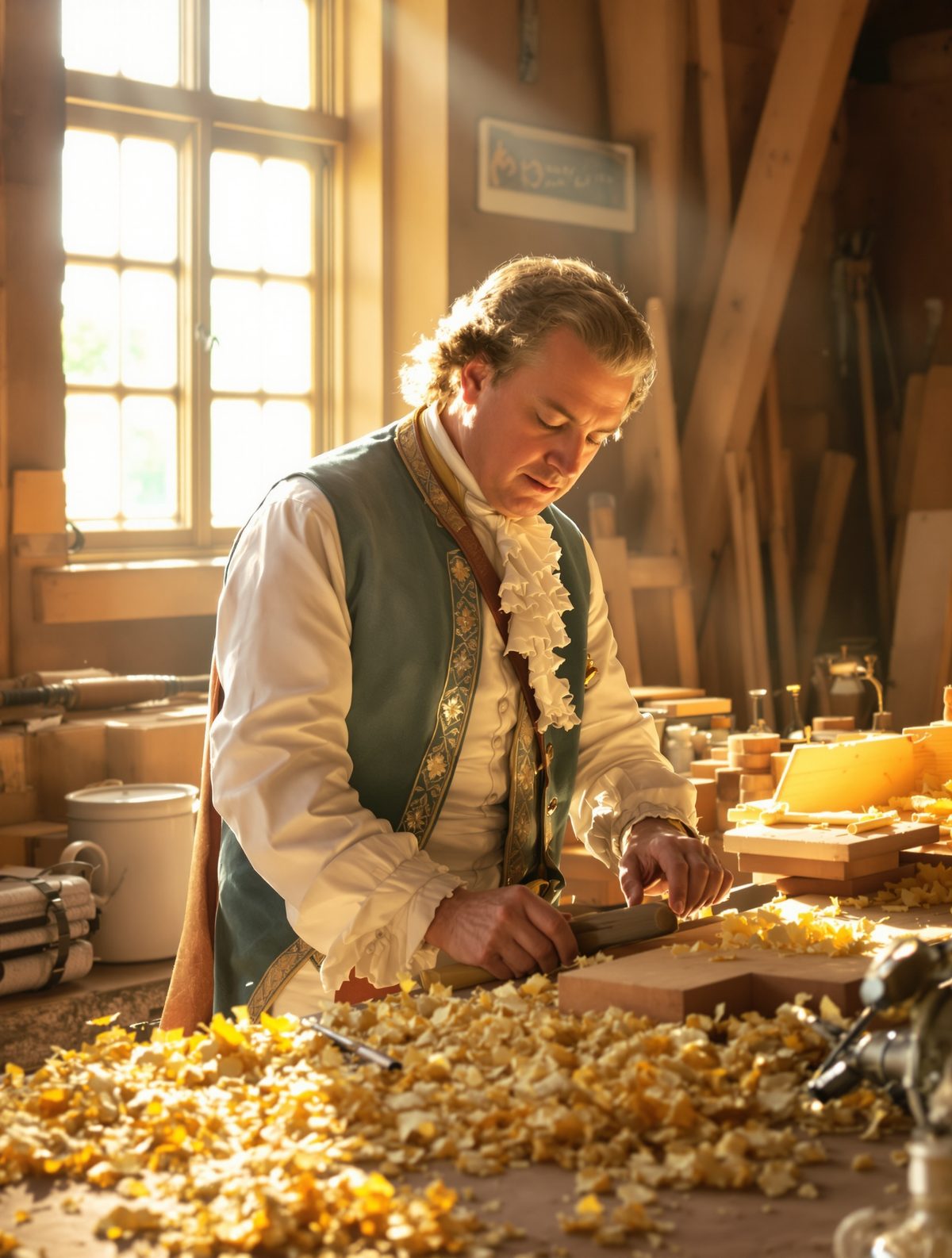
Peering inside, the page witnessed a sight that would have seemed impossible to anyone familiar with Georgian court protocol: there stood King George III, monarch of Great Britain and Ireland, Defender of the Faith, with his sleeves rolled up, his wig discarded, and his hands covered in sawdust. Before him lay the partially completed frame of what appeared to be an elegant writing desk, crafted with remarkable skill and attention to detail.
The King, far from being embarrassed by the discovery, seemed almost relieved. According to later accounts, he invited the startled page into his secret workshop, proudly showing off several completed pieces: a delicate bookshelf, a sturdy kitchen table, and a beautifully turned set of chair legs. Each piece bore the unmistakable marks of careful, patient craftsmanship—the work of someone who had clearly spent considerable time honing their skills.
A Royal Workshop Revealed
George III's carpentry workshop, as it turned out, was no mere whim. The King had quietly transformed a series of unused rooms in the castle's lower levels into a fully equipped woodworking space. Here, surrounded by carefully organized tools, seasoned timber, and works in various stages of completion, Britain's monarch had created a refuge from the crushing responsibilities of kingship.
The workshop itself was a testament to the King's methodical nature and genuine passion for the craft. Hand planes were arranged with military precision, chisels were kept razor-sharp, and lumber was carefully sorted by type and quality. The King, it emerged, had been secretly studying carpentry for years, learning from books and occasionally consulting with master craftsmen who were sworn to secrecy about their unusual pupil's identity.
What made this revelation so scandalous was not merely that the King was engaging in manual labor—though that alone was enough to send shockwaves through aristocratic society—but that he was genuinely good at it. The furniture George III produced was not the amateur dabbling one might expect from royal hands, but accomplished work that demonstrated real skill, patience, and artistic sensibility.
The King's carpentry pieces often found their way into the private apartments of family members, though recipients were initially unaware of their maker's identity. Queen Charlotte was reportedly delighted with a jewelry box of unknown origin, while the royal children played with toys that bore the secret mark of their father's handiwork.
More Than Just a Hobby
For George III, carpentry represented far more than a pleasant diversion from royal duties. In an age when kings were expected to be remote, almost divine figures, the tactile, immediate nature of woodworking provided a profound form of emotional release. Here was something he could control completely, where his decisions had immediate, visible results, and where the only approval that mattered was his own critical eye.
The King's passion for practical skills extended beyond carpentry. He was known to take a keen interest in agriculture, earning the nickname "Farmer George" for his progressive approaches to crop rotation and livestock breeding. His carpentry workshop represented the same impulse: a desire to engage with the physical world in a direct, meaningful way that his royal position rarely allowed.
Contemporary accounts suggest that George III found genuine peace in his workshop. The rhythmic motions of planing wood, the careful calculation required for complex joints, and the gradual transformation of raw timber into beautiful, functional objects provided a form of meditation that helped him cope with the immense pressures of ruling during one of Britain's most challenging periods.
Remarkably, the King often incorporated elements of royal symbolism into his work, though always subtly. Crown motifs might appear in the grain pattern he selected, or the proportions of a piece might echo the mathematical principles underlying classical architecture. Even in his most private moments, George III remained conscious of his royal identity, but here he could express it through personal creativity rather than ceremonial obligation.
A Legacy in Wood and Understanding
When news of the King's carpentry eventually spread beyond the palace walls, reactions were mixed but intense. Some members of the aristocracy were genuinely shocked that their sovereign would engage in what they considered common labor. Others, particularly those influenced by Enlightenment thinking, saw it as evidence of the King's progressive, practical nature.
The revelation also helped explain certain aspects of George III's character that had previously puzzled observers. His detailed knowledge of building techniques, his passionate interest in the construction projects at various royal residences, and his unusual ability to discuss practical matters with craftsmen and workers all made sense in light of his secret hobby.
Today, as we observe modern royals pursuing their own passions and interests, King George III's carpentry workshop seems remarkably ahead of its time. His insistence on maintaining a private space for personal fulfillment, his willingness to develop genuine expertise outside his official role, and his understanding that even kings need outlets for creativity and stress relief all feel surprisingly contemporary.
The pieces George III created in his secret workshop have largely been lost to history, scattered among family members or perhaps sitting unrecognized in storerooms and private collections. But the story of their creation remains a powerful reminder that behind every crown sits a human being, with the same fundamental needs for purpose, accomplishment, and peace that drive us all. In finding his own path to these universal requirements, King George III revealed not weakness, but a wisdom that perhaps more of his contemporaries should have recognized and admired.