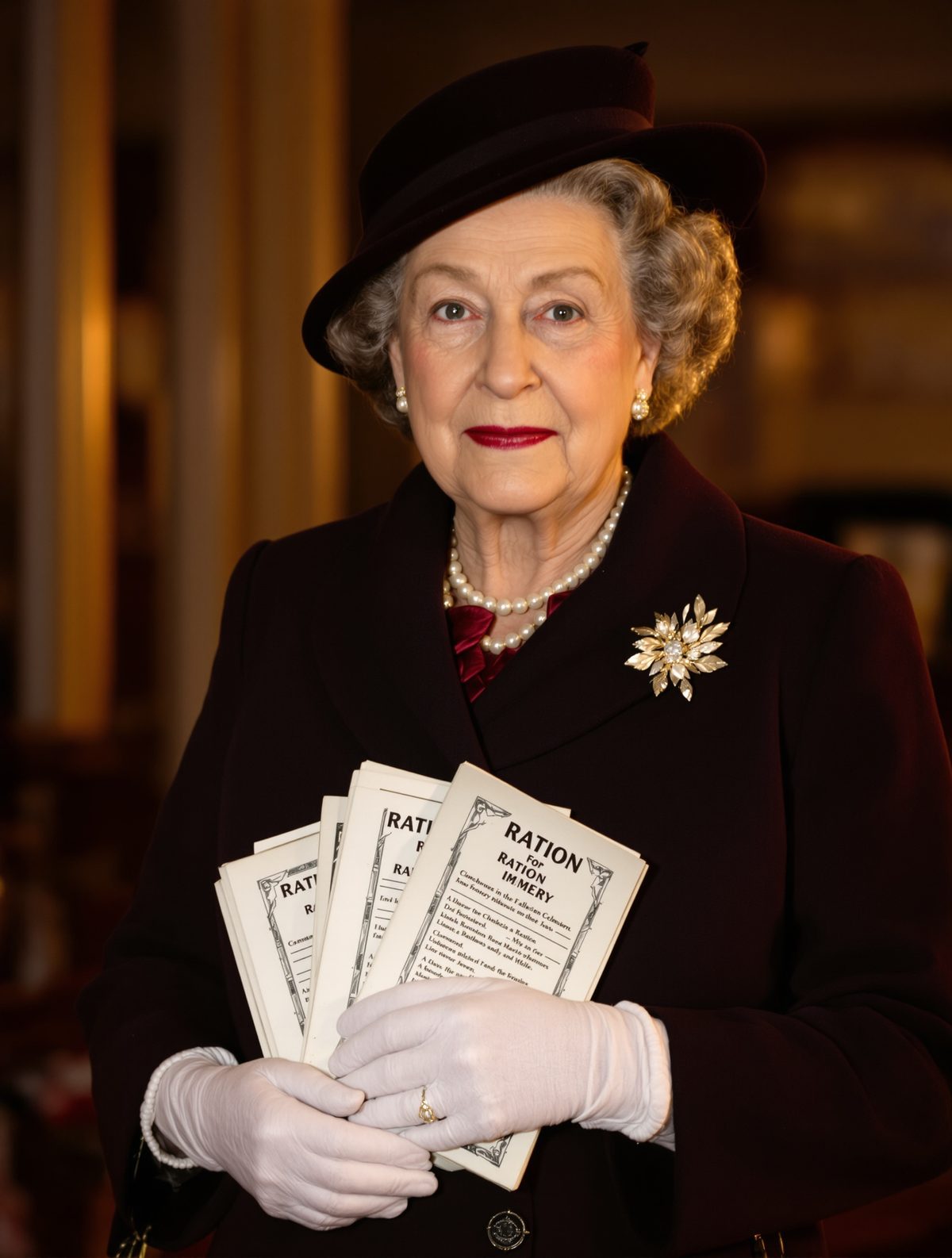
In the autumn of 1940, as London burned under the Blitz and rationing tightened its grip across Britain, an extraordinary scene unfolded in the quiet market town of Badminton. There, among the queue of housewives clutching their precious ration books, stood a dignified figure in a well-worn coat, carefully counting clothing coupons like any other wartime shopper. The woman was Queen Mary, the 73-year-old Queen Dowager, and her presence in that ordinary queue represented one of the most remarkable displays of royal solidarity with the British people during their darkest hour.
A Queen's Unprecedented Decision
When Queen Mary announced her intention to obtain her own ration book in 1940, the reaction from her household staff was one of barely concealed horror. For decades, they had served a monarch accustomed to the finest luxuries—elaborate Garrard tiaras, sumptuous Worth gowns, and wardrobes that rivaled those of European empresses. The idea that this same Queen would voluntarily subject herself to the same restrictions as her subjects seemed almost revolutionary.
Yet Queen Mary was resolute. Having lived through the First World War and witnessed the sacrifices made by ordinary families, she understood that this conflict demanded something different from the royal family. While King George VI and Queen Elizabeth remained at Buckingham Palace, enduring the bombing raids alongside Londoners, Queen Mary was determined to make her own statement of solidarity from her wartime residence at Badminton House in Gloucestershire.
The ration book system, introduced in January 1940, allowed each person just 66 clothing coupons per year—enough for perhaps one coat, one dress, and a few essential undergarments. For a woman whose pre-war wardrobe was legendary for its opulence, this represented an almost unimaginable constraint.
The Mortification of the Royal Household
Palace staff watched in astonishment as Queen Mary embraced her new circumstances with characteristic thoroughness. Lady Airlie, her devoted lady-in-waiting, later recalled the surreal experience of accompanying the Queen on shopping expeditions where every purchase required careful calculation. Gone were the days of simply selecting whatever caught the royal eye; now, each item had to be weighed against the precious coupons remaining in the book.
The Queen's dresser, who had spent years maintaining an elaborate royal wardrobe, found herself in the peculiar position of mending and altering existing garments rather than commissioning new ones. Queen Mary's famous toque hats, once refreshed seasonally with new trimmings and feathers, were now carefully refurbished with whatever materials could be found or repurposed.
Perhaps most shocking to the household was witnessing their mistress queue alongside village women at local shops. The Queen, who had once commanded the attendance of London's finest couturiers, now waited patiently in line, ration book in hand, discussing fabric shortages and clothing exchanges with her fellow shoppers as if she had been doing so all her life.
Royal Ingenuity in Wartime
What emerged during this period was a previously unseen side of Queen Mary's character—her remarkable adaptability and practical ingenuity. The Queen who had once been criticized for her rigid adherence to protocol revealed herself to be surprisingly resourceful when circumstances demanded it.
She became an enthusiastic participant in the "make do and mend" philosophy that characterized wartime Britain. Existing gowns were shortened, re-trimmed, and transformed to create "new" outfits within the constraints of rationing. The Queen's famous collection of jewels took on new importance as they could transform a simple, coupon-rationed dress into something appropriately regal for official occasions.
Her commitment extended beyond mere clothing purchases. Queen Mary threw herself into local wartime activities with unprecedented enthusiasm, organizing salvage drives and encouraging local women in their own rationing efforts. She understood that her visible participation in these restrictions sent a powerful message to a nation struggling with unprecedented hardship.
The Queen's approach to rationing became a source of inspiration rather than sympathy. She demonstrated that sacrifice was not beneath royal dignity but rather enhanced it. Her willingness to embrace these limitations showed a monarchy that truly understood the concept of shared national endeavor.
A Legacy of Wartime Solidarity
The impact of Queen Mary's wartime rationing extended far beyond her immediate household. News of the Queen Dowager's ration book travels spread throughout the country, carried by local shopkeepers and fellow customers who encountered her during those extraordinary shopping expeditions. For many Britons struggling with their own wartime restrictions, knowing that even the Queen was carefully counting coupons provided both comfort and motivation.
Her example influenced other members of the royal family and the wider aristocracy, many of whom followed suit in embracing rationing restrictions. The monarchy's willingness to share in national hardships strengthened the bond between crown and people during Britain's most challenging period.
This period also revealed Queen Mary's genuine understanding of ordinary life in ways that surprised even those closest to her. Her conversations with shop assistants about fabric quality and her knowledge of clothing prices demonstrated a practical awareness that few had suspected she possessed.
The transformation was so complete that when clothing rationing finally ended in 1949, Queen Mary reportedly expressed some nostalgia for the creative challenge it had provided. The woman who had once owned some of the world's most magnificent royal jewels had discovered satisfaction in the simple accomplishment of making a clothing ration book stretch through an entire year.
Queen Mary's wartime ration book stands as a powerful reminder that true leadership often requires stepping outside established norms to demonstrate genuine solidarity with one's people. In an era when public figures are frequently criticized for being out of touch with ordinary struggles, her example resonates with particular force. By voluntarily embracing the same restrictions that affected every British household, she showed that royal privilege could be temporarily set aside without diminishing royal dignity. Indeed, her willingness to queue alongside village housewives and carefully count clothing coupons may have been one of her most profoundly regal acts—a demonstration that true nobility lies not in luxury, but in sharing the common burden when the nation calls upon its people to sacrifice.