In the smoky and crowded halls of Westminster on a chilly October morning in 1714, history was quietly, yet resoundingly, made. For the first time, a monarch addressed the British Parliament without uttering a single word. This was not a rebellion in silence or a king's aloof disdain—rather, it was the inevitable outcome of a remarkable, if somewhat awkward, moment in British royal history. The king in question was George I, a German prince who had ascended the throne in the wake of the heavily contested rules of succession. What unfolded during this session would set a precedent for the evolving power dynamics within the British monarchy.
The Unexpected King
When Queen Anne passed away in August of 1714, the question of succession loomed large, fraught with both uncertainty and urgency. Amidst a crowded line of succession, it was George, the Elector of Hanover, who was plucked from relative obscurity to ascend the British throne. Yet here was a peculiar monarch: 54 years old, deeply entrenched in the ways of his native Germany, and possessing not a word of the English language.
George I's ascendancy was a byproduct of the Act of Settlement 1701, a pragmatic statute borne of religious and political necessity. It declared that only Protestant descendants of Sophia of Hanover could inherit the throne, thus excluding several dozen Roman Catholic claimants in favour of George.
The Language Dilemma
Once in London, George found himself at the helm of a country filled with customs, traditions, and a tongue entirely foreign to him. His proficiency lay in French and German, which, while advantageous in the courts of Europe, fell short in Britain. As he prepared for his first address before Parliament, the language barrier stood as an insurmountable challenge—one that underscored his outsider status but also heralded change.
In a kingdom where the power of the monarch had long been established by divine right and oratory eloquence, George's silence was more than a royal quirk. It was a signifier of the time's changing political tides, likely discomforting to some and quietly reassuring to others attuned to the dawning Parliamentary age.
The Parliamentary Address
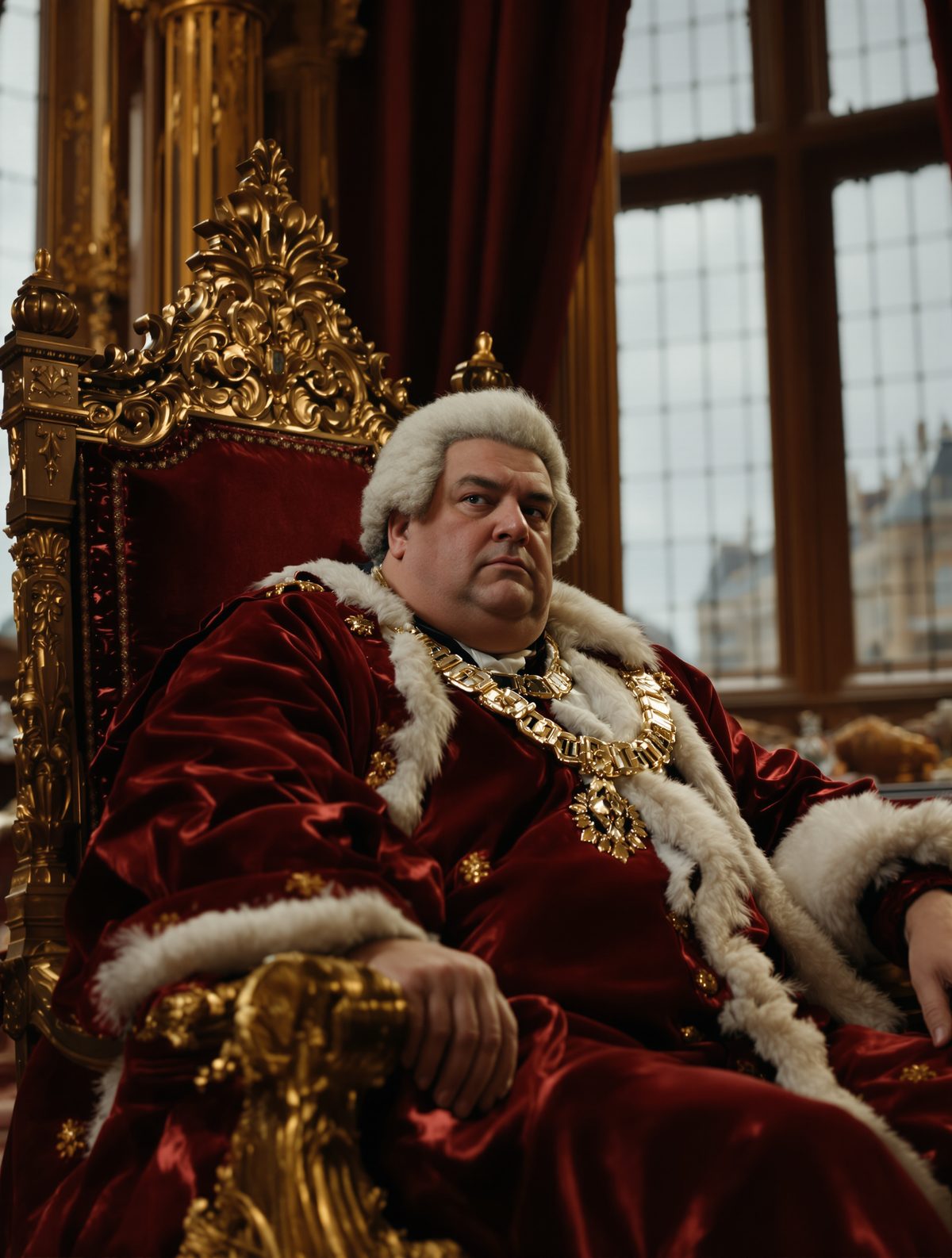
The anticipation in Parliament was palpable as King George I took his seat, watched by the brilliant spectacle of nobles, MPs, and courtiers assembled in their finery. Traditionally, the monarch addressed Parliament in spoken form, a ceremony steeped in centuries of pageantry and power. Thus, the moment when the king—silent and stoic—simply handed his speech to his ministers was nothing short of surreal.
"In this grand theatre of the state, the absence of words carried its own profound gravity, for it spoke to a ripple of change that could be felt from throne to Commons."
To a rapt crowd, the prime minister and ministers delivered the speech. They articulated the pressing plans and intentions of the new reign, ranging from domestic policy to matters of trade, and the fractious landscape of European politics. George I listened with active attention but remained silent—a sovereign in appearance and in solemnity, if not in speech.
The Ripple Effect
Though King George I's silence may have seemed a handicap, it proved an unexpected catalyst for a larger shift within the framework of British governance. In a practical sense, it necessitated the delegation of responsibilities to ministers adept in both language and policy, thereby fortifying the power and influence of the Cabinet.
As the king placed trust in his ministers, the nature of monarchial governance became less centralized upon the sovereign’s direct oversight and more dependent on the Parliamentary system. Thus, his silent Parliament session subtly empowered the very structures that would define modern constitutional monarchy.
The Human Dimension
Beneath the political implications lay a profoundly human tale of adaptation and transformation. George I, far from his native land and immersed in a strange new world, embraced the challenges set before him with measured respect. Though faced with skepticism and the imposing cultural chasm between him and his subjects, he carved a place for himself within this foreign kingdom.
Characterized by a sense of duty, George I's reign paved the way for deeper integration of the monarchy within the British polity. His deep-seated sense of responsibility reflected a ruler resilient in the face of unyielding circumstances, a king for whom service transcended the limits of language.
Inside the court, the atmosphere was equally vibrant with intellectual foment. The curiously cosmopolitan aura that he brought along enriched the royal court's culture, albeit presenting a striking juxtaposition to the traditional English setting. His embrace of continental ideas extended beyond language, showcasing a king who could relay profound influence through his principles and governance style.
Legacy of Change
The morning when King George I sat silently before Parliament ultimately influenced British governance in ways that are undeniably profound. His reign reconfigured the interactions between monarchy and state, fidelity and duty reigning supreme even amidst barrier divisions. He exemplified a monarch prepared to navigate both the literal and figurative barriers of his reign with dignified perseverance.
Today, the lineage of the British monarchy continues to reflect the adaptive spirit that George I encapsulated. Amidst a world dramatically different from that of 1714, the monarchy now stands as a symbol merging tradition with evolution, ever-resilient and quietly inspiring. George I's wordless Parliament speaks to the power of adaptation—a royal testament that even silence can echo through the annals of time with dignity and distinction.