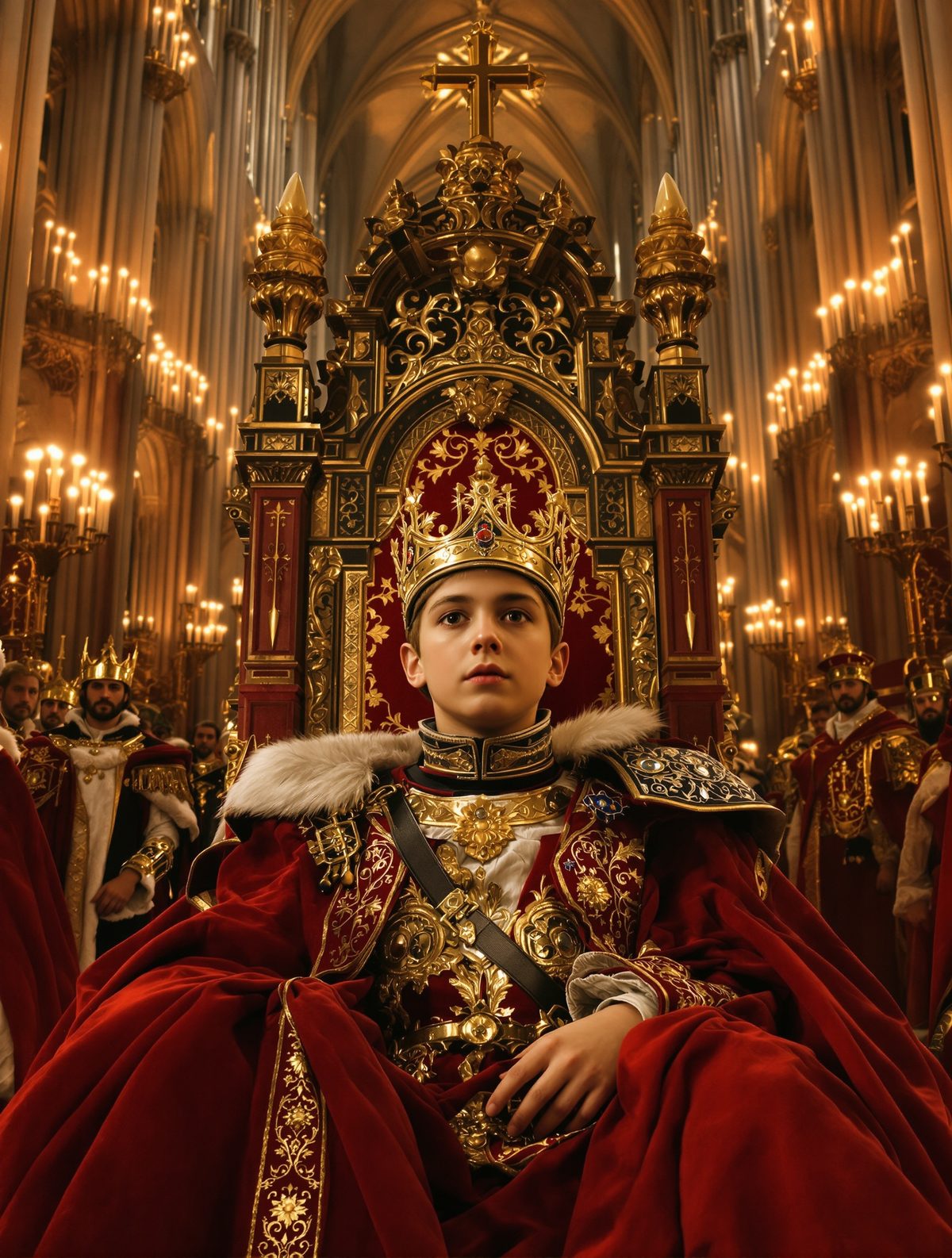
There he stood, a slight and solemn figure against the grandeur of Notre Dame Cathedral. The December air was cold, whispering through the high stone arches as if carrying echoes from centuries past. At just ten years old, Henry VI of England wore the weight of two crowns—one of England, his birthright, and now, as destiny would have it, the crown of France. What transpired was an extraordinary moment in the annals of history, where the innocence of a child met the ruthless demands of political ambition.
A Crown Twice Bestowed
Henry VI’s path to dual monarchy was paved with both triumph and desperation. Born in 1421, the infant Henry inherited the English crown after his father, the formidable Henry V, succumbed to illness in 1422. It was a heavy crown for such small shoulders, passed to an heir mere months old. Yet in the political landscape of 15th-century Europe, infancy was no excuse; bloodlines demanded sacrifice, and the delicate child was thrust into the daunting abyss of medieval diplomacy.
The Treaty of Troyes had set this unparalleled stage. Concessions had been made during Henry V's thunderous campaigns, where he sought to unite two powerful kingdoms. In a shrewd political maneuver, it declared that Henry V and his heirs would inherit the French throne. Thus, with Henry VI’s coronation in England came a promise—a regal vow to also reign over France. Fast forward to December 16th, 1431, and the young monarch found himself at the epicenter of a historic claim.
Inside Notre Dame: The Ceremony and the Boy
The atmosphere in Notre Dame that day was electric with anticipation and weighted with expectation. It was an unusual spectacle—a grand coronation entwined with an elemental human story. Nobles from both realms filled the cathedral, their rich garments rivaling the deep tapestries that adorned the walls. Outside, Parisians gathered, a curious mix of onlookers and skeptics.
As the ceremony unfolded, Henry’s youthful visage was awash with emotion. Accounts from the day recount how he wept openly throughout the proceedings. Though some chroniclers saw this as a symbol of vulnerability, others suggest it was a testament to the incredible responsibilities thrust upon him—an entire kingdom’s hopes resting on a child’s brow. Yet amidst tears, the ceremony proclaimed him King of France.
Henry's Latin responses during the ceremonial rites were carefully rehearsed, his voice—a child’s—echoed in the cavernous space, reaching the ears of those who could secure or contest his throne. But as the crown of France sat upon his head, tears gave way to the murmuring of prayers and invocations—a poignant reminder of the human heart beating beneath the royal mantle.
Court of Controversy and Conflict
Beyond the gilded elegance of the cathedral, the wider world was fraught with contention. The stark reality of Henry’s reign was that the English claim to the French throne was bitterly contested by Charles VII, who had been crowned King of France at Reims two years prior. The tussle for legitimacy wasn’t just a royal dilemma—it was a battle that enveloped entire nations in a tapestry of warfare and witness.
In his court, Henry VI was enveloped by stalwarts and skeptics. The Duke of Bedford, his uncle, was a steadfast regent navigating the precarious power balance that had to support England's grip on a volatile France. Many others, politicians and peers alike, questioned whether the boy king could ever secure authority in a land so deeply entwined with its own cultural and political loyalties.
The Burden of Legacy
Young Henry VI's dual coronation was meant to be a turning point—a forging of two crowns into a singular vision of dominance. Yet, the years that followed revealed the delicate folly of such ambition. The struggle to maintain power, both in France and within his own English realm, grew ever more challenging as Henry matured.
Interestingly, Henry VI’s regency and later reign were marked by periods of introspection and peace-seeking, rather than the militant zeal that characterized much of medieval monarchy. His later life, plagued by mental instability, drew sympathy even from his adversaries, reflecting the haunting reality of a life begun in the seat of power but wrought with personal torment.
Reflections of Past and Present
For modern admirers of the British monarchy, Henry VI’s story resonates with timeless lessons. His coronation at Notre Dame is a testament to the intricate dance of duty, destiny, and humanity. The echoes of medieval kingdoms haunt contemporary corridors of power, where expectations often collide with the personal journeys of those upon the world stage.
Today, amid the pomp and circumstance, the British monarchy continues to encapsulate an enduring legacy—a tapestry woven from the courage, contradictions, and character of its royal figures. Henry VI’s narrative reminds us that beneath the crown and behind the grandeur, a fragile humanity persists—an indelible mark that transcends centuries.
The coronation of a boy not yet in his teens underscores the intertwining of innocence and imperium—a poignant reminder that the path to sovereignty is often more labyrinth than straight line. As we reflect on the tableau of history, the joyous pageantry of royal tradition never loses sight of its most precious element: the personhood of those who wear the crown.