
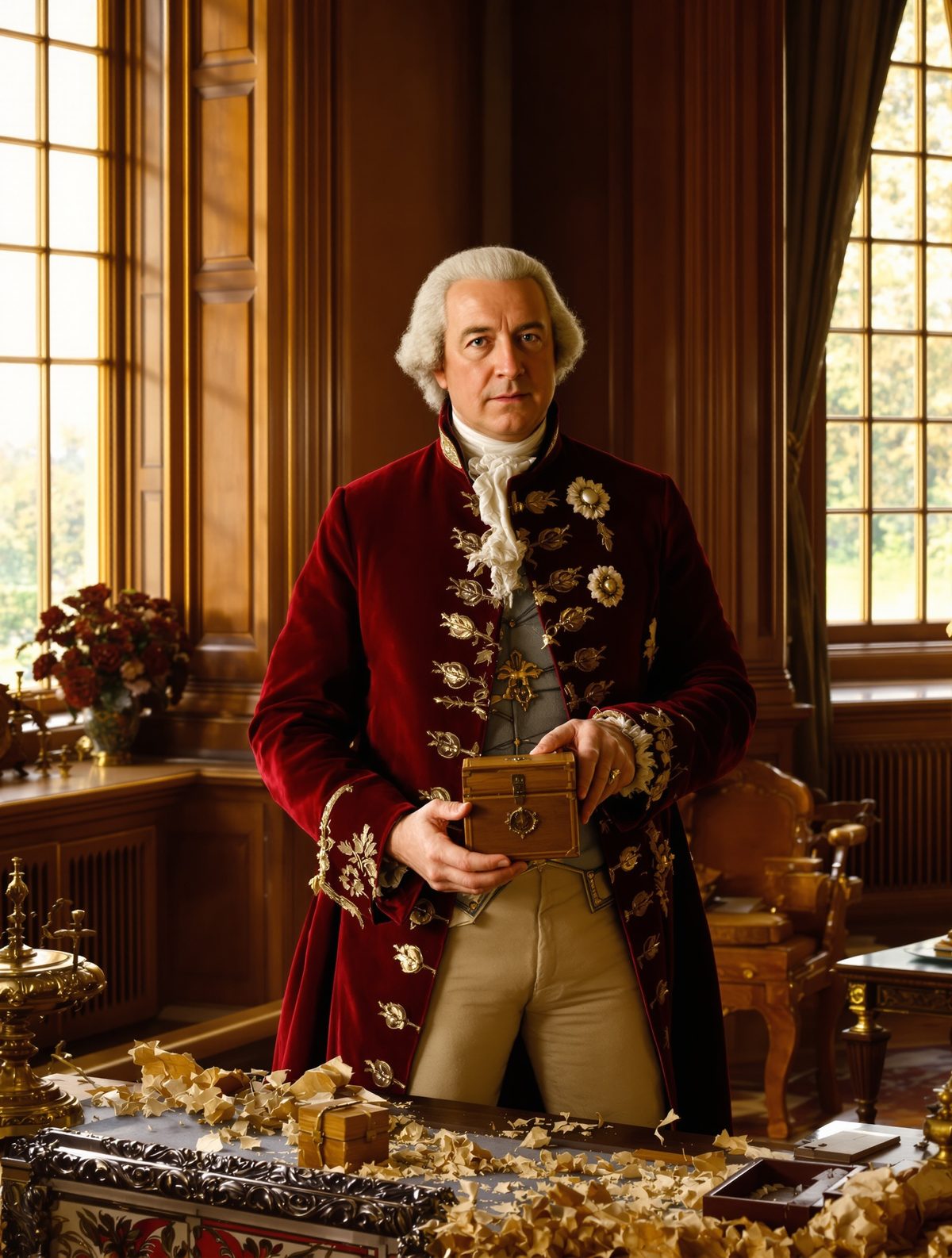
The sound of sawing echoed softly through the corridors of Windsor Castle, a rhythmic scraping that puzzled servants and startled courtiers. In an age when kings were expected to spend their days receiving ambassadors, reviewing state papers, and holding court in gilded splendour, King George III had discovered something far more satisfying: the simple pleasure of creating beautiful objects with his own two hands. Behind a carefully concealed door, away from the prying eyes of his scandalized court, Britain's monarch had built himself a secret workshop where wood shavings carpeted the floor and the sweet scent of sawdust filled the air.
A King's Unconventional Passion
King George III's love affair with carpentry began in the 1760s, not long after his accession to the throne in 1760. While his courtiers expected their sovereign to embody the refined leisure of the aristocratic class, George harboured a deep fascination with craftsmanship that would have been more at home in a tradesman's cottage than a royal palace. The young king, barely twenty-two when he inherited the crown, found solace and satisfaction in the methodical process of measuring, cutting, and joining wood into functional and beautiful furniture.
The workshop itself was a marvel of royal secrecy. Tucked away in the medieval heart of Windsor Castle, George had commandeered a series of rooms that he personally converted into a fully equipped carpentry shop. Here, surrounded by workbenches, hand tools, and carefully selected timber, the King of Great Britain and Ireland would spend hours absorbed in his craft, often working late into the evening by candlelight. The space was his sanctuary, a place where the burdens of kingship could be temporarily set aside in favour of the honest satisfaction of manual labour.
What made George's workshop truly remarkable was not just its existence, but the quality of work that emerged from it. The king was no mere dabbler; he approached carpentry with the same methodical precision he brought to matters of state. His pieces demonstrated genuine skill and artistry, from elegant writing desks to intricate cabinets, each bearing the unmistakable mark of royal craftsmanship—though few at court would ever know their true provenance.
Courtly Horror and Social Conventions
When word of the king's secret hobby finally leaked beyond the workshop walls, the reaction from the royal household was nothing short of scandalous. In the rigid social hierarchy of eighteenth-century Britain, manual labour was considered the province of the lower classes, utterly beneath the dignity of a monarch who ruled by divine right. The very idea that their sovereign would soil his hands with sawdust and glue sent ripples of horror through the aristocratic establishment.
Court officials were aghast. Here was the head of the most powerful empire in the world, a king who commanded the loyalty of millions, choosing to spend his precious time engaged in what they considered common trade. Whispered conversations filled the palace corridors as courtiers debated whether such behaviour was merely eccentric or actively damaging to the crown's prestige. Some worried that if word reached the public, the monarchy's carefully cultivated image of remote majesty would be irreparably damaged.
The king's private secretaries and advisors attempted, with varying degrees of subtlety, to redirect their sovereign's attention toward more suitable royal pursuits. They suggested that His Majesty might find greater satisfaction in expanding the royal art collection, commissioning new works from fashionable artists, or perhaps taking up more aristocratic hobbies like astronomical observation—anything that didn't involve callused hands and wood shavings on the royal clothing.
Yet George III remained remarkably unmoved by their concerns. The king who would later be remembered for his strong will in political matters proved equally determined to preserve his private passion for craftsmanship. He continued his carpentry work with quiet persistence, understanding perhaps better than his courtiers that true satisfaction often comes from the most unexpected sources.
The Psychology of Royal Craftsmanship
To understand King George III's devotion to carpentry, one must consider the unique pressures and isolation that defined royal life in the eighteenth century. As monarch, George inhabited a world of constant ceremony, where every moment was scripted and every gesture carried political significance. The informality of his workshop represented a radical departure from the suffocating protocol that governed his public existence.
In his carpentry, the king found something increasingly rare in royal life: immediate, tangible results from his efforts. While the complex machinery of government moved slowly and the outcomes of royal decisions often remained unclear for months or years, a piece of furniture could be completed in days or weeks. There was honest satisfaction in seeing a rough piece of timber transformed into something both beautiful and useful through the application of skill and patience.
The physical nature of the work also provided a welcome contrast to the mental demands of kingship. After hours spent reviewing parliamentary business or receiving diplomatic reports, George could find restoration in the simple act of planning joints or smoothing wood with his hands. The workshop became his refuge, a place where the only expectations were those he set for himself and the only judge of success was his own satisfaction with the finished piece.
This hands-on approach to creation may have also reflected George III's broader character as a monarch who took genuine interest in the practical aspects of his realm. Throughout his reign, he demonstrated curiosity about agriculture, science, and industry—interests that set him apart from many of his more traditionally-minded courtiers and connected him, perhaps, to the innovative spirit that was beginning to transform British society.
A Legacy Hidden in Plain Sight
While King George III's carpentry workshop remained largely secret during his lifetime, some of his pieces did find their way into the public areas of the royal residences, their true origins diplomatically concealed. Visitors to Windsor Castle and other royal properties admired the craftsmanship of certain furniture pieces, never suspecting that they were examining the handiwork of the king himself.
The workshop continued to serve as George's retreat throughout the most challenging periods of his reign. During the tumultuous years of the American Revolutionary War and the later struggles with France, the king found solace in the familiar routine of his craft. Even as his courtiers fretted about the unconventional nature of his hobby, George understood something profound about the relationship between manual work and mental well-being that modern psychology has only recently begun to appreciate.
Records suggest that the king's carpentry work continued well into the 1780s, only gradually declining as the pressures of his later reign and eventual illness made such sustained physical activity more difficult. The workshop itself was quietly converted to other uses, its role in royal history becoming yet another fascinating footnote in the complex story of the Georgian monarchy.
Today, King George III's secret carpentry workshop stands as a touching reminder that even monarchs are, fundamentally, human beings seeking meaning and satisfaction in their daily lives. His story challenges our assumptions about royal behaviour and dignity, suggesting that true nobility might sometimes be found not in the grandest state rooms, but in the honest pleasure of creating something beautiful with one's own hands. In an age when we increasingly recognize the value of mindfulness and the therapeutic benefits of craftwork, George III's eighteenth-century insight seems remarkably prescient—a king who understood that sometimes the most regal thing a ruler can do is remember their own humanity.